EN 14387 Respiratory Protective Equipment - Gas Filters and Combination Filters
The European standard “EN 14387 Respiratory protective equipment - Gas filters and combined filters - Requirements, tests, marking” describes the requirements, test methods and marking requirements for gas filters and combined filters designed for use as replaceable components in non-assisted respiratory protective equipment (RPDs), excluding emergency relief devices.
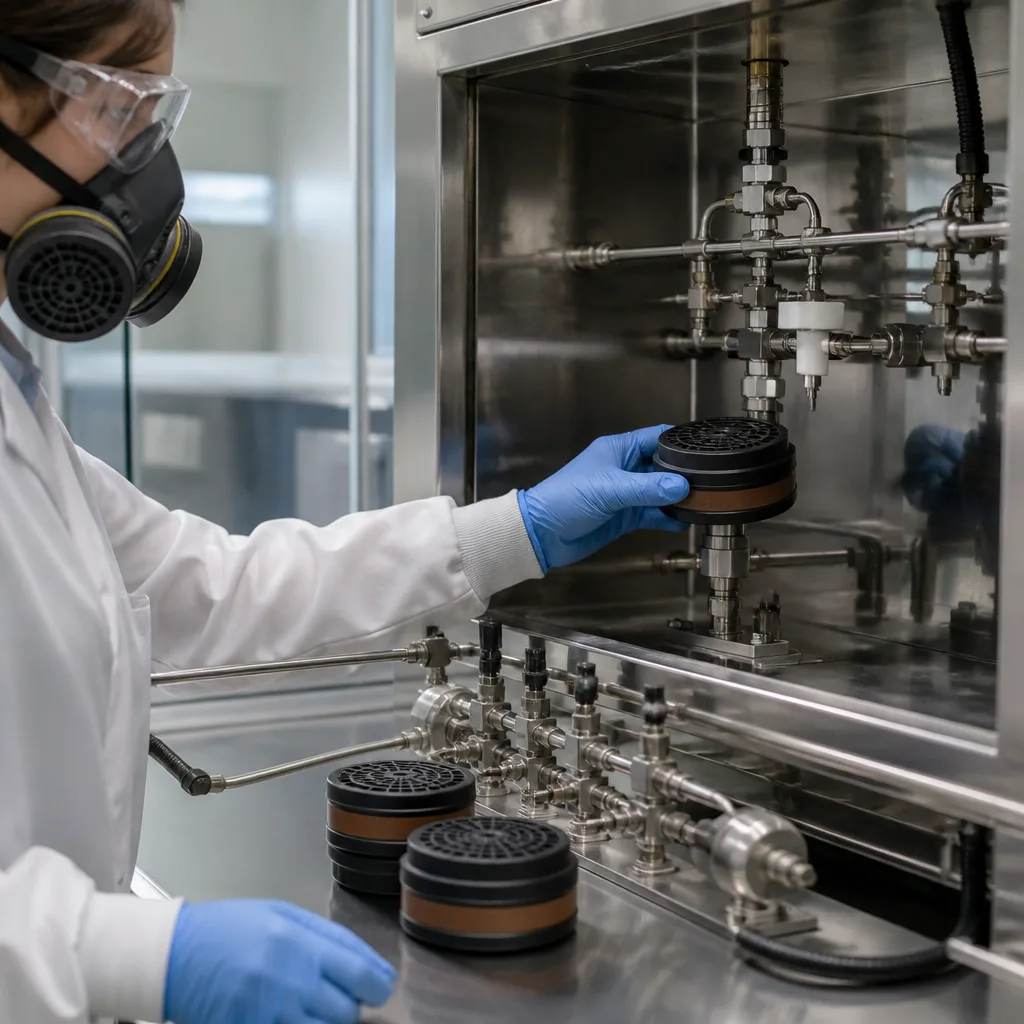
Filters used to protect against carbon monoxide are outside the scope of this standard.
Laboratory tests for assessing compliance with the requirements are included in this standard.
Some filters conforming to this standard may also be suitable for use with assisted respiratory protection devices or emergency relief devices. In this case, they must be tested and marked in accordance with the relevant standard.
Gas filters are classified according to type and class according to this standard. The filter types are defined as follows:
- Gas filters: Gas filters are manufactured in one of the following types:
- Type A: As specified by the manufacturer, for use against certain organic gases, vapors, and substances with a boiling point above 65 degrees Celsius.
- Type B: For use against certain inorganic gases and vapors, as specified by the manufacturer.
- Type E: For use against sulfur dioxide and other acidic gases and vapors, as specified by the manufacturer.
- Type K: For use against ammonia and organic ammonia derivatives, as specified by the manufacturer.
- Type AX: For use against certain organic gases and vapors with a boiling point less than or equal to 65 degrees, as specified by the manufacturer. Type AX filters are for single-shift use only and must be marked with the specified symbol.
- Type SX: For use against specific gases and vapors, as specified by the manufacturer.
- Multi-type gas filters: Filters that combine two or more of the above types and meet the requirements of each type individually (excluding type SX).
- Combination filters: Gas or multi-type gas filters containing a particle filter conforming to EN 143 standard.
- Custom filters:
- Type NOP3: For use against nitrogen oxides, e.g. NO, NO2, NOX.
- Type HgP3: For use against mercury.
These filters must always include a P3 filter conforming to the EN 143 standard and, with the exception of the SX type, can be combined with each other or with the specified types.
Type A, B, E, and K gas filters are classified according to their capacity as follows:
- Class 1 Low capacity filters
- Class 2 Medium capacity filters
- Class 3 High-capacity filters
A gas filter is a filter designed to remove specific gases or vapors from the air we breathe. Unlike particle filters, which primarily trap airborne particles, gas filters typically use adsorbent materials, often activated carbon, to trap or react with hazardous gases and vapors. For example, depending on its classification, a filter may be designed to provide protection against:
- Organic gases and vapors
- Inorganic gases and vapors
- Sulfur dioxide and other acidic gases
- Ammonia and organic ammonia derivatives
The EN 14387 standard includes laboratory tests to determine whether gas and combination filters meet the specified requirements. Key areas of evaluation include:
- Gas/vapor filter performance: The filter is exposed to specified challenging substances under controlled laboratory conditions. The aim is to determine whether the filter can provide the protection required for its assigned classification.
- Permeability performance: One of the most important characteristics of a gas filter is its permeability. Permeability occurs when a contaminant begins to pass through the filter in an amount exceeding the specified limit. The permeability behavior of a filter depends on the following factors:
- Type of pollutant
- Concentration
- Airflow
- Temperature
- Gender
- Adsorbent properties
- Filter design
Therefore, the test provides a standardized method for evaluating filter performance.
- Particle filtration: For combined filters, the particle filter component is also evaluated according to applicable requirements. This is important because a combined filter must address both the gas/vapor hazard and the particulate hazard for which it is classified.
- Mechanical performance: Filters are also subject to requirements aimed at ensuring that their construction remains fit for use. This helps to verify that the filter does not become unusable due to reasonably foreseeable mechanical stresses during use and transport.
- Breathing resistance: The filter's resistance to airflow is a crucial performance characteristic. Excessive resistance can make breathing difficult and increase user fatigue. Therefore, tests evaluate the filter's resistance under specific conditions.
- Connection and compatibility: The filter must be compatible with the respiratory protective device for which it is intended. Therefore, the filter and respirator combination should be considered as a complete protective system, rather than treating the filter as a standalone product.
The EN 14387 standard also addresses marking, allowing users and inspectors to identify important information about the filter. Depending on the filter, the markings may include the following information:
- Filter type / class
- Applicable gas or vapor category
- Particle classification, if applicable.
- Producer identity
- Relevant product ID
- Other information required by the standard
Correct labeling is crucial because selecting the wrong filter can lead to inadequate respiratory protection.
The EN 14387 standard is important because respiratory filters are a critical safety component. A respirator may provide inadequate protection even if it appears effective from the outside in the following situations:
- If the wrong filter has been selected.
- If the filter's capacity is insufficient.
- If the pollutant is outside the approved application area.
- If the filter is punctured.
- If the filter is damaged.
- If the filter is installed incorrectly.
- If the filter is used outside of its intended conditions.
The EN 14387 standard defines standardized requirements and laboratory tests that help manufacturers demonstrate that gas and combination filters meet defined performance requirements. Therefore, it is valuable for:
- Filter manufacturers
- Respiratory device manufacturers
- Occupational health and safety departments
- Testing laboratories
- quality control personnel
- Employers who choose respiratory protective equipment
- Inspection and certification bodies
EN 14387 applies wherever replaceable gas or combination filters are used in conjunction with suitable respiratory protective equipment. Typical applications may include:
- Chemical processing
- Industrial production
- Painting and coating processes
- Laboratories
- Pharmaceutical production
- Petrochemical operations
- Waste treatment
- Maintenance procedures
- Certain construction and industrial activities
The appropriate filter should be selected based on the actual risk, rather than always choosing the filter classification that appears highest.
The EN 14387 standard should not be evaluated in isolation. A complete respiratory protection system may include various standards covering different components. For example,
- EN 14387 Gas and combination filters
- EN 143 Particle filters
- EN 136 Full face masks
- EN 140 Half masks and quarter masks
- EN 149 Particle filter half masks
- Other standards (depending on the specific respiratory protection device)
The appropriate combination depends on the type of respirator and the hazard.
For many years, our organization, with its competent and experienced staff, has been understanding the needs of its clients, providing the advanced testing services they require, and assisting them in the establishment, implementation, and improvement of management systems. Within this framework, we also provide testing services in accordance with the EN 14387 standard.



