

The ISO 16602 standard, developed by the International Organization for Standardization (ISO), “ISO 16602 Protective clothing against chemicals – Classification, labeling and performance requirements,” describes the minimum performance classification and labeling requirements for protective clothing designed to provide protection against chemicals. Protective clothing covered by the ISO 16602 standard includes, but is not limited to, full coveralls, liquid-proof or spray-proof coveralls, work overalls, jackets, trousers, aprons, work aprons, hoods, arm guards, and shoe and boot covers.
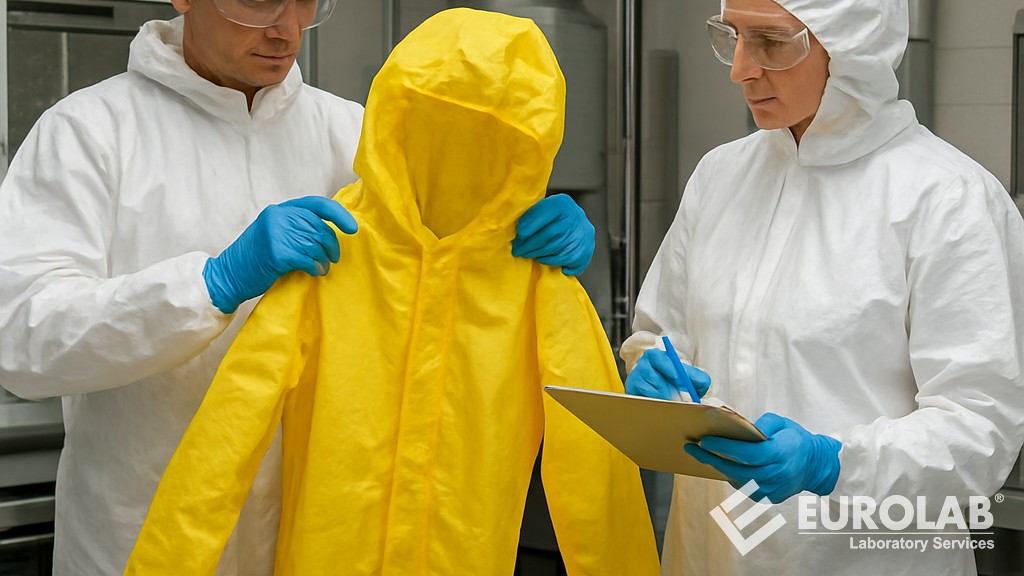
Chemical protective clothing that provides protection against airborne particles is addressed by the ISO 13982-1 standard referenced in this standard. The ISO 16602 standard does not address protection against solid chemicals other than airborne solid particles (for example, it does not address the problem of chemical dust and particles passing through materials and clothing by friction or stretching, or by direct contact of dust or particles with the clothing surface).
The ISO 16602 standard does not address gloves, boots, eye and face protection, and respiratory protection unless they are an integral part of protective clothing. This standard does not address protection against biological or thermal (hot or cold) hazards, ionizing radiation, or radioactive contamination. It also does not address specialized clothing used in hazardous chemical emergencies.
The ISO 16602 standard aims to provide manufacturers of chemical protective clothing with minimum requirements for testing, classifying, and labeling chemical protective clothing. To assist users of products covered by this standard, it provides descriptions of referenced test methods, guidelines for conducting hazard and risk assessments, and recommended performance levels for specific applications.
In short, the ISO 16602 standard is based on a system of six performance types that help determine the level of hazard and provide guidance for the appropriate personal protective equipment to be worn: Specifically, personal protective equipment is assigned a number from one to six depending on how it performs in various situations.
The types have been defined as follows:
Types 1-4 primarily focus on liquid and gas protection, while Types 5-6 focus on particles and limited liquid exposure. Many garments combine types and include additional classes of mechanical protection (such as abrasion, tear, and puncture). Many everyday disposable coveralls fall into the Type 4, 5, or 6 category.
However, no type is better or worse than another, but knowing the working environment is crucial for selecting the correct personal protective equipment (PPE) for the situation. For example, when dealing with dry particles, PPE rated as Type 5 is usually sufficient to protect users. When dealing with infectious agents, such as bloodborne pathogens, certain aerosols, and body fluids, a Type 5 or Type 6 mask is generally required to provide adequate protection.
In short, the ISO 16602 standard defines the minimum performance classification, labeling, and performance requirements for protective clothing designed to protect the user against chemicals in liquid, aerosol, solid, or gaseous form. This standard helps manufacturers test, classify, and label chemical protective clothing consistently worldwide. It is particularly useful in sectors such as chemical manufacturing, emergency response, pharmaceuticals, agriculture, and hazardous waste management.
This new update to the standard is designed as a multi-part series. However, the current version is still widely referenced and used by manufacturers and security professionals worldwide.
The main objectives of this standard are as follows:
The ISO 16602 standard defines the following tests:
In conclusion, the ISO 16602 standard provides a clear and internationally accepted framework for the classification and labelling of chemical protective clothing. Its six-type system helps safety professionals select appropriate personal protective equipment for different chemical risks, ranging from fully gas-tight coveralls (Type 1) to basic splash-resistant coveralls (Type 6).
For many years, our organization, with its competent and experienced staff, has been understanding the needs of its clients, providing the advanced testing services they require, and assisting them in the establishment, implementation, and improvement of management systems. Within this framework, we also provide testing services compliant with the ISO 16602 standard.
To get an appointment, to get more detailed information or to request an evaluation, you can ask us to fill in our form and reach you.

