

The EN 659 standard, a European standard, describes the minimum performance requirements and test methods for firefighters' protective gloves. This standard applies only to firefighters' protective gloves that protect hands during normal firefighting, including search and rescue. These gloves are not designed for the deliberate use of liquid chemicals, but provide some protection against accidental contact with chemicals. Protective gloves for special operations in firefighting service are not covered by this standard.
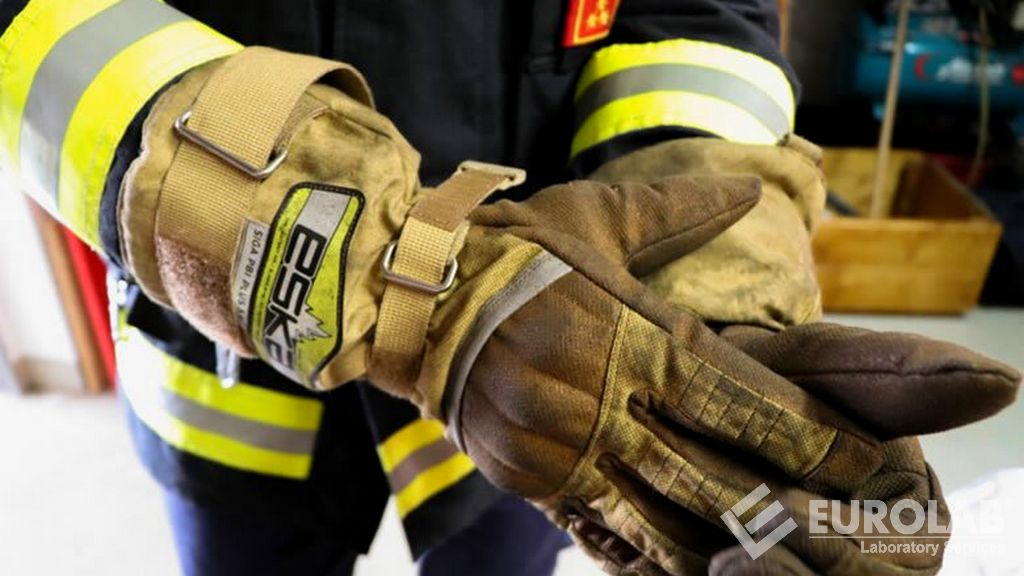
This standard refers to the test procedures described in the EN 420, EN 388 and EN 407 standards for firefighting gloves, as well as other specific test methods for properties such as water resistance and chemical penetration.
To determine the burning behavior, the fingers of a glove are exposed to a small flame of gas for a specified period of time (3 and 15 seconds), while the glove's behavior is visually observed. Classification is based on afterflame and flash time and whether the glove seams have opened and whether the glove material has melted or not.
To determine the contact temperature, the glove's thermal insulation is measured by the rate of temperature rise of a calorimeter inside the glove while the outer part of the glove is in contact with a hot probe of defined dimensions and temperature.
To determine the convective heat, the glove's thermal insulation is measured by the rate of temperature rise of a calorimeter inside the glove while the glove's outside is in contact with a controlled gas flame.
To determine radiant heat, the glove's thermal insulation is measured by the temperature rise rate of a calorimeter inside the glove while the outside of the glove is exposed to radiant heat of a defined flow density.
To determine the minor molten metal effect, the glove's thermal insulation is measured by the rate at which a calorimeter temperature rises inside the glove, while drops of molten metal of particular size affect the outside of the glove at a defined rate.
In the EN 659 standard, the requirements are explained under the following headings: general requirements, dimensions, abrasion resistance, cut resistance, tear resistance, puncture resistance, burning behavior, convective heat resistance, radiant heat resistance, contact heat resistance, heat resistance of lining material, heat shrinkage, seam breaking strength, time to remove gloves, resistance of glove material to water penetration (optional), whole glove integrity testing and resistance to liquid chemical penetration.
Our organization also provides protective gloves testing services for firefighters within the scope of EN 659 standard, with its trained and expert staff and advanced technological equipment, among the numerous test, measurement, analysis and evaluation studies it provides for businesses in various sectors.
To get an appointment, to get more detailed information or to request an evaluation, you can ask us to fill in our form and reach you.

