

The European standard "EN 15090 Footwear for Firefighters" specifies the minimum requirements and test methods for the performance of three types of footwear for use by firefighters in firefighting, general-purpose rescue, fire rescue, and hazardous material emergencies. This standard does not cover specific personal protective equipment used in high-risk situations (e.g., the conditions described in ISO 15538).
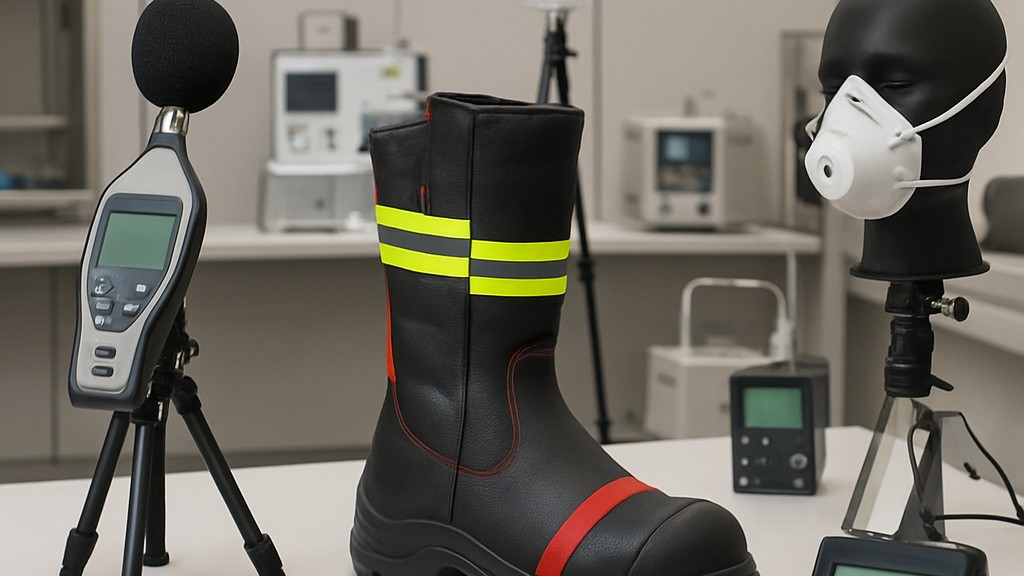
For the purposes of this standard, the terms and definitions in the “ISO 20345 Personal protective equipment - Safety footwear” standard apply.
Footwear for firefighters should be classified as follows, according to the table given in the standard:
Footwear must conform to one of the designs B to E, as outlined in EN ISO 20345:
Shoe types for firefighters are determined as follows:
The minimum number of samples shall be the minimum number of test pieces taken from each sample specified in the table provided in this standard, as well as the number specified in EN ISO 20344. Wherever possible, test pieces should be taken from the entire shoe, unless otherwise specified in this standard and EN ISO 20344. If it is not possible to obtain a sufficiently large test piece from the shoe, a sample of the material from which the component is made may be used, and this must be stated in the test report. If samples from each of the three sizes are required, these should consist of the largest, smallest, and medium sizes of the shoe being tested.
Unless otherwise specified in the test method, all test pieces shall be conditioned in a standard atmosphere of 23°C plus 2°C and 50% plus 5% relative humidity for at least 48 hours prior to testing. The maximum time between removal from the conditioning atmosphere and the start of testing shall not exceed 10 minutes unless otherwise specified in the test method.
Each test piece must meet the specific requirement individually, unless otherwise specified in the test method. For each test method described in this standard, measurement uncertainty can be evaluated. One of two approaches should be used:
In the high-risk world of firefighting, where flames roar, structures collapse, and hazardous chemicals roam, every piece of protective equipment is crucial. Among these, footwear serves as a critical line of defense, protecting firefighters' feet from crushing impacts, scorching heat, slippery surfaces, and toxic spills. The EN 15090 standard establishes stringent minimum requirements and test methods to ensure boots and footwear perform reliably in the chaotic environments of firefighting, rescue operations, and hazardous materials accidents.
This standard addresses the unique demands of firefighting environments, distinguishing it from general safety footwear standards such as EN ISO 20345, which focuses on toe protection for industrial workers, and EN ISO 20347, for work shoes without toe caps. EN 15090 has been updated to include new technologies such as advanced composites or improved slip resistance protocols. This standard is not just a checklist; it has been harmonized under the personal protective equipment (PPE) directive (EU9 2016/425), and equipment—which must carry the CE marking for market access throughout Europe—is mandatory.
The scope of the EN 15090 standard is laser-focused: it includes performance criteria for three different types of firefighter footwear, tailored to increasing risk levels. Unlike broader personal protective equipment standards, it emphasizes scenarios involving fire, rescue, and chemical hazards and excludes ultra-specialized equipment for extreme conditions (for example, according to the ISO 15538 standard for forest fires).
This standard has two purposes: to reduce risks through evidence-based testing and to guide risk assessments for appropriate footwear selection.
Firefighters face a multitude of threats: toe-crushing debris, heel strikes from falls, punctures from sharp objects, heat conduction from molten surfaces, water ingress during prolonged exposure, radiant heat from fires, and direct flame contact. The EN 15090 standard ensures footwear can withstand these while maintaining mobility and comfort during demanding shifts.
The EN 15090 standard structures its requirements around material durability, ergonomic design, and experimental testing. Footwear is divided into three types, with protective features increasing according to application severity. All types must pass basic tests for upper strength, sole adhesion, and labeling, but higher types add layers such as puncture resistance and chemical permeation barriers.
This standard defines three types, each suitable for specific operational contexts:
These classifications allow supply teams to match equipment to their mission profiles: Type 1 is for light mobility in brush fires, while Type 3 is suitable for urban hazmat teams.
Firefighting fatalities are often caused by equipment failures, 15-20 percent of injuries are caused by slips, and inadequate heat protection exacerbates burns. The EN 15090 standard addresses this issue by implementing proven safety measures, reducing downtime, and increasing operational reliability.
Ultimately, the EN 15090 standard isn't just a bureaucracy; it's a marvel of engineering that a firefighter demonstrates with every step they take. By codifying protection against the multifaceted fury of fire, it honors the courage of those who rush toward danger. From forest fires to urban blazes, well-fitting footwear saves lives.
Our organization, which has been operating for many years and meticulously follows global developments in science and technology, employs a skilled team and extensive infrastructure to conduct testing, measurement, and analysis in a wide range of areas for businesses across all sectors. In this context, we also provide testing services in accordance with the EN 15090 Firefighter Footwear standard.
To get an appointment, to get more detailed information or to request an evaluation, you can ask us to fill in our form and reach you.

