IEC 61111 Working Under Voltage - Electrical Insulating Mats
The International Electrotechnical Commission (IEC) standard "IEC 61111 Working under voltage - Electrical insulating mats" specifies the requirements for electrical insulating mats made of elastomers used as floor coverings for the electrical protection of workers in electrical installations. This standard covers test principles for alternating current (AC). There is limited history of use in direct current (DC) applications. Information on the recommended maximum voltage for use is included in the standard's appendix (Annex A).
For the purposes of this standard, the following definitions apply in addition to the terms and definitions given in IEC 61318:
- A disruptive discharge refers to the transition of an arc after dielectric breakdown. The term sparkover is used when a disruptive discharge occurs in a gaseous or liquid dielectric. The term flashover is used when the disruptive discharge occurs along the surface of a solid dielectric that is at least partially surrounded by a gaseous or liquid medium. The term perforation is used when a disruptive discharge occurs in a solid dielectric that results in permanent damage.
- An elastomer is a macromolecular material that rapidly returns to its original dimensions and shape after significant deformation under mild stress and stress release. This definition applies under room temperature test conditions. Elastomer is a general term that includes rubber, latex, and elastomeric compounds, which may be natural or synthetic, or a blend or combination of both. It also includes thermoplastic elastomer materials.
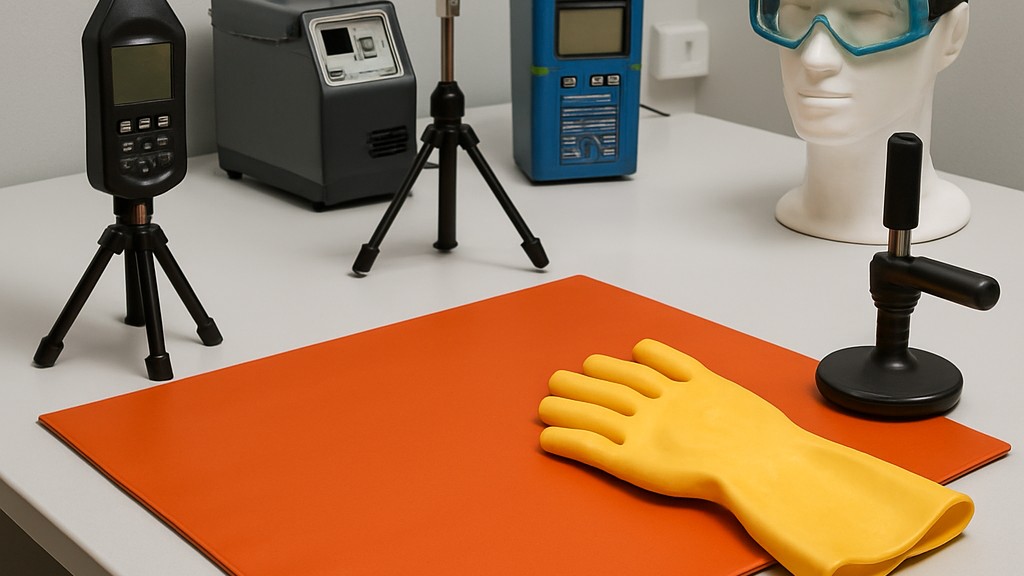
- Electrical insulation mats are flexible sheets made of elastomer and are used to cover the surface on which a worker stands (the potential of this surface is usually the potential of the ground). The mats are available in a variety of precise shapes or on rolls, allowing workers to custom-cut the material to suit the application.
- Nominal voltage refers to the convenient approximate voltage value used to specify or describe a system.
- Proof test voltage is the specified voltage applied to a device or test piece for a defined period of time under specified conditions to ensure that the electrical strength of the insulation is above a specified value.
- Withstand test voltage is the voltage that a test piece must withstand without disruptive discharge or other electrical breakdown when the voltage is applied under specified conditions.
Electrical insulation mats must be designed and manufactured in a way that contributes to the safety of users, provided that they are used by qualified personnel, in accordance with safe working methods and instructions for use.
Electrical insulation mats covered by this standard are classified as follows:
- According to electrical class: class 0, class 1, class 2, class 3 and class 4
- In the case of Category C mats (resistance to extremely low temperatures), they are classified by adding the suffix “C” to the class description.
Guidelines for selecting classes (alternating current and direct current) are included in the standard's annex (Annex A). Guidelines for the temperature range in which electrical insulation mats can be used are included in Annex B.
In this standard, physical requirements are regulated under the following headings:
- Composition
- Figure
- Dimensions and tolerances
- Workmanship and finish
- Mechanical, climatic and environmental requirements
- Dielectric requirements
- Marking
- Packaging
- Instructions for use
The IEC 61111 standard describes the following test methods used to verify the performance of insulating mats:
- Visual inspection: This testing method is used to detect physical defects such as cracks, holes, cuts, and embedded foreign objects. The mat is examined under good lighting. The mat should be clean and dry.
- Dimensional testing: This testing method is used to verify that the mat meets specified tolerances for thickness, width, and length. Appropriate measuring instruments, such as micrometers and rulers, are used.
- Mechanical properties: These tests include tensile strength and elongation at break and are used to check mechanical strength. Specimens are tested under controlled conditions to determine the material's strength and flexibility.
- Oil resistance testing: This test method is used to evaluate performance after exposure to oil. A sample is immersed in insulating oil at a specific temperature (usually 70 degrees Celsius) for a specified time (e.g., 24 hours), after which the mechanical or electrical properties are tested.
- Flame retardancy test: This test method is used to check a material's resistance to flame propagation. A sample is exposed to flame and observed to see if it self-extinguishes within a specified time.
- Low-temperature flexibility testing: This test method is used to evaluate flexibility under cold conditions. The sample is bent at low temperatures (e.g., minus 25 degrees Celsius) to ensure that no cracking or damage occurs.
- Acid resistance test: This test method is used to evaluate chemical resistance. The sample is immersed in a dilute acid solution (e.g., sulfuric acid) for a specified time and then evaluated for degradation.
- Electrical tests: These tests are critical to determining insulation capacity:
- Dielectric strength (proof) test: This test method is used to verify that the mat can withstand a specified high voltage without breaking down. Voltage levels: Depends on the mat's class (e.g., Class 0, 1, 2, 3, 4). For example, Class 0 has a test voltage of 5 kV for 1 minute.
- Leakage current test (optional): This test method is used to measure any leakage current under the test voltage. It is usually performed with a dielectric strength test.
- Puncture testing (destructive): This testing method is used to determine the voltage at which a material fails. This is a destructive test and is not performed on standard production samples.
- Aging tests:
- Thermal aging: This method is used to simulate prolonged exposure to heat.
- UV resistance: This method is used for mats designed for outdoor use.
Our organization, which has been supporting businesses across all sectors for years through a wide range of testing, measurement, analysis, and evaluation activities, has a strong team of employees who closely follow global developments in science and technology and are constantly improving themselves. In this context, we also provide testing services in accordance with the "IEC 61111 Working under Voltage - Electrical Insulation Mats" standard.



