

The EN ISO 3746 Acoustics - Determination of sound power levels and sound energy levels of noise sources using sound pressure - Investigation method using an enveloping measurement surface on a reflective plane, a standard based on a European standard and subsequently published by the International Organization for Standardization (ISO), describes methods for determining the sound power level or sound energy level of a noise source (machine or equipment) from sound pressure levels measured on a surface enveloping the noise source in a given test environment.
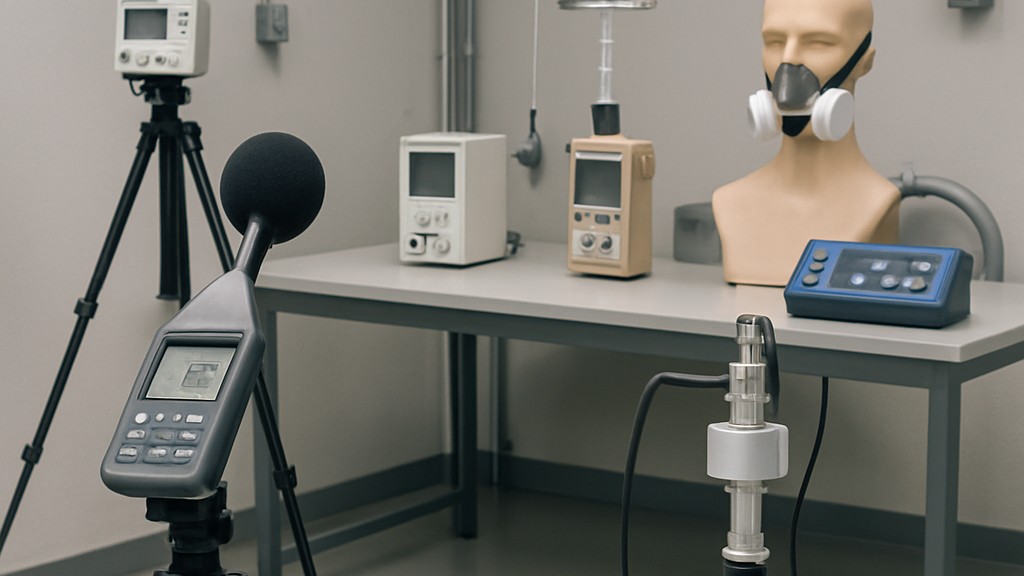
The sound power level (or sound energy level in the case of noise bursts or transient noise emissions) produced by a frequency A-weighted noise source is calculated using these measurements. Differently shaped measurement surfaces can yield different estimates of the sound power level of a given noise source, and a suitably prepared test code (ISO 12001) provides detailed information on surface selection.
The methods specified in this standard are suitable for all types of noise (stationary, unstationary, fluctuating, and isolated sound energy bursts) defined in ISO 12001. This standard is applicable to any type and size of noise source (e.g., stationary or slow-moving plant, installation, machine, component, or subassembly) provided the measurement conditions are met. The measurement conditions given in this standard may not be applicable to very tall or very tall sources, such as chimneys, ducts, conveyors, and multi-source industrial plants. In such cases, a test code for determining noise emissions from specific sources may provide alternative methods.
Test environments applicable to measurements made in accordance with this standard may be located indoors or outdoors where the tested noise source is mounted or where one or more sound-reflecting planes are located in the vicinity.
Information on the uncertainty of sound power levels and sound energy levels determined in accordance with this standard is given for measurements using frequency A-weighting. The uncertainty is in accordance with ISO 12001, accuracy grade 3 (research grade).
For the purposes of this standard, the following terms and definitions apply:
Applicable test environments for measurements in accordance with this standard are a room or a flat outdoor area that is adequately isolated from background noise and meets the qualification requirements of this standard. Environmental conditions that have an adverse effect on microphones used for measurements (e.g., strong electric or magnetic fields, wind, impact from air discharge from the tested noise source, high or low temperatures) should be avoided. The instructions of the measuring instrument manufacturers regarding adverse environmental conditions should be followed.
In an outdoor area, care should be taken to minimize the effects of adverse meteorological conditions (e.g., temperature, humidity, wind, precipitation) on sound propagation and sound generation in the frequency range of interest, or on background noise during measurements. At altitudes above 1500 m, sound power levels and sound energy levels should be corrected by reference to meteorological conditions in accordance with ISO 3744. When the reflective surface is not a ground plane or an integral part of a test room surface, special care should be taken to ensure that the plane does not emit any noticeable sound due to vibrations.
The A-weighted sound pressure levels due to background noise, averaged over microphone positions or passages on the measurement surface, shall be at least 3 dB lower than the average operating sound pressure level of the tested noise source when measured in the presence of this background noise.
Annex A specifies procedures for determining the magnitude of the environmental correction to account for deviations of the test environment from ideal conditions. Measurements in accordance with this standard are only valid when K2A u is 7 dB. NOTE 1 If the magnitude of the environmental correction exceeds 7 dB, the ISO 3747, ISO 9614-1 or ISO 9614-2 standards may be used. In some special cases, the horizontal test plane is only partially reflective (e.g., lawn mowers, some types of earthmoving machinery). In such cases, a relevant noise test code describes in detail the nature of the plane on which the source is mounted and specifies the possible consequences on the measurement uncertainty.
Our organization, which has been supporting businesses across all sectors for years through a wide range of testing, measurement, analysis, and evaluation activities, boasts a strong team of employees who closely follow global developments in science and technology and are constantly improving themselves. In this context, we also provide testing services in accordance with the standard "EN ISO 3746 Acoustics - Determination of sound power levels and sound energy levels of noise sources using sound pressure - Research method using an envelope measurement surface on a reflective surface."
To get an appointment, to get more detailed information or to request an evaluation, you can ask us to fill in our form and reach you.

