

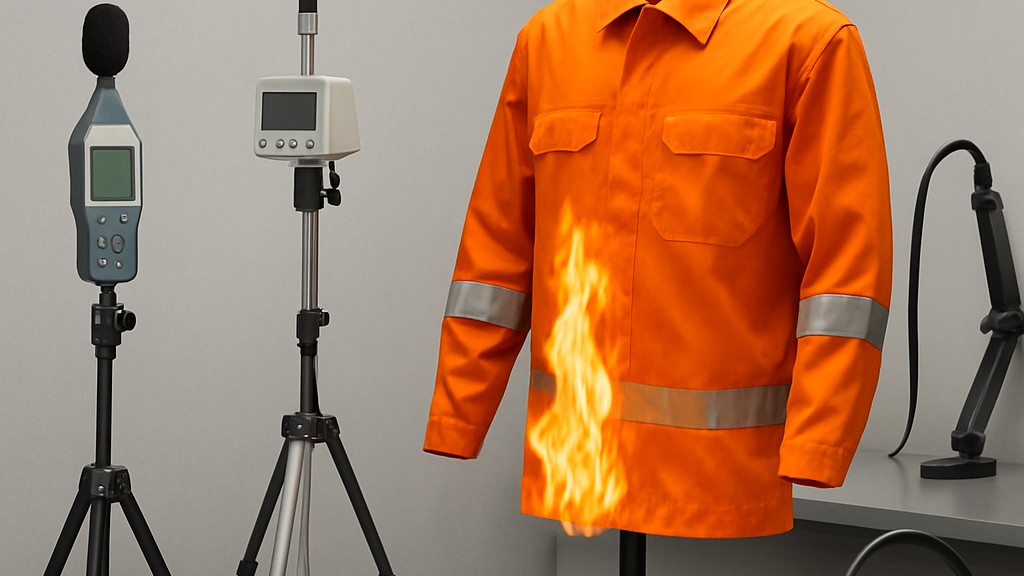
The standard “ISO 11612 Protective clothing - Clothing providing protection against heat and flame - Minimum performance requirements” published by the International Organization for Standardization (ISO) describes the performance requirements for protective clothing made of flexible materials designed to protect the body of the wearer, excluding the hands, from heat and flame.
To protect the wearer's head and feet, the only items of protective clothing covered by this standard are gaiters, hoods, and overboots. However, visors and respirator requirements are not specified for hoods.
These Internationally declared performance requirements apply to protective clothing that can be worn for a wide variety of end uses where clothing with limited flame spread characteristics is needed and where the wearer may be exposed to radiant, convective or contact heat or molten metal splashes.
The purpose of this standard is to provide minimum performance requirements for heat and flame protective clothing that can be worn for a wide range of end uses. Other standards related to heat and flame protective clothing have also been published, but these are primarily applicable to specific products or end uses.
There are three performance levels for most of the hazards specified in the ISO 11612 standard:
For protection against excessive exposure to radiant heat, a fourth performance level must be considered: high-performance materials such as aluminized and similar materials. The level of personal protection to be provided depends on the results of the risk assessment, and some comments on the risk assessment are included in the annex to this standard (Annex D).
For complete protection against exposure to heat and flame, the head, face, hands and feet may need to be protected with appropriate personal protective equipment and, in some cases, appropriate respiratory protection may also be required.
In short, the ISO 11612 standard specifies the performance requirements for protective clothing made of flexible materials designed to protect the wearer's body, excluding the hands, from heat and flame. This standard is widely applied in industries such as welding, foundry, metalworking, petrochemical, and other environments where workers are exposed to risks from radiant, convective, or contact heat, as well as molten metal splashes.
ISO 11612 also covers special protective equipment for the head and feet, such as gaiters, hoods, and overboots, but does not cover requirements for visors or respirators. This standard is applicable to a wide range of end uses where limited flame spread characteristics are required and workers may encounter radiant heat, convective heat, contact heat, or molten metal splash.
The general design and performance requirements presented by this standard are briefly as follows:
The ISO 11612 standard provides various test methods for assessing the protective performance of clothing. To comply with this standard, clothing must meet minimum performance levels for the limited flame spread test and at least one of the other indices.
The test methods described in this standard are:
The ISO 11612 standard is critical in industries where workers are exposed to thermal hazards, including:
Compliance with the ISO 11612 standard ensures that protective clothing provides a reliable barrier against heat and flame hazards, reducing the risk of serious injury or death. Flame-retardant materials self-extinguish once the ignition source is removed, making them essential for high-risk environments. Employers should select certified clothing and ensure proper use and maintenance to maximize safety.
Ultimately, the ISO 11612 standard is a vital framework for ensuring the safety of workers in environments exposed to heat and flame. By establishing rigorous testing and performance requirements, it ensures that protective clothing can withstand a variety of thermal hazards while maintaining functionality and comfort. Understanding this standard, its test methods, and its applications helps employers and workers select appropriate personal protective equipment and create safer workplaces in high-risk industries.
Our organization, which has been operating for many years and meticulously follows global developments in science and technology, employs a team of experienced professionals and a broad infrastructure to conduct testing, measurement, and analysis in a wide range of areas for businesses across all sectors. In this context, we also provide testing services in accordance with the ISO 11612 Protective clothing - Clothing providing protection against heat and flame - Minimum performance requirements standard.
To get an appointment, to get more detailed information or to request an evaluation, you can ask us to fill in our form and reach you.

