

The European standard “EN 50214 Flat Flexible Cables” describes the structure, requirements and specific test methods for flat, flexible PVC or halogen-free insulated and sheathed cables with nominal voltages of Uo/U 300/500 V and above, Uo/U 450/750 V for use in passenger and freight elevators, and Uo/U 450/750 V for general purpose and special applications such as cranes and hoists.
The latest update to this standard conforms to an agreement specifying the following cables:
The total diameter limits of the cables have been calculated according to the EN 60719 standard.
EN 50214 is a European standard specifying the structure, performance requirements, and test methods for flat flexible cables used in elevators, cranes, hoists, and other continuously moving industrial equipment. The latest version includes several significant technical updates, including support for halogen-free cable structures and modern contact elements.
This standard plays a vital role in ensuring the reliability and safety of flexible cables that are subjected to continuous bending, torsion, and mechanical stress during operation.
The EN 50214 standard applies to:
This standard defines requirements for cable structure, dimensions, electrical performance, mechanical strength, and test procedures.
Flexible cables used in elevators and industrial lifting equipment are subjected to harsh operating conditions throughout their service life. Every movement subjects the cable to repeated bending and tensile forces. Without standardized design and testing, cables can suffer from the following problems:
The EN 50214 standard ensures that cables maintain their mechanical and electrical integrity even after millions of movement cycles.
This standard specifies requirements covering various critical areas.
Modern versions also incorporate halogen-free cable designs, which enhance fire safety.
These features help ensure a long service life in harsh environments.
These requirements are important for both power transmission and control circuits.
These tests ensure reliable performance in factories, warehouses, construction sites, and commercial buildings.
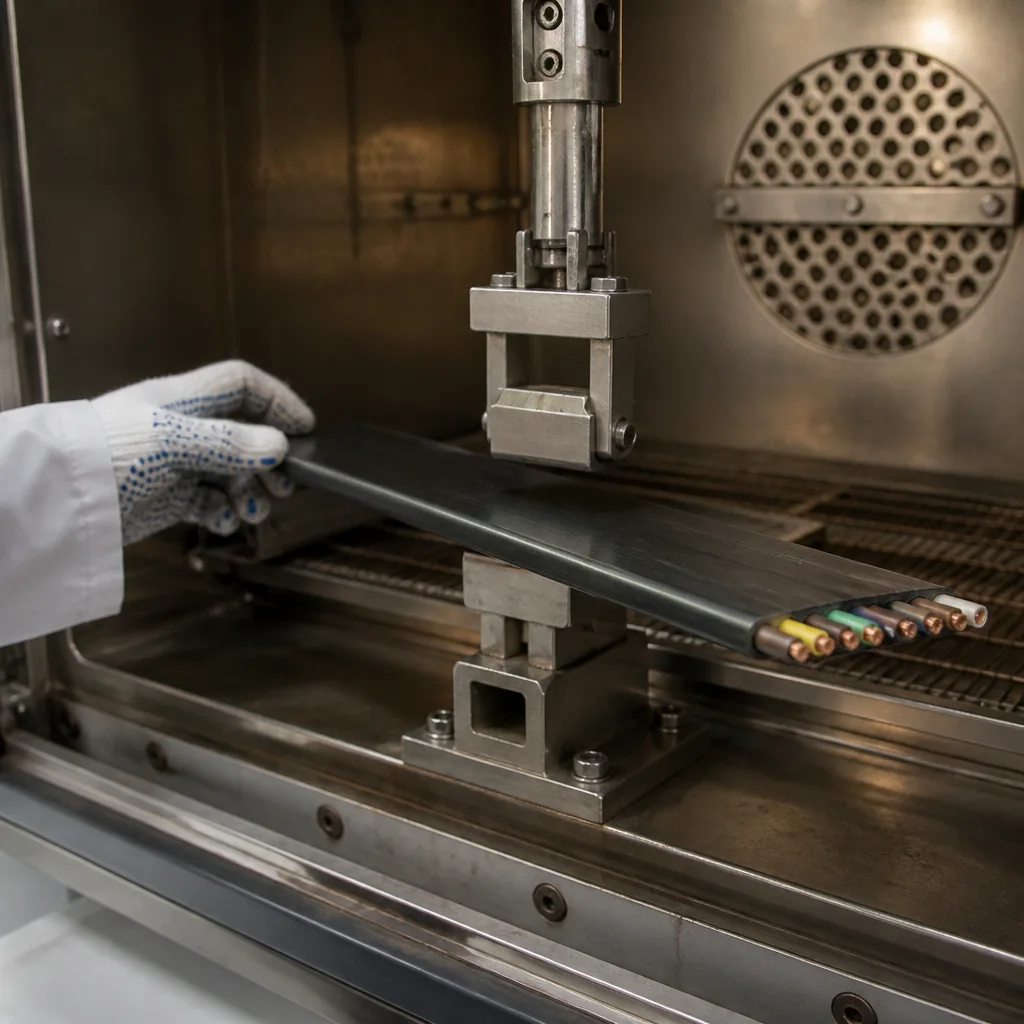
The EN 50214 standard includes the following specific test methods to verify cable quality:
These tests verify that the manufactured cables meet consistent performance requirements before being put into service.
The latest version of the EN 50214 standard offers several significant improvements over the previous version, including:
These changes reflect advances in elevator technology and the increasing use of integrated control and communication systems.
The EN 50214 standard is widely used by the following sectors:
Manufacturers complying with the EN 50214 standard benefit from the following:
For end users, compliance contributes to safer and more reliable operation of elevators and industrial lifting systems.
The EN 50214 standard complements several other European standards, including those listed below:
In conclusion, the EN 50214 standard is the principal European standard regulating flat flexible cables used in elevators, cranes, hoists and similar mobile equipment. By specifying stringent construction requirements and rigorous electrical and mechanical testing, it helps ensure that cables can withstand continuous movement and maintain safe and reliable operation. The latest revision of this standard modernizes it by incorporating halogen-free cable options, support for integrated communication elements, and compliance with existing elevator safety standards, making it a key reference for cable manufacturers, equipment designers and certification bodies across Europe.
For many years, our organization, with its competent and experienced staff, has been understanding the needs of its clients, providing the advanced testing services they require, and assisting them in the establishment, implementation, and improvement of management systems. Within this framework, we also provide testing services in accordance with the EN 50214 standard.
To get an appointment, to get more detailed information or to request an evaluation, you can ask us to fill in our form and reach you.

