

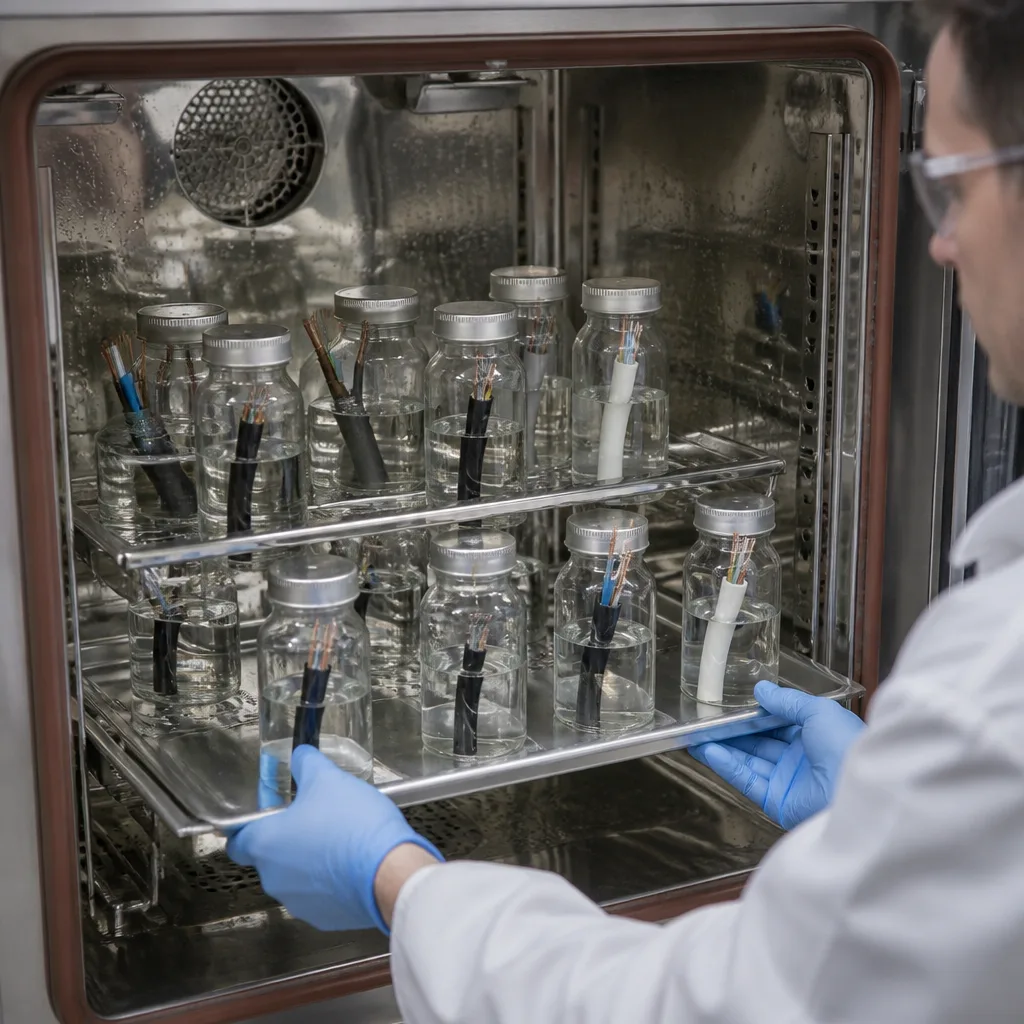
The European standard “EN 50497 Recommended test method for assessing the risk of plasticizer leakage from PVC insulated and sheathed cables” demonstrates the leakage of plasticizer from PVC insulated and sheathed cables individually using an accelerated test. This method is designed for use where the manufacturer identifies a specific risk that cannot be assessed solely by the conformity test described in EN 60811-1-2. This method is designed as a qualitative test on the finished product and not as an individual material test.
While any leaching is most likely plasticizer, other components may also leach and are treated equally in this test for the purposes of this standard. The method was specifically developed for PVC/PVC cables. No recommendations are given regarding its use with cables based on other insulation and sheath materials.
For the purposes of this standard, the following terms and definitions apply:
For testing, two representative samples are taken from the finished cable. The cable is cut into two test samples, each approximately 200 mm long plus/minus 10 mm. If a manufacturer produces the entire range of a product to a specific standard, and the same materials are used, then testing only one representative size is sufficient.
Test samples must be conditioned at 23 degrees plus/minus 2 degrees for 24 hours prior to testing.
Two conditioned test specimens are hung vertically in an air oven with filter paper placed underneath them. The bottom edge of each specimen should be 15 mm plus/minus 5 mm above the filter paper. The test specimens are hung in the air oven for 7 days at a temperature 10 degrees above the maximum permissible conductor temperature of the cable, but at a minimum of 80 degrees plus/minus 2 degrees. Immediately following this 7-day period in the air oven, the test specimens are separated as follows:
In both cases, the test specimen, suspended vertically with filter paper placed underneath at the previously described distance, is kept under the relevant conditions for 21 days. The test specimens are checked at regular intervals for signs of plasticizer leaching for 28 days (7 days + 21 days).
When evaluating the results, inspection for plasticizer leakage should be performed without magnification, using normal or corrected vision. The following should not be present:
The EN 50497 standard provides a recommended test method for assessing the risk of plasticizer migration (leakage) from PVC-insulated and PVC-sheathed cables and cords. Plasticizer leakage can cause cables to become sticky, attract dust, or lead to performance and aesthetic problems over time, especially in emergency or safety-critical circuits.
This standard applies to PVC insulated and PVC sheathed cables designed with natural fire resistance. It is particularly important for cables used in emergency circuits (e.g., fire alarms, emergency lighting, and evacuation systems). The described method is an accelerated testing method aimed at predicting long-term behavior related to plasticizer degradation.
This method,
PVC (polyvinyl chloride) is widely used in cable insulation and sheathing due to its flexibility, flame retardancy, and cost-effectiveness. However, PVC requires plasticizers (e.g., phthalates) to achieve the desired flexibility. Under certain conditions (heat, time, incompatible materials), these plasticizers can migrate to the surface (a phenomenon known as exudation or sweating).
The EN 50497 standard helps reduce risks in safety-related installations by providing a standardized way to test and qualify cables. It is often mentioned in conjunction with other fire-related cable standards (such as the EN 50200 or EN 50525 series of standards).
The EN 50497 standard provides a recommended test method for evaluating plasticizer migration (leakage) from PVC-sheathed cables and cords. Plasticizer leakage can cause cables to become sticky, attract dust, or lead to sustained performance and aesthetic issues, particularly in emergency or safety-critical circuits.
The main reasons why the EN 50497 standard is considered important are as follows:
The test is performed not only on the raw materials but also on the finished cable product, which makes it more representative of real-world service behavior.
For many years, our organization, with its competent and experienced staff, has been understanding the needs of its clients, providing the advanced testing services they require, and assisting them in the establishment, implementation, and improvement of management systems. Within this framework, we also provide testing services in accordance with the EN 50497 standard.
To get an appointment, to get more detailed information or to request an evaluation, you can ask us to fill in our form and reach you.

