

The standard “EN IEC 60156 Insulating fluids - Determination of breakdown voltage at mains frequency - Test method”, developed by the International Electrotechnical Commission (IEC) and later published as a European standard as part of harmonization efforts, describes the method for determining the dielectric breakdown voltage of insulating fluids at power frequency. This test procedure is performed in a specific device where the oil sample is exposed to an increasing AC electric field until fracture occurs.
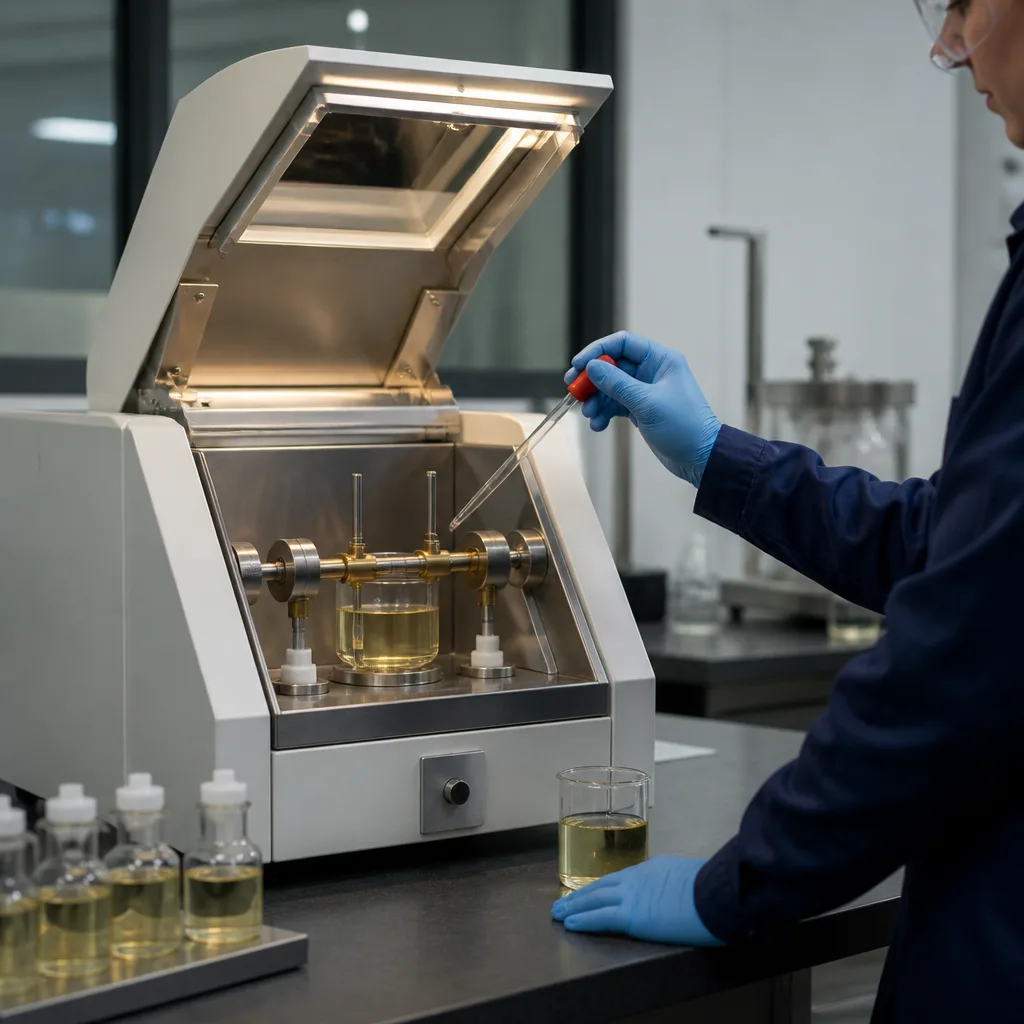
The described method is applicable to all types of insulation fluids with a nominal viscosity of up to 350 mm² /s at 40 degrees . It is suitable both for acceptance testing of unused fluids upon delivery and for determining the condition of samples taken during equipment monitoring and maintenance.
The EN IEC 60156 standard is required to evaluate the electrical insulation performance of transformer oils and other insulating fluids used in power transformers, switchgear, circuit breakers, reactors, and high-voltage equipment. This standard is widely applied by transformer manufacturers, electricity companies, testing laboratories, and maintenance organizations.
The primary purpose of the EN IEC 60156 standard is to determine the voltage at which an insulating fluid electrically breaks down when exposed to an increasing alternating current (AC) electric field. The measured breakdown voltage indicates the condition of the insulating fluid and helps determine whether it is suitable for:
Breakdown voltage is one of the key indicators of insulation quality. An insulating fluid normally prevents the flow of electric current between energized conductors. As the voltage increases,
The voltage at which this occurs is called the dielectric breakdown voltage. A higher breakdown voltage generally indicates better electrical insulation.
The EN IEC 60156 standard includes the following:
This standard is also applicable to the following:
This standard is not intended to provide a complete assessment of the oil condition; instead, it evaluates dielectric strength as a key property. The test measures the voltage required to create an electrical breakdown between two standardized electrodes immersed in an insulating fluid. The test process follows these steps:
These tests require a dielectric breakdown testing device consisting of the following components:
Modern devices automatically,
Rather than relying on a single failure event, this standard requires multiple consecutive measurements on the same sample. Between each test,
The last reported value is usually the arithmetic mean of the breakdown voltages.
Several factors can significantly reduce dielectric strength:
These particles intensify local electric fields and promote premature failure.
These contaminants reduce dielectric performance.
Accurate fat sampling is crucial. Incorrect sampling can lead to:
This results in artificially low breakdown voltages. The IEC 60475 standard is widely referenced for accurate sampling procedures.
The EN IEC 60156 standard is widely used in the following areas:
The EN IEC 60156 standard is frequently used, often in conjunction with complementary insulation oil standards, including:
Together, these standards provide a comprehensive assessment of insulation fluid quality.
The EN IEC 60156 standard is widely applied in the following areas:
Electrical insulation failure is a leading cause of transformer and high-voltage equipment failures. Measuring dielectric breakdown voltage helps identify moisture, contamination, and oil degradation before they lead to insulation failure, extending equipment life and reducing maintenance costs. Regular testing in accordance with EN IEC 60156 standard supports predictive maintenance and improves the reliability of power systems.
For many years, our organization, with its competent and experienced staff, has been understanding the needs of its clients, providing the advanced testing services they require, and assisting them in the establishment, implementation, and improvement of management systems. Within this framework, we also provide testing services compliant with the EN IEC 60156 standard.
To get an appointment, to get more detailed information or to request an evaluation, you can ask us to fill in our form and reach you.

