

The “IPC-A-24 Surface insulation resistance” standard, published by the Printed Circuits Institute (IPC), defines a single-sided (quadruple) pattern used to evaluate the interaction of solder flux and solder paste residue on printed circuit boards.
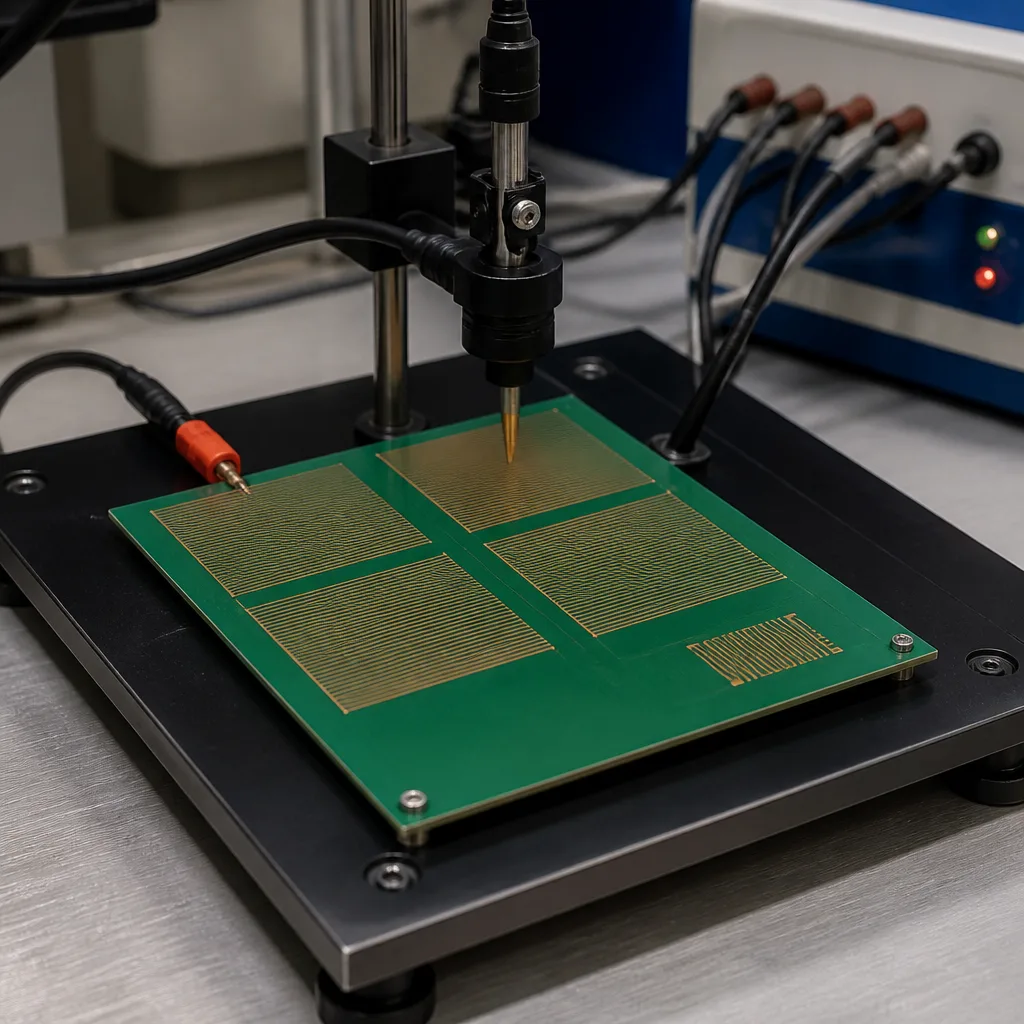
This single-sided (quadruple) pattern is used to evaluate the interaction of solder flux and solder paste residue on printed circuit boards. This board was used in the third phase of a test program evaluating alternative technologies used to eliminate chlorofluorocarbons in printed circuit board assembly processes. The board contains a four-comb pattern with 0,4 mm lines and 0,5 mm spacing. A stencil pattern is also provided (2 x 30 x 45 cm 1:1). No components are provided for this drawing. The main drawing IPC-100024 and the list of specifications are included.
The IPC-A-24 standard is a standard that provides drawings and specifications for a single-sided test card primarily used for surface insulation resistance testing. The card is designed as a 4-pattern (four identical combs or nested patterns on a card) to evaluate the interaction between solder flux, solder paste residues, and the printed circuit board surface. It helps manufacturers and material suppliers assess how well flux residues resist causing electrical leakage or corrosion under humid or environmental stress conditions.
The primary use of the IPC-A-24 standard is to define surface insulation resistance testing to characterize solder fluxes, solder pastes, and cleaning processes. This standard also measures the insulation resistance between closely spaced conductors after the board has been processed (e.g., after solder paste has been applied, refluxed, and sometimes cleaned or left with uncleaned residue).
This standard is commonly referenced in flux qualification standards and process reliability testing. It is particularly helpful in determining whether residues, especially in high-humidity environments, are corrosive or conductive enough to cause reliability problems in electronic components.
This card is often discussed in conjunction with the IPC-B-24 test card (or pattern). IPC-B-24 generally refers to the specific card design or layout used for surface insulation resistance testing, while IPC-A-24 provides the drawing/Gerber files.
The main features of the IPC-A-24 card are as follows:
The standards and test methods related to the IPC-A-24 standard are as follows:
The test involves pressing/remelting (or applying) solder paste, optional cleaning, and then exposing the board to 85 degrees Celsius temperature and 85 percent relative humidity or similar conditions, and measuring the resistance.
The main areas of application for the IPC-A-24 standard are as follows:
This test board plays a critical role in ensuring the long-term reliability of electronic products by verifying that processing residues do not compromise their electrical insulation properties.
In short, the IPC-A-24 standard supports the electronics industry by providing a consistent circuit board design and testing methodology to evaluate contamination, ionic residues, solder residues, soldering process effects, and material compatibility.
Surface insulation resistance is a critical indicator of how well an electronic assembly can resist unwanted current leakage across insulating surfaces under environmental stresses such as heat, humidity, and applied voltage.
The primary purpose of this standard is to standardize the design and use of test coupons or cards that measure the resistance between conductive patterns on a substrate. These test boards simulate real-world printed circuit board conditions and are used to determine whether residues or contaminants might cause:
This standard standardizes the testing method, enabling different laboratories and manufacturers to produce comparable surface insulation resistance data.
The IPC-A-24 standard focuses on the physical design, conductor spacing, material considerations, and pattern geometry of surface insulation resistance test panels. This standard is commonly used in conjunction with the following test methods:
The IPC-A-24 standard specifies the following:
These geometries create narrow spaces where ionic contamination or moisture can promote current flow.
Material consistency is crucial because substrate properties affect moisture absorption and ionic mobility.
This helps eliminate variability from card to card.
Typical failure mechanisms identified include:
The IPC-A-24 standard is widely used in the following areas:
For many years, our organization, with its competent and experienced team, has been understanding the needs of its clients, providing the advanced testing services they require, and assisting them in the establishment, implementation, and improvement of management systems. Within this framework, we also provide testing services compliant with the IPC-A-24 standard.
To get an appointment, to get more detailed information or to request an evaluation, you can ask us to fill in our form and reach you.

