

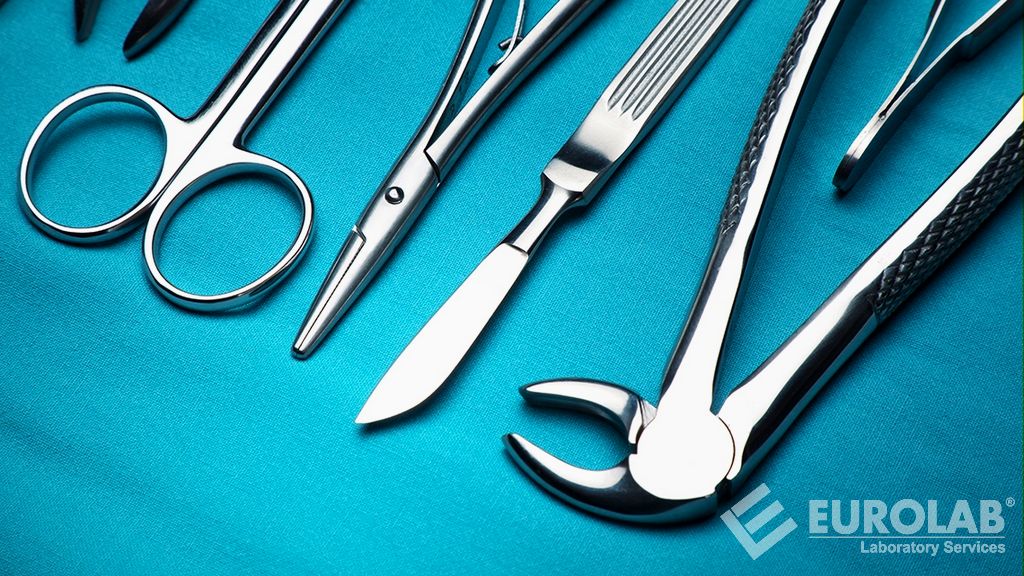
The ASTM F1089-18 standard, published by the American Society for Testing and Materials (ASTM) , describes evaluation criteria and defines test methods for determining the corrosion resistance of new and reusable surgical instruments made from stainless steel alloys, similar to but not limited to those listed in another ASTM standard, ASTM F899.
Surgical instruments containing special stainless steel materials should use the boil test and the copper sulfate test:
Surgical instruments containing any of the following stainless steel materials should use the weld test:
The copper sulfate test is used to detect the presence of free iron on the surface of materials. The copper sulfate test is not recommended for martensitic materials or ferritic materials containing less than 16 percent chromium because these steels give a positive indication regardless of the presence or absence of anodic surface contaminants.
The boiling test is applied to martensitic, austenitic, ferritic and precipitation hardening materials to detect surface defects, free iron or other anodic surface contaminants on stainless steel.
Corrosion is a common type of surgical instrument damage. Types of corrosion include pitting, stress, wear, friction, and cracking. Pitting appears as a small hole in stainless steel surrounded by reddish-brown corrosion deposits. The main reason for this is chlorides. These break the passive layer of the instrument's steel, causing pitting. Specifically, pitting is caused by fluids with a high chloride content that adhere to the surface of the surgical instrument. New instruments have a higher risk of pitting as the passivation layers are still thin. Surgical instrument passivation layers thicken over time. Stress corrosion occurs in stainless steel as visual cracks and fractures. This type of tool damage is typically found in areas of high tensile stress such as welded, riveted or screwed connections.
Our organization also provides standard testing services for the corrosion of surgical instruments within the scope of ASTM F1089-18 standard, with its trained and expert staff and advanced technological equipment, among the numerous test, measurement, analysis and evaluation studies it provides for businesses in various sectors.
To get an appointment, to get more detailed information or to request an evaluation, you can ask us to fill in our form and reach you.

