

EUROLABoffers a range of medical device cleaning verification services to verify manufacturers' cleaning instructions for reusable devices. This includes contamination, cleanliness and post-treatment effectiveness testing. Simulated handling test applications are used to simulate actual surgical procedures rather than direct grafting methods.
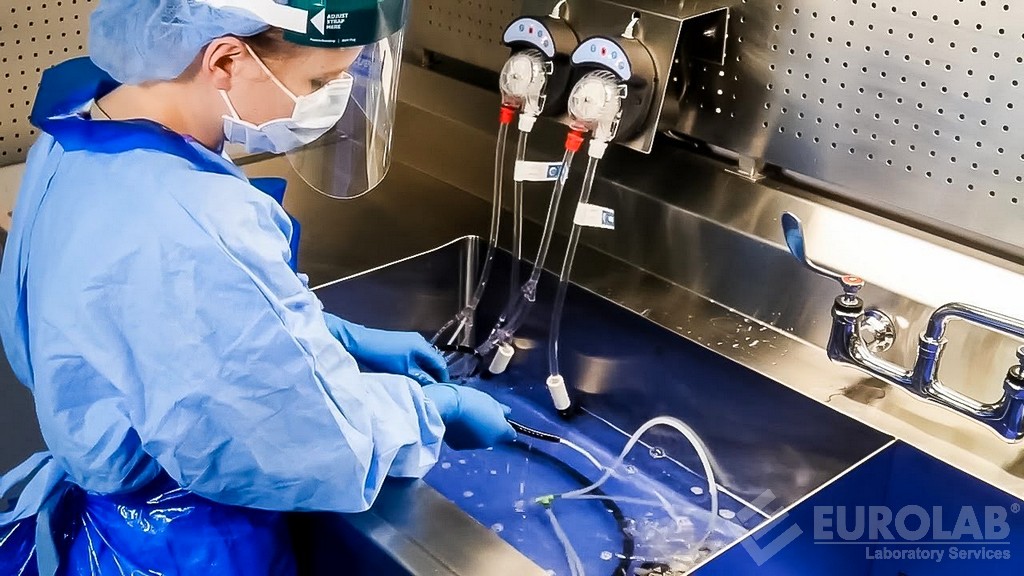
Options are available to use validated or customized test soils to create clinically meaningful conditions. This test complies with AAMI TIR12, AAMI TIR30 (ST98: draft), ISO 17664 and the guidance document “Reprocessing of Medical Devices in Healthcare: Validation Methods and Labeling”. EUROLABProcessing scientists at , actively serve on applicable AAMI, ISO, and ASTM committees and have expertise in creating worst-case test conditions to help device manufacturers meet regulatory expectations.
Applicable Standards
Cleaning validations assess the recommended cleaning procedure for a reusable device according to AAMI TIR12, AAMI TIR30, ISO 17664 and the document "Reprocessing Medical Devices in Health Devices: Validation Methods and Labeling". This verification is required to ensure that the device can be cleaned properly after use. It is the manufacturer's responsibility to apply this data, along with the functionality and sterilization data, to the instructions of the end user.
Contamination: Devices are contaminated using appropriate test soil to detect clinically significant markers such as protein, hemoglobin, carbohydrates, total organic carbon, and endotoxin. The method of contamination is determined by considering the intended use of the device and the waiting time between patient use and cleaning. Devices are typically sprayed, handled with contaminated gloves, and/or immersed in test soil. All moving parts can be operated to simulate clinical use and then left in contact with the test soil for an appropriate period. Devices are then removed from the soil and allowed to rest for an appropriate period to simulate the waiting time between patient use and processing.
Positive device recovery: Extraction(s) will be performed to identify residues in a positive device. Multiple extractions are performed on the device to obtain an extraction yield; this information allows for the determination of how well the marker(s) are recovered using the chosen extraction method.
Cleaning operations: Test devices will be cleaned using the manufacturer's recommended cleaning procedures. A manual process may involve immersion devices in detergents prepared according to the detergent manufacturer's recommendations. A soft bristle brush can be used to help remove soil, paying particular attention to cracks and difficult-to-clean areas. Some devices may need to be subjected to a mechanical step, which may include ultrasonic cleaning in an enzymatic detergent. EUROLAB It can also perform fully automatic verification on common healthcare washer-disinfectors.
Residual test: After the devices are cleaned, any remaining test soil is extracted using an approved method. The extraction liquid is then tested to assess the amount of residual test marker remaining on the device. This test, combined with visual inspection, helps verify that the process is appropriate for adequately cleaning the device.
EUROLAB, with its highly expert team and internationally accredited laboratories, Cleaning Verification - Reusable Devices It performs all test, analysis, measurement, evaluation and report generation services completely and reliably.
To get an appointment, to get more detailed information or to request an evaluation, you can ask us to fill in our form and reach you.

