

The Bacterial Filtration Efficiency (BFE) test is performed on filtering materials and devices designed to protect against biological aerosols such as face masks, surgical gowns, caps, and air filters.
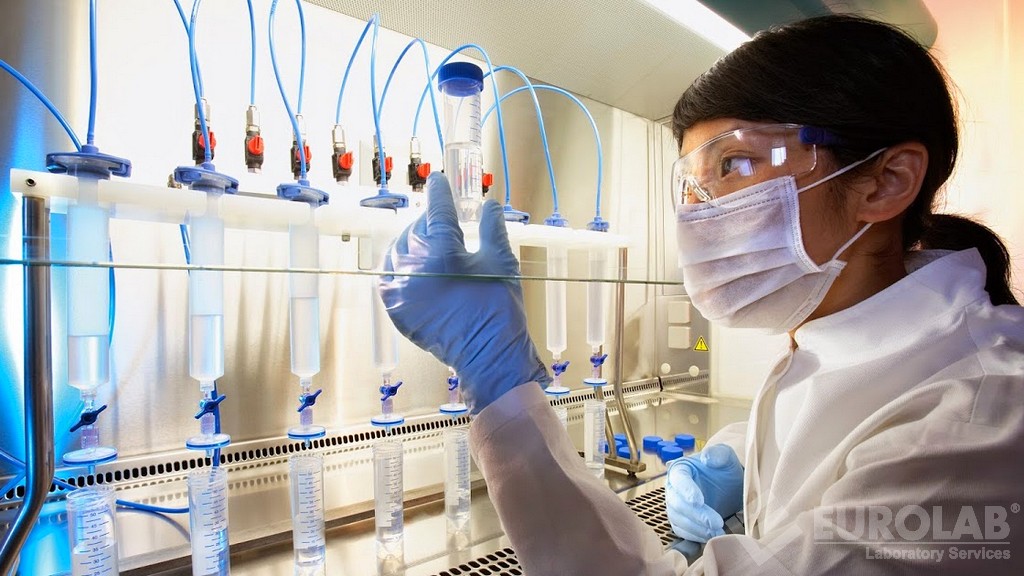
This test is used for FDA 510(k) applications for surgical masks, is required for ASTM F2100 and EN 14683, and complies with ASTM F2101 and EN14683. EUROLAB staff helped develop this testing method, so they have a lot of experience for this test. We can provide one-stop service for all ASTM F2100 and EN 14683 testing needs.
The Bacterial Filtration Efficiency test determines the filtration efficiency by comparing the bacterial control numbers with the test substance waste numbers. The test is carried out using Staphylococcus aureus as the challenge organism. After the pre-conditioning of the filtrate medium, the liquid suspension of S. aureus is aerosolized and sent to the filtrate medium at a constant flow rate of 28.3 liters per minute (LPM) or 1 cubic meter per minute (CFM).
Aerosol droplets are drawn from the six-stage Andersen sampler for collection. The number of bacterial aerosol droplets that come into contact with the filter medium is determined by performing test controls in the test system without the filter medium. Difficulty controls are maintained at 3.0-0.3 colony forming units (CFU) with an average particle size (MPS) of 1700 ± 3000 µm. This allows filtration efficiency to be reported up to> 99,9%.
The BFE test offers a number of advantages over other filtration efficiency tests. It has been used for years with little or no modifications and provides a standard reference for comparison of filtration materials. The average particle size can be tightly controlled and is sized using a six-stage viable particle Andersen sampler that allows for step-by-step analysis. The BFE procedure is repeatable and creates a more serious challenge for most filtration devices than expected in normal use. Many materials can be evaluated in a relatively short time.
The BFE test is usually done in conjunction with the Differential Pressure (Delta P) test.
We recommend the Increasing Difficulty method for built-in filters. This procedure uses a higher concentration concentration to be delivered to each test material. Filtration efficiency measurements can be determined up to> 99.9999%.
Increased Bacterial Filtration Efficiency test determines filtration efficiency by comparing bacterial control numbers with test substance waste numbers. The test is carried out using Staphylococcus aureus as the challenge organism. A liquid suspension of S. aureus is aerosolized and introduced into the filtration medium at a constant flow rate of 30 liters per minute (LPM).
Aerosol droplets are collected in parallel in all glass impacts (AGI). Difficulty is given at one minute intervals and sampling of AGIs is performed for two minutes to clean the aerosol chamber. The titer of the assay fluid is determined using standard plate count and / or membrane filtration techniques. The number of bacterial aerosol droplets that come into contact with the filter medium is determined by test control without the filter medium in the test system. The square control is maintained at 1 x 10 6 colony forming units (CFU) with an average particle size (MAS) of 3.0 ± 0.3 μm. This allows filtration efficiencies to be reported up to> 99.9999%.
The increased BFE test offers a number of advantages over other filtration efficiency tests. It has been used for years with little or no modifications and provides a standard reference for comparison of filtration materials. The increased BFE procedure is very repeatable, easy to do, and creates a more serious challenge than expected in most filtering devices.
The Viral Filtration Efficiency (VFE) test follows the same procedure as BFE, except that the used organism of difficulty is bacteriophase phiX174.
Difficulty controls are maintained in 3.0-0.3 plaque-forming units (PFU) with an average particle size (MPS) of 1100 ± 3300 µm. This allows filtration efficiency to be reported up to> 99,9%.
The increased VFE test follows the same procedure as BFE, except that the used organism of difficulty is bacteriophase phiX174.
The square control is maintained at ≥1 x 10 6 plate-forming units (PFU) with an average particle size (MAS) of 3.0 ± 0.3 μm. This allows filtration efficiencies to be reported up to> 99,9999%
EUROLAB, with its highly expert team and internationally accredited laboratories, Bacterial - Viral Filtration Efficiency (BFE / VFE) Test It performs all test, analysis, measurement, evaluation and report generation services completely and reliably.
To get an appointment, to get more detailed information or to request an evaluation, you can ask us to fill in our form and reach you.

