Surgical Gowns and Barrier Tests - AAMI PB70 - EN 13795
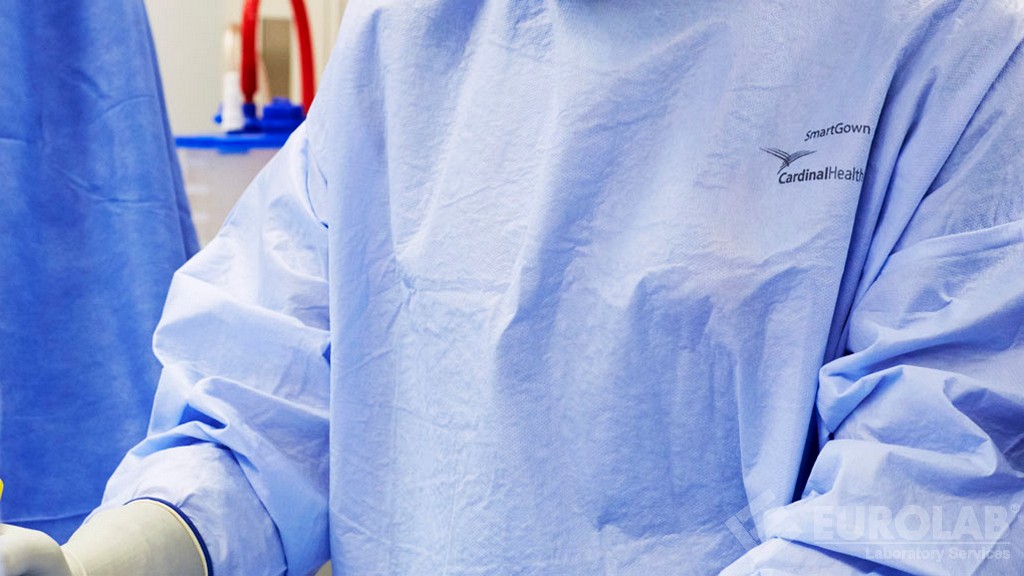
EUROLABoffers a comprehensive range of testing for surgical gown and drape barrier performance and biocompatibility. These tests are necessary to ensure that performance characteristics are validated to support marketing label claims and to classify surgical drapes and gowns. The number of test locations and product classification (AAMI PB70 or EN 13795) determine the type of testing to be performed. For Viral Penetration testing, a compatibility assessment must be made for each material and, if different, each site.
Manufacturers should also consider microbial cleanliness of the suit using the bioburden test method, following EN ISO 11737-1. Particle shedding characteristics and biocompatibility should also be evaluated depending on the type of material and intended use.
Summary of tests for AAMI PB70:
- Hydrostatic pressure test, AATCC 127, ISO, EN
- Spray impact test, AATCC 42
- Synthetic blood penetration, ASTM F1670 or ISO 16603
- Viral penetration, ASTM F1671 or ISO 16604
Summary of tests for EN 13795:
- Hydrostatic pressure test, AATCC 127, ISO, EN
- Resistance to wet bacterial penetration, ISO 22610
- This test uses an electrically powered turntable to rotate the agar plate, while a vertical finger presses a bacteria-inoculated material. The inoculated material called donor is located on the test substance. The finger is moved over the entire surface of the plate for 15 minutes at 60 revolutions per minute. It applies a force of 3 Newton to the finger agar plate. Due to the effect of friction and fluid migration, bacteria can migrate from the donor from the test sample to the agar plate. The results characterize barrier capacity and penetration over time.
- Dry microbial penetration resistance, ISO 22612
- Dry microbial penetration determines the ability of contaminated particles to migrate through materials. The test samples are fixed in a container and 10 contaminated talc 8 (CFU / g) is poured over the B. atrophaeus test sample per gram colony-forming unit. A sedimentation plate is placed at the bottom of each sample at a short distance below the test sample. The device supporting the containers is vibrated at approximately 30 rpm for 20.800 minutes. The talc penetrating the test material is kept on the sedimentation plate, which is removed and incubated after testing.
- Evaluation of explosion resistance in dry and wet state, ISO 13938-1
- Specimens have been attached to the dispersion tester using a clamp with an area of 10 cm and the condition for wet and / or dry testing. The pressure is increased at a constant rate of 2 mL / min until the sample bursts. The pressure at the explosion, the duration of the explosion and the height at the explosion are recorded.
- Tensile test (Dry), EN 29073-3
- Tensile test (Wet), EN 29073-3
- Particle shed analysis or primer: Gelbo flex test, ISO 9073-10
- The samples are subjected to a combined bending and compression effect in a test chamber using a Gelbo Flex mechanism. During stretching, air is taken from the chamber and the particles produced are numbered and sized using a laser particle counter.
Additional tests to consider for surgical gowns and drapes:
- Biocompatibility, ISO 10993
- ISO tests for viral and blood penetration, ISO 16603 and 16604
- Particle shed analysis: Helmke drum particle count, IEST RP-CC003.4
- This procedure is performed to quantify the particles removed from a sample by applying mechanical energy under dry conditions to simulate spillage from the surface of the sample. The average particle concentration is determined and used to calculate a particle emission rate that can be compared to the test product cleanliness classification listed in IEST-RP-CC003.4.
- Tensile and tear resistance
Applicable Standards
- AAMI PB70
- EN 13795
- EN 14126
Sample Features
- HPT110: 32 samples recommended for FDA submission, Minimum 5 samples recommended. Each sample must be a minimum of 8 x 8 inches (203 x 203 mm)
- HPT210: 6 finished products or 250 samples of ~ 250 x 6 cm. 1 set (5 reps, 1 negative)
- HPT220: 12 finished products or 200 samples of ~ 200mm x ~ 12mm cut from finished products. 1 set (10 reps; 2 negatives)
- HPT230: A finished product where 10 samples can be taken from the critical area so that 5 samples can be taken from the non-critical area. The test amount should comply with the EN13795 guideline.
- HPT235: A finished product where 10 samples can be taken from the critical area so that 5 samples can be taken from the non-critical area. The test amount should comply with the EN13795 guideline.
- PHY150: Minimum 10 samples (5 crosses and 5 machines); each sample should be 500 x 200 mm
- PHY155: Minimum 10 samples (5 crosses and 5 machines); each sample should be 500 x 200 mm
- PSA115: At least 5 samples are recommended. Add 2 extra samples for installation; each sample must be a medium size garment
- PSA120: Minimum 14 swatches per material type. Each color sample should be at least 22 cm x 28,5 cm.
- SBP110: 32 samples recommended for FDA Submission (ASTM F1670 requires at least 3 samples). Each sample must be a minimum of 3 x 3 inches (75 mm x 75 mm). Include 4 extra samples for installation.
- SBP120: 32 suggested samples for FDA Submission; each sample must be a minimum of 3 x 3 inches (75 mm x 75 mm). Include 4 extra samples for installation.
- SIT110: 32 samples recommended for FDA submission, Minimum 5 samples recommended. Each sample must be at least 178 x 330 mm (7 x 13 inches)
- VPT110: The price is per sample. 32 samples recommended for FDA Submission (ASTM F1671 requires at least 3 samples); each sample must be a minimum of 3 x 3 inches (75 mm x 75 mm). Include 4 extra samples for installation.
- VPT120: 32 suggested samples for FDA Submission; each sample must be a minimum of 3 x 3 inches (75 mm x 75 mm). Include 4 extra samples for installation.
EUROLAB, with its highly expert team and internationally accredited laboratories, Surgical Gowns and Barrier Tests - AAMI PB70 - EN 13795 It performs all test, analysis, measurement, evaluation and report generation services completely and reliably.



