

Masks designed for respiratory protection certification may require NaCl, DOP, valve leak, and inhalation/exhalation tests to verify compliance with NIOSH standards. EUROLAB offers testing services for these tests.
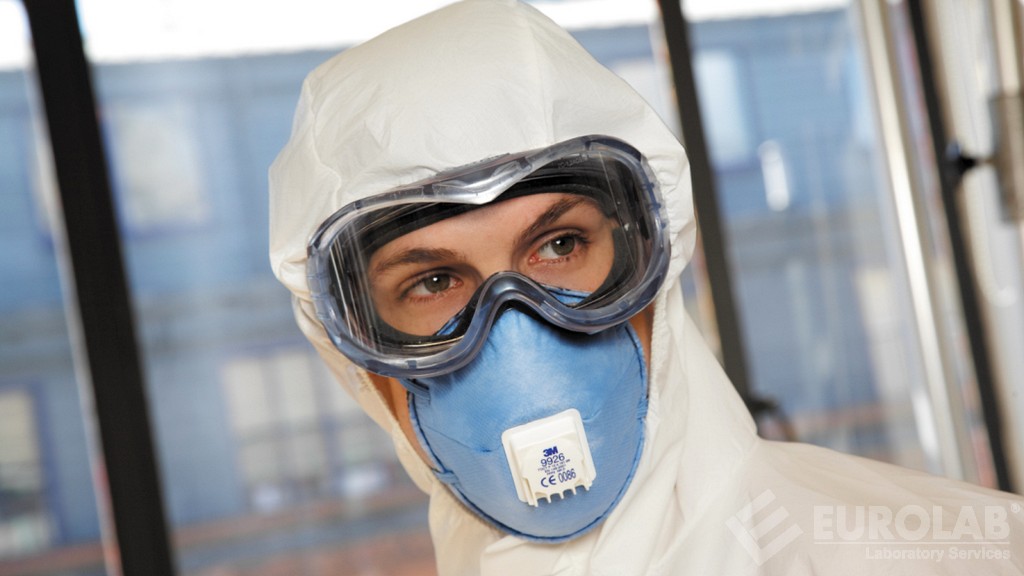
The Sodium Chloride Aerosol Challenge (NaCl) - NIOSH Respirator Prequalification test uses a widely accepted method to evaluate the particle penetration and air flow resistance properties of various filtration materials. Masks must be prequalified before being submitted to NIOSH for certification; Other materials such as breathing system filters and face masks are tested to determine filtering efficiency for marketing. These tests are performed for masks requiring N95 respirator approval.
Dioctyl Phthalate (DOP) testing is used to evaluate particle penetration and air flow resistance properties for a variety of filtration materials, including HEPA filters, NIOSH respirators, and filter media. The test is in accordance with 42 CFR Part 84 and NIOSH Procedure No. It complies with RCT-APR-STP-0051-0056, 2005 and is required for prequalification for NIOSH certification of respirators. EUROLABhas extensive experience testing filters and other filtering devices.
The test is in accordance with 42 CFR Part 84 and NIOSH Procedure No. It is carried out in accordance with RC-APR-STP-0057, 0058 and 0059. EUROLABhas comprehensive testing filters and other filtering devices.
The Sodium Chloride Aerosol Challenge test can determine filtration efficiency measurements of up to 99.999%. In this procedure, the TSI® CERTITEST® Model 8130 Automatic Filter Tester reservoir is filled with 2% NaCl solution. The sample is placed in the filter holder. Cone or molded masks and masks are mounted on a test fixture and sealed in a cylinder filter holder to ensure the mask is properly sealed.
Samples are subjected to aerosolized NaCl. NaCl concentration is measured before and after collision with the sample. The amount of NaCl passing through the sample is used to calculate the filtration efficiency of the sample.
NIOSH prequalification masks need to be preconditioned at 25 ± 85% RH and 5 ± 38 ° C for 2.5 hours before evaluating the filtration efficiency.
There are three categories for NIOSH certified, powerless, air-purifying, particle filter respirators: N (Non-Oil-resistant), R (Oil-resistant) and P (Oil-Proof).
Test items submitted for testing according to NIOSH requirements will be tested according to 42 CFR Part 84 "Approval of Respiratory Protective Devices".
DOP aerosol testing is a widely accepted method for evaluating the particle penetration and air flow resistance properties of various filtering materials (eg, respiratory system filters, NIOSH respirators and face masks). A DOP aerosol is used in the procedure using the TSI® CERTITEST® Model 8130 Automatic Filter Tester.
The test products are struggling with the most penetrating particles with a particle size range of 0.3 μm. Filtration efficiency measurements can be determined up to 99,999%. Samples can be tested at flow rates up to 90 liters per minute (LPM). The filtration requirement for HEPA filters is 0.3% at 99.97 μm using the DOP test.
In addition to NaCl and DOP tests, mask manufacturers may need to demonstrate inhalation, exhalation and valve leak tests in accordance with 42 CFR Part 84 and NIOSH procedures.
EUROLAB, with its highly expert team and internationally accredited laboratories, Mask Sensitivity Tests - NIOSH It performs all test, analysis, measurement, evaluation and report generation services completely and reliably.
To get an appointment, to get more detailed information or to request an evaluation, you can ask us to fill in our form and reach you.

