
The ASTM F3014 Standard Test Method for Penetration Testing of Needles Used in Surgical Sutures, developed by the American Society for Testing and Materials (ASTM), describes the penetration testing method for sharp and blunt needles used in placing surgical sutures. This standard only defines the test procedures (Phase 1) and does not define a test environment. Test environments will be addressed in the next stage of the evolution of this test method (Phase 2).
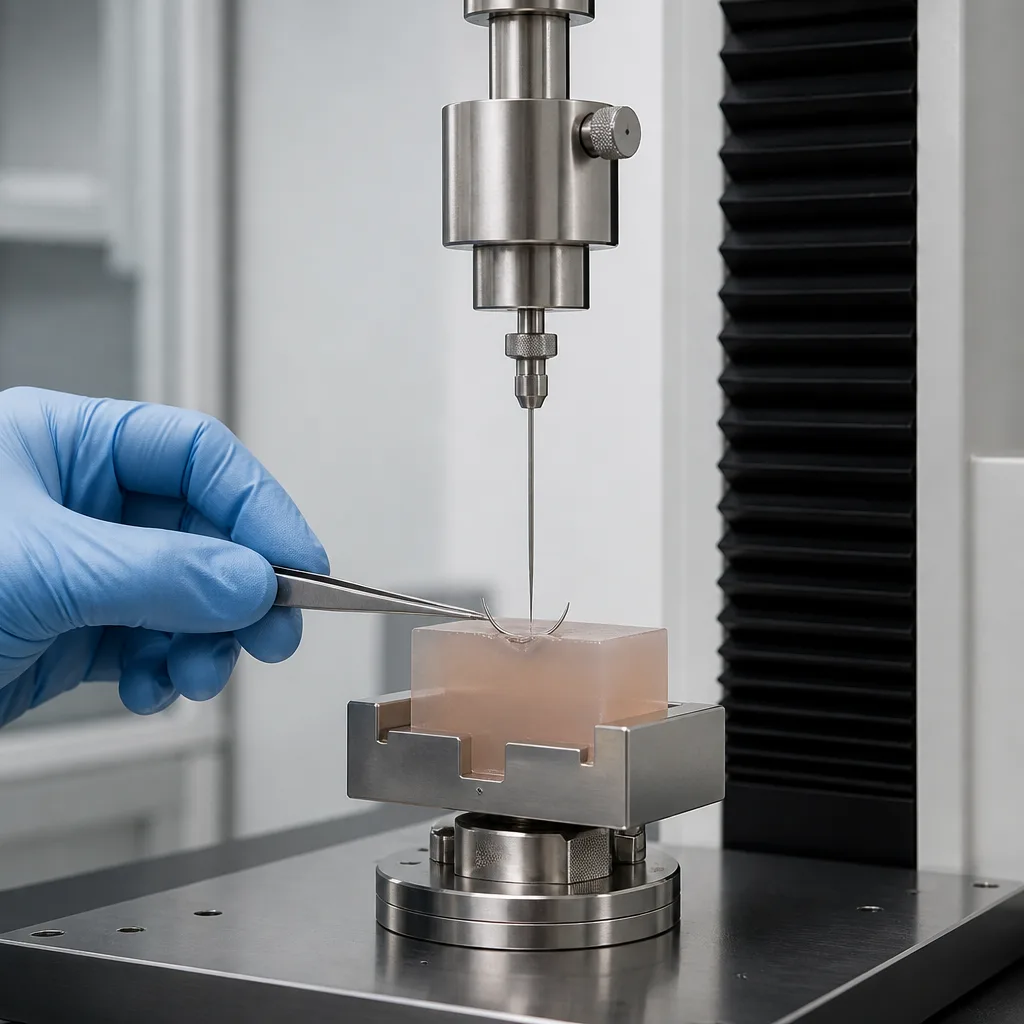
The described test method is applicable to straight and curved surgical needles. This test method is not intended to address the value of the test under actual usage conditions. It is assumed that the needles used in this test have passed all applicable quality standards and have no physical deformation that would inappropriately affect the test results. This test method measures the force required for a needle to pass through a medium and its ability to do so multiple times.
This test method allows for the evaluation of the force with which a surgical needle passes through a selected medium. The needle is passed through a chosen medium at a selected speed and along a selected path. This process applies a force that reflects the resistance to passage, depending on the shape and coating of the needle.
In short, the ASTM F3014 standard establishes a consistent method for evaluating the penetration performance of surgical needles. This standard provides manufacturers, testing laboratories, and medical device developers with a repeatable procedure for measuring the force required for a surgical needle to penetrate a specific test medium. This allows for objective comparisons between different needle designs, manufacturing processes, and surface treatments.
Surgical needles play a critical role in wound closure and tissue repair. Their penetration characteristics directly affect surgeon control, tissue trauma, and patient outcomes. The ASTM F3014 standard helps to ensure that these characteristics are measured using standardized laboratory methods.
The primary purpose of the ASTM F3014 standard is to provide a standardized methodology for the following:
Instead of defining pass/fail criteria, this standard establishes a uniform testing procedure to ensure that results from different laboratories are comparable.
The ASTM F3014 standard applies to surgical needles used with medical sutures, including:
This standard focuses specifically on needle penetration performance rather than the mechanical properties of the bonded suture.
The test determines the force required for a surgical needle to penetrate a controlled test medium. During the test,
Typical equipment used in testing includes:
The testing system must provide accurate alignment and controlled movement to ensure repeatable results.
The ASTM F3014 standard allows for the measurement of various key performance characteristics, including:
These measurements help identify differences such as:
The main variables that affect test results are:
The ASTM F3014 standard is widely used in the following areas:
The ASTM F3014 standard is applicable to many healthcare sectors, including:
The main advantages provided by the ASTM F3014 standard are as follows:
In contrast, while the ASTM F3014 standard is valuable for laboratory evaluation, it has several limitations:
The ASTM F3014 standard complements other standards used in the evaluation of surgical sutures and needles. Together, these standards provide a comprehensive assessment of:
The ASTM F3014 standard, when used in conjunction with standards such as ISO 13485 for medical device quality management and ISO 10993 for biological evaluation, contributes to the overall safety and performance assessment of surgical suture products.
This standard helps manufacturers produce needles with predictable penetration performance, promoting consistent quality throughout the manufacturing process.
In conclusion, the ASTM F3014 standard defines an important test method for evaluating the penetration characteristics of surgical needles used with medical sutures. By providing a standardized and reproducible procedure for measuring penetration force, this standard allows manufacturers to compare needle designs, maintain manufacturing quality, and generate reliable performance data. While laboratory tests cannot perfectly replicate clinical conditions, the ASTM F3014 standard serves as a valuable tool in the development and quality assurance of surgical needles, ultimately contributing to safer and more effective medical devices.
For many years, our organization, with its competent and experienced team, has been understanding the needs of its clients, providing the advanced testing services they require, and assisting them in the establishment, implementation, and improvement of management systems. Within this framework, we also provide testing services in accordance with the ASTM F3014 standard.
To get an appointment, to get more detailed information or to request an evaluation, you can ask us to fill in our form and reach you.

