ISO 23328 Respiratory System Filters for Anesthesia and Respiratory Use
The “ISO 23328 Respiratory system filters for anesthesia and respiratory use” standard published by the International Organization for Standardization (ISO) consists of the following subsections published under the same title:
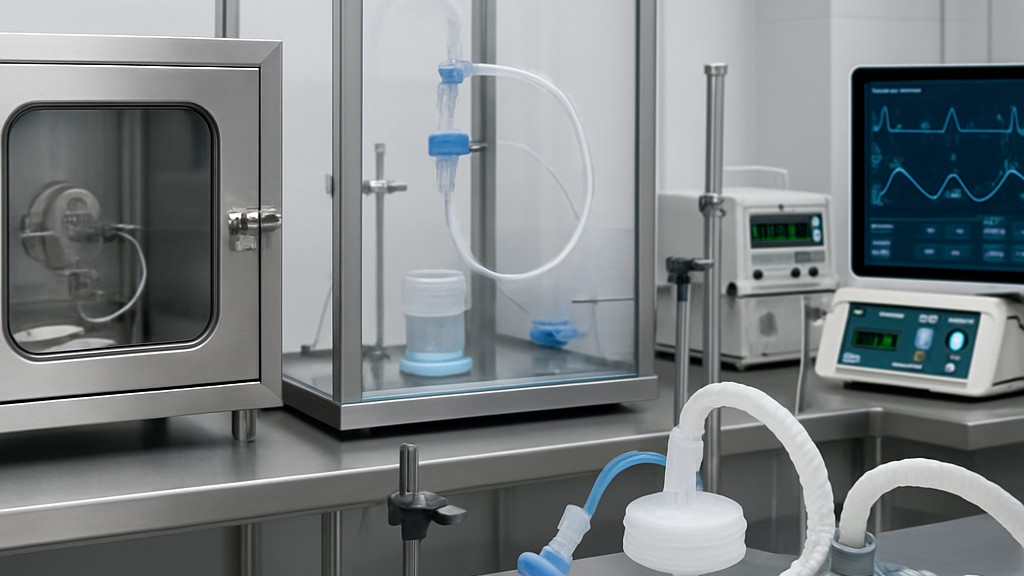
- ISO 23328-1 Part 1: Salt test method for evaluating filtration performance describes the short-term airborne sodium chloride particle challenge test method for evaluating the filtration performance of respiratory system filters designed for filtering inspired gases. This standard applies to respiratory system filters used with clinical respiratory systems. This standard is not applicable to other filter types, such as those designed to protect vacuum sources or gas sample lines, to filter compressed gases, or to protect test equipment for physiological respiratory measurements. Non-filtration aspects of respiratory system filters are addressed in ISO 23328-2.
For the purposes of this standard, the following terms and definitions apply:
- A respiratory system filter is a device that aims to reduce the transmission of particles, including microorganisms, in the respiratory systems.
- Challenge concentration is the concentration of sodium chloride particles in the airstream when it reaches the respiratory system filter. Challenge concentration is expressed in milligrams per cubic meter.
- Penetration concentration, respiratory system filterThe concentration of sodium chloride particles in the airflow exiting the condenser. The penetration concentration is expressed in milligrams per cubic meter.
- The penetration value is the concentration of sodium chloride particles passing through the respiratory system filter (as a percentage of the concentration at challenge).
- A filtration efficiency of 2,5 percent is 100 minus the penetration value.
The ability of a respiratory system filter to remove particles is measured by spraying a sodium chloride solution into an airstream and passing the sodium chloride particles produced by the sprayer through the respiratory system filter.
The generation of aerosols from a sprayer produces electrostatically charged particles. The magnitude of the charge is reduced by mixing the airstream containing the particles with the ionized airstream, so that when the two streams are mixed, the particles are neutralized to a Boltzmann equilibrium state.
The flows selected for testing represent typical flows likely to be encountered during the intended use of the respiratory system filter.
Respiratory system filter performance is evaluated by measuring the penetration concentration of sodium chloride particles in the airflow exiting the respiratory system filter and comparing this to the concentration of sodium chloride particles in the airflow entering the respiratory system filter. Respiratory system filters are tested in the unused state after being removed from their packaging and conditioned to simulate clinical use.
The ambient conditions during the tests should be as follows: temperature 23 degrees plus/minus 2 degrees, relative humidity 60 percent plus/minus 15 percent, and pressure 96 kPa plus/minus 10 kPa.
- ISO 27956-2 Part 2: Non-filtration aspects" specifies the requirements for non-filtration aspects of respiratory system filters for anesthesia and respiratory purposes, providing information on connection points, leakage, flow resistance, packaging, marking, and supply. The test method is designed for respiratory system filters used with clinical respiratory systems. It does not apply to other filter types, such as those designed to protect vacuum sources or gas sample lines, to filter compressed gases, or to protect test equipment for physiological respiratory measurements. A method for evaluating the filtration performance of respiratory system filters is given in ISO 23328-1.
For the purposes of this standard, the following terms and definitions apply:
- Respiratory system filter respiratory system port, connected to the respiratory system respiratory system filter is the port.
- The respiratory system filter patient connection port is a respiratory system filter port designed to connect to a device such as a tracheal or tracheostomy tube connector or face mask.
- The respiratory system filter accessory port is a respiratory system filter port that can be connected to an accessory device for purposes such as gas sampling, monitoring and pressure measurement.
- Respiratory system filter internal volume: the volume contained in the respiratory system filter, when unpressurized, is subtracted from the volume of all solid elements within the respiratory system filter and the volume inside all female connectors.
- Pressure drop is the difference between the pressure measured in a gas flow into the breathing system filter and the pressure measured in a gas flow through the breathing system filter at a constant gas flow rate.
Respiratory system filter port connectors are:
- Breathing system filter breathing system and patient connection ports: The connectors at the breathing system port and the patient connection port must comply with the ISO 5356-1 standard.
- Accessory ports: If the breathing system filter is equipped with an accessory port, this port must not accept 15 mm or 22 mm conical connectors complying with ISO 5356-1 and ISO 5356-2 standards and means must be provided for closing the port.
The ambient conditions during the tests should be as follows: temperature 23 degrees plus/minus 2 degrees, relative humidity 60 percent plus/minus 15 percent, and pressure 96 kPa plus/minus 10 kPa.
The measurement of pressure drop should be determined in accordance with the ISO 9360-1 standard using the flow rates given in the table.
The gas leak test must comply with the ISO 9360-1 standard.
The packaging of the respiratory system filter supplied sterile must comply with the requirements of the ISO 11607 standard.
Our organization, which has been supporting businesses across all sectors for years through a wide range of testing, measurement, analysis, and evaluation activities, boasts a strong team of employees who closely follow global developments in science and technology and are constantly improving themselves. In this context, we also provide testing services to businesses in accordance with the ISO 23328 "Respiratory system filters for anesthesia and respiratory use" standard.



