EN 13348 Copper and Copper Alloys - Seamless Round Copper Tubes for Medical Gases or Vacuum
The European standard “EN 13348 Copper and copper alloys - Seamless round copper tubes for medical gases or vacuum” describes the requirements, sampling, test methods and delivery conditions for copper tubes.
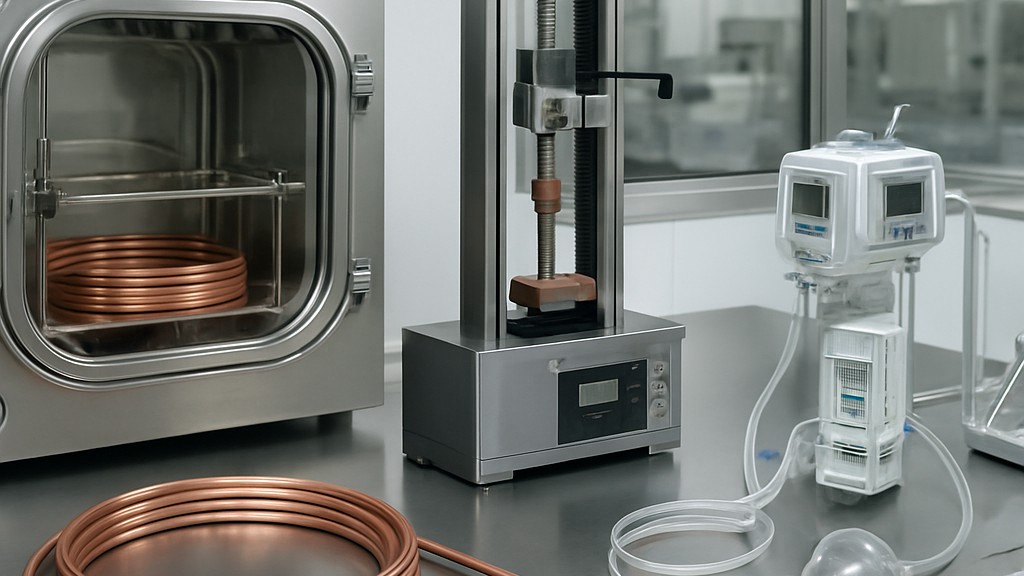
This standard applies to seamless round copper tubes with an outside diameter of 6 mm to 219 mm inclusive and used for vacuum piping systems or for the distribution of the following medical gases intended for use at working pressures up to 2.000 kPa:
- Oxygen, nitrous oxide, nitrogen, helium, carbon dioxide, xenon
- medical air
- Special mixtures of the above mentioned gases
- Air for operating surgical instruments
- Anesthetic gases and vapors
For the purposes of this standard, the following terms and definitions apply:
- Seamless round copper tube: It is a hollow semi-finished product with a circular cross-section, made of copper, with uniform wall thickness and a continuous circumference at all stages of production.
- Soldering: It is a joining process using filler metal with a liquidus temperature above 450 degrees.
- Average diameter: It is the arithmetic average of the maximum and minimum outer diameters passing through the same cross section of the pipe.
- Deviation from circular form: It is the difference between the maximum and minimum outside diameters measured at any section of the pipe section.
- Deviation from concentricity: It is half the difference between the maximum and minimum wall thicknesses of the same section of the pipe section.
- Production batch: A certain quantity of products in the same form, same material condition and same cross-sectional dimensions produced under uniform conditions during the same production sequence.
- Permanently marked: Marking that remains legible until the end of the installation's lifespan, for example by stamping, engraving or etching.
- Temporarily marked: The state of being marked in a way that remains legible until the facility is put into operation.
EN 13348 is a European standard that specifies the requirements for seamless, round copper tubes used in medical gas and vacuum installations. This standard ensures that copper tubes used in healthcare environments meet high safety, cleanliness, and performance requirements. The tubes covered by this standard are specifically designed for the transport of gases such as oxygen, nitrous oxide, medical air, carbon dioxide, and vacuum.
The EN 13348 standard applies to:
- Seamless copper tubes produced in straight lengths or in coils.
- Pipes used in medical gas supply systems in hospitals, clinics, laboratories and similar medical facilities.
- Pipes carrying non-flammable medical gases, oxygen-enriched air, vacuum or mixtures of these gases.
Due to the sensitive nature of medical gas systems, these copper tubing must meet stringent standards for cleanliness, mechanical strength, and dimensional tolerance.
The EN 13348 standard outlines the following basic criteria for copper pipes:
- Material and composition: The pipes shall be made of deoxidized phosphorus-containing copper (Cu-DHP, CW024A) with high purity and corrosion resistance.
- Dimensions and tolerances: Pipes must meet precise outside diameter and wall thickness tolerances, ensuring uniformity in fittings and connections.
- Mechanical properties: Pipes are tested for tensile strength, elongation, and hardness to ensure they can withstand the required pressure conditions.
- Internal cleanliness: This is one of the most critical elements of the standard. Pipes must be degreased internally and delivered plugged at both ends, free of any residual oil, grease, or particles that could contaminate medical gases or harm patients.
- Marking and traceability: Pipes must be clearly marked with the manufacturer's identity, EN 13348 standard designation and production traceability information.
- Packaging and delivery: Tubes must be delivered clean, dry and sealed, usually with plastic stoppers or caps, to maintain the high level of cleanliness required for medical facilities.
The EN 13348 standard requires manufacturers to:
- Dimension controls
- Pressure test
- Cleaning verification (often includes residue testing to meet stringent limits)
Sensitive applications may require third-party audits to ensure compliance.
The EN 13348 standard is essential because it ensures the safety, cleanliness, and reliability of copper pipes used in medical gas and vacuum systems, which are critical components in hospitals and healthcare facilities. The reasons for this importance are as follows:
- Ensures patient safety: Medical gases such as oxygen, nitrous oxide, and medical air are vital to patient care. Any contamination in copper piping (e.g., oil, grease, particulates) can:
- May cause direct harm to patients if inhaled
- May compromise the purity of gases
- May damage sensitive medical equipment
This standard prevents these risks and ensures internally oil-free and clean pipes.
- Guarantees system reliability: Hospital gas distribution systems must operate faultlessly 24/7. Pipes complying with EN 13348 standard:
- Meets stringent mechanical strength requirements
- Resistant to corrosion and pressure damage
- Reliably compatible with standard connectors and fittings
In this way, it provides a long-lasting and leak-proof system.
- Enables standardization across Europe: The EN 13348 standard creates a uniform specification for all manufacturers and installers in the European Union and other regions that have adopted it. This ensures:
- Simplifies the procurement process
- Ensures compatibility of parts
- Supports regulatory compliance
- Reduces maintenance and downtime: Using appropriate piping minimizes the risk of contamination or mechanical failure, ensuring:
- Less frequent maintenance
- Lower long-term costs
- Less disruption to hospital operations
- Facilitates regulatory and legal compliance: Many national and international health regulations require medical gas systems to use certified materials. EN 13348 certified pipes:
- Meets legal and insurance requirements
- Helps hospitals avoid penalties or deductions for non-compliance
- Protects against installation errors: Requiring clear marking, traceability and packaging (e.g. sealing of ends to exclude contaminants) reduces risks such as:
- Accidental use of non-medical tubing
- Incorrect installation
- Loss of cleanliness before use
Consequently, EN 13348 is not only a technical standard but also a safeguard for human health. It is a vital standard for copper piping used in medical gas systems. It is indispensable in all medical environments, ensuring that copper piping in life-support systems meets the highest standards of cleanliness, durability, and quality. This standard defines stringent requirements to ensure safety, hygiene, and reliability in life-critical applications.
Our organization, which has been supporting businesses across all sectors for years through a wide range of testing, measurement, analysis, and evaluation activities, has a strong team of employees who closely follow global developments in science and technology and are constantly improving themselves. In this context, we also provide testing services in accordance with the EN 13348 Copper and copper alloys - Seamless round copper tubes for medical gases or vacuum.



