

The tear resistance test measures the force required to tear a sample material such as woven or non-woven fabrics and a plastic film or sheet. This test allows the producers to determine the strength of the sample.
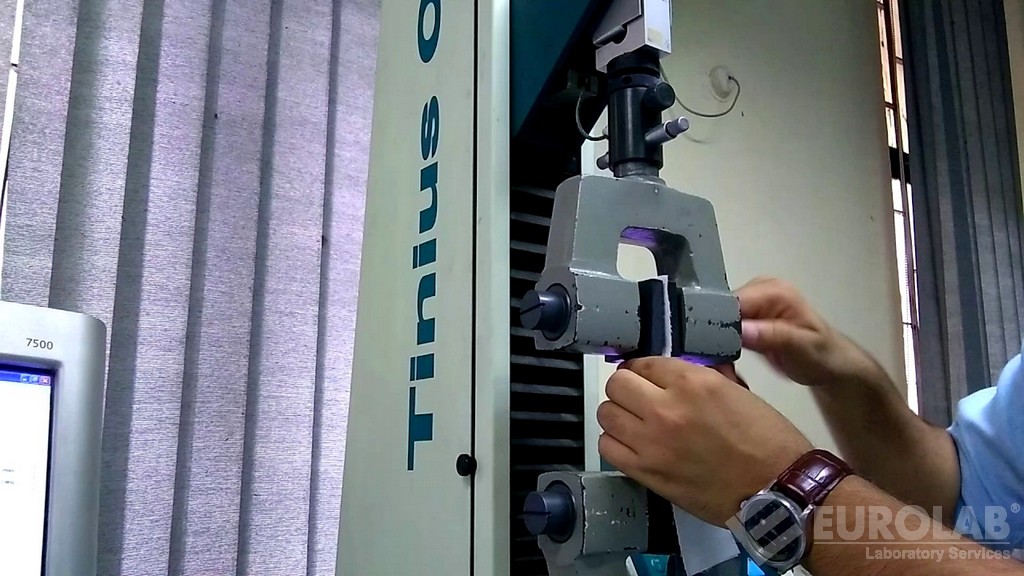
This test complies with the following standards: ASTM D1004 Standard Test Method for Initial Tear Strength of Plastic Films and Coatings and ASTM D5587 Standard Test Method for Tear Strength of Fabrics by Trapezoid procedure. EUROLAB, is an active member of ASTM committees.
The tensile test measures the force required to stretch and break a sample. It is used to determine the strength and elasticity of woven or non-woven fabrics, plastic film or sheets, gloves, condoms and other materials.
Thin plastic films are tested by cutting an inch wide strip. Thickness is measured at three points. Speed and grip distances vary depending on the% elongation of the sample. The samples are drawn until they break, and the rupture factor, tensile strength, breaking strength, elongation and modulus are reported.
Thicker plastics are cut with ASTM D412 mold C. Marks are made at 1 inch intervals and the median of three thickness measurements is used to calculate the cross-sectional area. The instrument is set at a crosshead speed of 20 inches per minute and the sample is placed on the handles. The elongation of the sample is measured between the marks with an extensometer.
Fabric samples are cut up to 4 x 6 inches in both machine and diagonal directions. The instrument is set at 12 inches per minute and the sample is placed on 1 x 1 inch handles. The sample is pulled until it breaks and the breaking force and elongation are measured. Puncture GLU 140 is also used for fabrics and plastic films.
EUROLABtests fabrics according to EN 29073 or ISO 9073 or ASTM D5034 and D5035. Plastics are tested according to ASTM D882, ASTM D638. Fabrics are tested wet or dry. We are an active member of ASTM committees.
For specific tests for surgical gowns and drapes, please see:
Tear resistant
In the tear resistance test, plastic samples are cut using ASTM D1004 C die and the average of various thickness measurements is reported. The instrument is set at a crosshead speed of 2 inches per minute and the sample is placed on the handles. The maximum load in pound force is reported for the sample.
Fabric samples are cut 3 x 6 inches. The instrument is set at 12 inches per minute and the sample is placed on the handles. The maximum load in pound force is reported. Puncture GLU 140 is also used for fabrics and plastic films.
EUROLAB, with its highly expert team and internationally accredited laboratories, Tensile and Tear Resistance Tests for Fabrics It performs all test, analysis, measurement, evaluation and report generation services completely and reliably.
To get an appointment, to get more detailed information or to request an evaluation, you can ask us to fill in our form and reach you.

