EN 1644 Test Methods for Nonwoven Compresses for Medical Use
The European standard “EN 1644 Test methods for nonwoven compresses for medical use” consists of the following sub-sections published under the same title:
- The standard “EN 1644-1 Part 1: Nonwoven fabrics used in the production of compresses” describes the following physical and chemical test methods for evaluating nonwoven fabrics used as compress materials for medical applications:
- Conditioning test method
- Test method for determining liquid absorption time.
- Liquid absorption capacity determination test method
- Test method for determining water-soluble substances.
- Fluorescence determination test method
- Test method for determining acidity or alkalinity.
- Test method for determining water-soluble substances.
- Test method for determining surfactants.
The EN 1644-1 standard outlines test methods for nonwoven fabrics used in medical compresses (such as gauze and wound dressings). This standard specifically focuses on nonwoven fabrics, which are widely used due to their softness, absorbency, and cost-effectiveness.
The primary objective of the EN 1644-1 standard is to ensure that nonwoven fabrics used in compresses meet the performance, safety, and quality requirements for medical use. Because these materials come into direct contact with wounds, their properties must be rigorously controlled.
This standard is for nonwoven fabrics used in the following areas:
- Medical compresses
- wound dressings
- Surgical pads
This standard defines test methods, not product specifications; that is, it specifies how to test, not the acceptance limits. This standard includes methods for evaluating various critical characteristics:
- Absorbency: Measures how quickly and how much fluid a compress can absorb. Important for wound care and fluid management.
- Tensile strength: Determines resistance to tearing or breaking during use. Important for safe handling and application.
- Fiber shedding (lining): Evaluates the release of fibers from the material. It is critical for preventing wound contamination.
- Softness and flexibility: Ensures patient comfort. Reduces irritation upon contact with the skin.
- Cleanliness and purity: Controls contaminants or residues. Essential for sterile or hygienic applications.
Typical procedures in the EN 1644-1 standard include:
- Conditioning of samples under controlled temperature and humidity.
- Using standardized equipment for reproducible results.
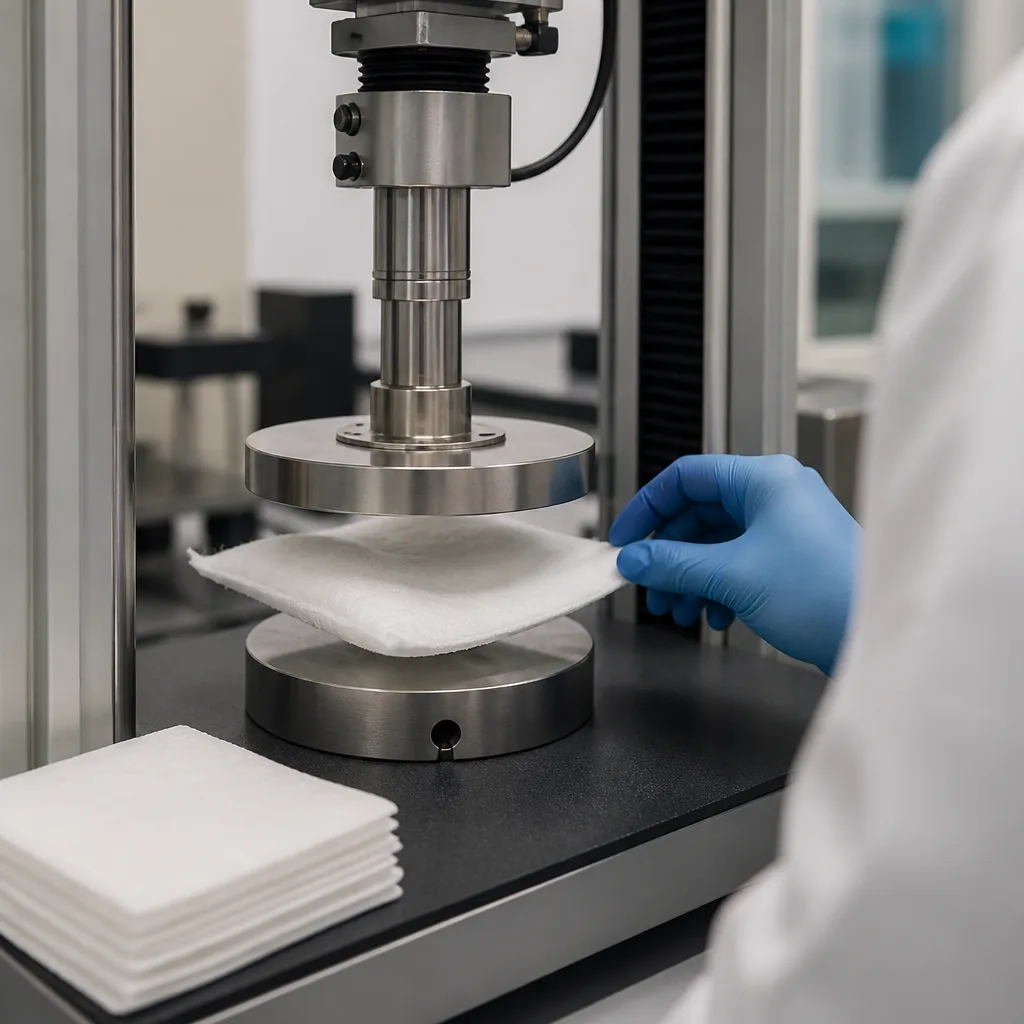
- Performing mechanical and physical tests under defined loads and conditions.
These methods ensure consistency between laboratories and manufacturers.
The EN 1644-1 standard is considered important for the following reasons:
- Patient safety: Non-woven compresses are applied directly to wounds. This standard ensures the following:
- The risk of infection should be minimal.
- Absence of harmful fiber release.
- Reliable absorption of liquids.
- Product quality and consistency: Manufacturers can do the following:
- To maintain uniform production quality.
- Verifying raw materials and processes.
- Regulatory compliance: This standard helps meet the following requirements:
- Medical device regulations in Europe
- CE marking processes
- Industrial standardization provides a common framework for:
- Testing laboratories
- Healthcare product manufacturers
Nonwoven materials are preferred for the following reasons:
- They have high absorbency.
- They don't dissolve like woven gauze.
- They can be designed for specific medical functions.
- They are cost-effective and disposable.
In conclusion, the EN 1644-1 standard is a critical standard for ensuring that nonwoven materials used in medical compresses are safe, effective, and reliable. By defining consistent testing methods, it supports high-quality healthcare products and protects patient well-being.
- The standard “EN 1644-2 Part 2: Finished compresses” describes the physical and chemical test methods for evaluating finished nonwoven compresses:
- Absorbent capacity test method
- Structural strength testing method
- Burst strength test method (dry and wet)
- Compatibility test method
- Wet hair shedding test method
- Dry lint test method
- Conditioning test method
While the EN 1644-1 standard focuses on raw nonwoven materials, the EN 1644-2 standard addresses the testing of pre-made compresses, which are final medicinal products ready for clinical use.
The primary purpose of this standard is to define standardized testing methods for evaluating the performance and quality of finished medical compresses to ensure they are safe and effective when applied to patients. These compresses are typically used for:
- Wound cleaning
- Exudate absorption
- Protecting the injured tissue.
- Surgical procedures
The EN 1644-2 standard applies to:
- Sterile and non-sterile compresses
- Finished products made from the following materials:
- Nonwoven materials
- Gauze or combination structures
Unlike the EN 1644-1 standard, which tests raw materials, the EN 1644-2 standard evaluates the entire product, including its structure and final performance. The key characteristics evaluated are:
- Absorption capacity and speed: Measures how much fluid the compress can absorb and how quickly it absorbs it. This is critical for wound management and preventing leakage.
- Dimensional stability: Ensures the compress maintains its size and shape during use. This is important for consistent wound closure.
- Tensile strength and integrity: Evaluates resistance to tearing or deformation. Ensures the compress does not disintegrate during use.
- Fiber release (lining): Evaluates the tendency for fiber shedding. Minimizes the risk of contamination in wounds.
- Edge finishing and construction: Checks whether edges are secure (e.g., folded or sealed). Prevents fraying and loose fibers.
- Cleanliness and hygiene: Ensures the absence of contaminants. This is especially critical for sterile compresses.
The EN 1644-2 standard uses the following:
- Controlled environmental conditions (temperature, humidity)
- Standardized sample preparation.
- Mechanical and absorption testing techniques
The focus is on real-world performance simulating how compresses behave during actual medical use.
The EN 1644-2 standard is considered important for the following reasons:
- Patient safety: Since the finished compresses come into direct contact with the wounds, the standard ensures the following:
- No harmful fiber shedding.
- Sufficient fluid absorption
- Structural integrity during use
- Product reliability: Manufacturers can guarantee the following:
- Consistent product performance
- Compliance with health expectations.
- Regulatory compliance: Supports compliance with:
- European medical device regulations
- CE marking requirements
- Quality assurance in production: It provides a framework for:
- Routine quality control
- Product verification before market launch.
The EN 1644-1 standard tests raw nonwoven materials, while the EN 1644-2 standard tests the finished compressed product. Together, they ensure quality throughout the entire production chain, from raw materials to the final medical device.
In conclusion, the EN 1644-2 standard is essential to verify that finished medical compresses meet stringent performance and safety requirements. By standardizing testing methods for the end product, it plays a vital role in protecting patients, supporting regulatory compliance, and ensuring consistent product quality in healthcare applications.
For many years, our organization, with its competent and experienced staff, has been understanding the needs of its clients, providing the advanced testing services they require, and assisting them in the establishment, implementation, and improvement of management systems. Within this framework, we also provide testing services in accordance with the EN 1644 standard.