

The “AECTP 300 Method 309 Salt spray test” standard, developed by NATO under the Allied Environmental Conditions and Test Publication (AECTP), describes a test method designed to provide repeatable conditions for determining the relative resistance of a material to the effects of an aqueous salt atmosphere.
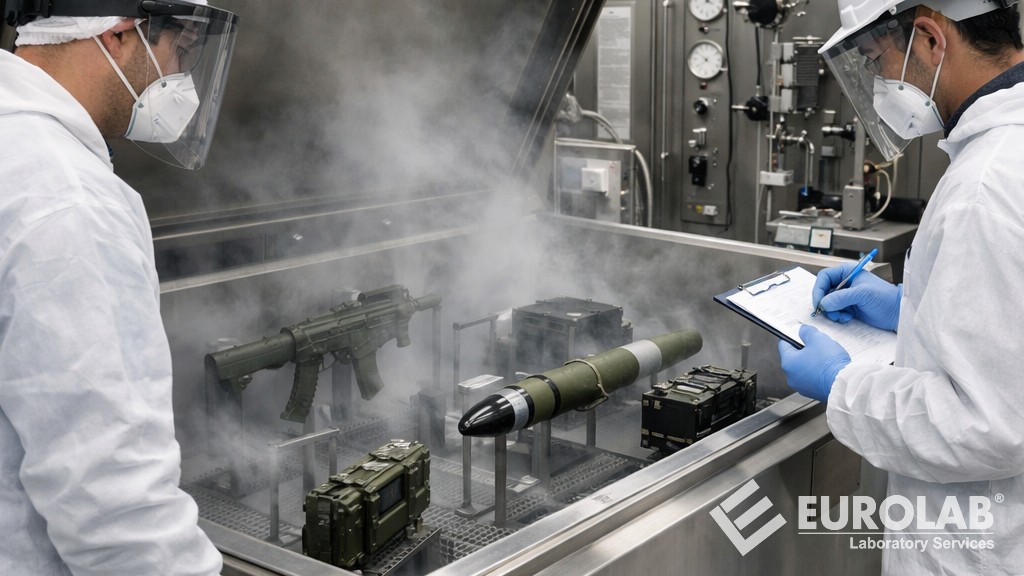
All military equipment is exposed to some type of salt throughout its service life, which can affect its performance. The fundamental value of the proposed test procedure lies in testing coatings and surface treatments on the materials. This procedure can also be used to identify potential design issues, such as incompatible materials.
However, this testing method has limitations regarding the simulation of real-life conditions, and successful completion of the test does not guarantee that specific material components will satisfactorily withstand all saline conditions they may be exposed to in service. In particular, the procedure does not replicate all the effects of the marine atmosphere, and a direct correlation between salt spray corrosion and corrosion occurring in the natural environment has not been demonstrated. Since there is no quantitative correlation between the time spent inside the chamber and the time spent in the field, this test has proven generally unreliable for predicting the service life of different materials or coatings.
This test is not a substitute for evaluating moisture and fungal corrosion because their effects differ from those of salt spray, and this test is not designed to test component parts and material samples such as bolts, wires, transistors, and integrated circuits.
In general, the AECTP 300 series of standards includes climatic environmental testing methods for defense equipment. These standards provide standardized methods for simulating harsh natural conditions, ensuring military equipment performs reliably in global deployments. Method 309 specifically addresses salt spray (salt vapor or salt spray) testing.
AECTP 300 Method 309 evaluates the effects of aqueous salt atmospheres on materials, coatings, and surfaces. It simulates corrosive salt environments such as those encountered in marine operations, coastal areas, or areas with high salinity due to sea spray. The test accelerates corrosion to identify weak points in design, protective coatings, or material selection that could lead to degradation in real-world use.
This method is particularly important for military equipment exposed to oceanic or coastal environments, where salt can cause rapid electrochemical corrosion in metals, degrade paints and seals, or affect electronic components.
The primary objectives of Method 309 are as follows:
This method is commonly used for coatings found in vehicles, aircraft, ships, weapon systems, and electronic devices. Unlike natural exposure, this test accelerates corrosion in a controlled chamber, allowing for faster evaluation without waiting for years of field degradation.
This testing method involves placing the item to be tested in a special salt mist chamber, where a fine mist of saline solution (typically 5 percent sodium chloride) is continuously sprayed at a controlled temperature (approximately 35 degrees). Exposure times vary depending on the expected lifespan and severity category of the equipment, typically ranging from days to weeks; cycles also include drying times to increase realism.
The basic parameters are:
Following exposure, items are inspected for corrosion, pitting, blistering, or functional degradation.
AECTP 300 Method 309 is compatible with the standards “IEC 60068-2-11 Environmental tests - Part 2-11: Tests - Test Ka: Salt mist” and “IEC 60068-2-52 Environmental tests - Part 2-52: Tests - Test Kb: Salt mist, cyclic (sodium chloride solution)”, but has been adapted to NATO defense needs. This standard is used in conjunction with other AECTP 300 methods (e.g., Method 310 for rain, Method 313 for sand/dust) and the broader series (AECTP 100 for planning, AECTP 200 for environmental definitions).
Limitations include the inability of laboratory tests to fully replicate synergistic natural effects (e.g., combined with UV or vibration). Therefore, results offer a degree of confidence rather than an absolute prediction.
In short, AECTP 300 Method 309 is a critical tool for ensuring that NATO military equipment can withstand corrosive salt environments, enhancing reliability and longevity in challenging operational areas. This standard is a cornerstone of NATO's environmental testing framework and is specifically designed to simulate corrosive salt-laden atmospheres. Its importance stems from the real-world challenges military equipment faces in maritime, coastal, and shore operations, where salt exposure accelerates degradation.
This standard is considered important for the following reasons:
For many years, our organization, with its competent and experienced staff, has been understanding the needs of its clients, providing the advanced testing services they require, and assisting them in the establishment, implementation, and improvement of management systems. Within this framework, we also provide testing services to businesses in accordance with the "AECTP 300 Method 309 Salt spray test" standard.
To get an appointment, to get more detailed information or to request an evaluation, you can ask us to fill in our form and reach you.

