

The "MIL-STD-1275E Department of Defense Interface Standard: Specifications for 28-Volt DC Electrical Systems in Military Vehicles" standard, developed by the U.S. Department of Defense, describes the operating voltage limits and transient voltage characteristics of 28-volt DC electrical power at the input power terminals of equipment connected to the electrical power distribution system in military land vehicle platforms.
The general requirements in this standard are stated as follows:
In the world of demanding military operations where land vehicles navigate challenging environments from scorching deserts to freezing tundras, reliable electric power is indispensable. Electronic systems powering communications, navigation, weapons, and sensors must withstand not only the rigors of combat but also the unpredictable electrical transitions inherent in vehicle power systems. This standard ensures interoperability and robustness across all platforms, from tanks and armored personnel carriers to logistics trucks.
This standard does not specify power sources or entire systems, but focuses on the input terminals of operational equipment—any electronic device, subsystem, or assembly directly connected to the vehicle's 28-volt DC distribution network. By standardizing these interfaces, it minimizes the risks of component failure, performance degradation, and operational disruption.
The MIL-STD-1275 standard essentially specifies the electrical environment that equipment must tolerate and not degrade. This includes steady-state voltages, transient currents, surges, fluctuations, and surges resulting from events such as engine starting, alternator discharges, or firearm discharges. Equipment must operate without degradation under these conditions, and emissions must remain within limits.
The value of the MIL-STD-1275 standard lies in its promotion of platform-independent designs. A single electronic module (such as a ruggedized radio or fire control system) can be fitted to various vehicles without requiring redesign, reducing logistics costs and accelerating deployment. In the age of networked warfare, where vehicles are integrated with AI-powered sensors and electric propulsion systems, unreliable power can lead to system-wide failures.
Ensuring compliance with the MIL-STD-1275 standard includes the following:
As military vehicles become electrified (such as autonomous drones or fully electric tanks), the MIL-STD-1275 standard will likely be extended to 600-volt DC systems or cybersecurity integrated for power lines. For now, it continues to form the basis of reliability by guaranteeing uninterrupted power supply when the mission requires it.
In short, this standard is a safety measure that transforms chaotic electrical environments into predictable ones for soldiers.
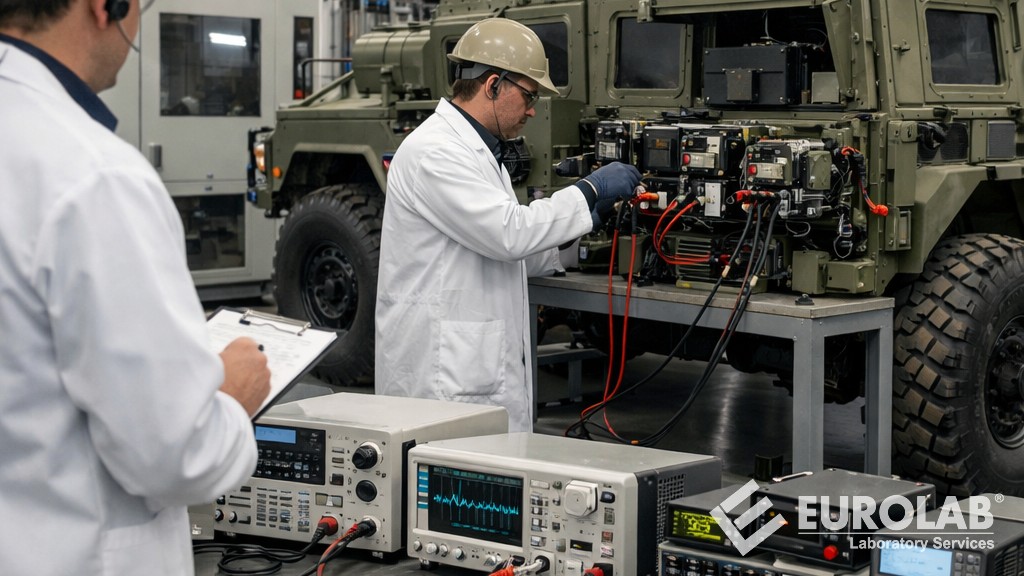
MIL-STD-1275 standard test methods focus on verifying equipment performance under the electrical conditions specified in the standard. These conditions include steady-state voltage limits, voltage surges, surges, load discharges, motor starting, and ripple. Tests are performed at the input terminals of the equipment to ensure that the equipment can operate within the defined electrical environment and not cause excessive disturbances to the power bus. Tests are typically conducted in controlled laboratory environments using specialized equipment such as transient generators, oscilloscopes, and ambient chambers to simulate operational extremes.
The main objectives of testing methods are:
Each test method involves applying specific waveforms, durations, and conditions while monitoring equipment performance. The main tests performed under this standard are:
For many years, our organization, with its competent and experienced staff, has been understanding the needs of its clients, providing the advanced testing services they require, and assisting in the establishment, implementation, and improvement of management systems. Within this framework, we also provide testing services to businesses in accordance with the "MIL-STD-1275E Department of Defense interface standard: Specifications for 28-volt DC electrical systems in military vehicles" standard.
To get an appointment, to get more detailed information or to request an evaluation, you can ask us to fill in our form and reach you.

