Low Temperature Test (Military and Industrial Products)
Low temperature testing is performed to evaluate the material's low temperature bending, brittleness, compression, retraction, torsional stiffness, and Young's modulus at low temperatures. Most of these tests are performed at temperatures of minus 40 degrees Celsius or below, depending on the specification. A specific test, the low-temperature pullback test, allows rapid measurement of the crystallization effects of materials.
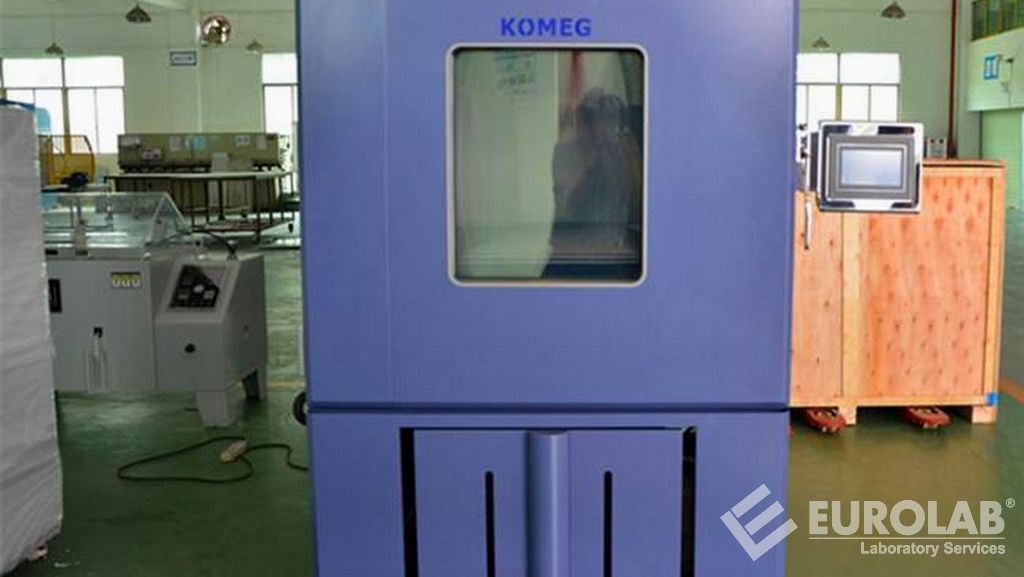
The main international standards based on low temperature tests are:
- ASTM D2137-11 Standard test methods for rubber property - Point of brittleness of flexible polymers and coated fabrics. These test methods It covers the determination of the lowest temperature at which rubber vulcanized and rubber-coated fabrics will not show breakage or coating cracks when subjected to specified impact conditions.
- ASTM D746-20 Standard test method for the brittle temperature of plastics and elastomers on impact. This test method involves determining the temperature at which plastics and elastomers exhibit brittle deterioration under specified impact conditions. It also offers two routine inspection and admission procedures.
- ASTM D1229-03 Standard test method for rubber property - Compression set at low temperatures. This test method involves evaluating the ability of vulcanized rubbers, which are compressed at room temperature and then exposed to a low temperature (air or carbon dioxide atmosphere), to recover from deformation when removed from the clamping device while still at low temperature.
- ISO 812 Rubber, vulcanized or thermoplastic - Determination of low temperature brittleness. This standard defines a test method for determining the lowest temperature at which rubber materials do not exhibit brittle deterioration, or the temperature at which, under certain conditions, half of the test pieces used in a test fail upon impact.
- ASTM D380-94 Standard test methods for rubber hose. These test methods cover procedures for the inspection and testing of rubber hose of all types and structures. In case of conflict between the merits of these test methods and the merits of detailed specifications or test methods for a particular hose, the latter takes precedence.
- ASTM D1329-16 Standard test method for evaluating rubber property - Retraction at low temperatures (TR test). This test method includes a temperature withdrawal procedure for rapid evaluation of crystallization effects and comparison of viscoelastic properties of rubber and rubber-like materials at low temperatures. This test method is useful when used in conjunction with other low temperature tests in selecting materials suitable for low temperature service.
- ASTM D2240-00 Standard test method for rubber property - Durometer hardness. This test method identifies eight types of rubber hardness testers known as durometers: types A, B, C, D, DO, O, OO, and M. The procedure for determining the indentation hardness of substances classified as thermoplastic elastomers, vulcanized (thermoset) rubber, elastomeric materials, cellular materials and some plastics is also described. This test method is not applicable for testing coated fabrics.
- ASTM D1053-92a Standard test methods for rubber property - Low temperature curing: flexible polymers and coated fabrics. These test methods describe the use of a torsion apparatus to measure the relatively low temperature curing of flexible polymeric materials and fabrics coated with them. A routine inspection and acceptance procedure to be used as a pass-fail test at a given temperature is also described. These test methods provide comparative data for evaluating the low temperature performance of flexible polymers and fabrics coated with them.
Military equipment is tested according to MIL-STD-810G Method 502.5, a United States military defense standard. This standard provides a test method developed to evaluate the effects of low-temperature conditions on material safety, integrity, and performance. Materials or equipment that must be used in a low-temperature environment for their lifespan, such as computers and LCD screens to be used in low-temperature regions, are evaluated according to this test method. The most common problems include: failure of the boot system to load, hardening of assembly parts, drive failure, drive failure, changes in the electrical properties of electronic components, connection failure in integrated circuits, cracking due to differential expansion, cracking of surface coatings, and LCD screen malfunction due to stagnant or frozen liquid crystal material.
Among the numerous tests, measurements, analyses, and evaluations our organization provides for businesses in various sectors, we also offer low-temperature testing services for military and industrial products, thanks to our trained and expert staff and advanced technological equipment .



