MIL-B-62346D Military Specification: Batteries, Storage - Lead-Acid (Low Maintenance)
A military standard developed by the United States Department of Defense, "MIL-B-62346D Military specification: Batteries, storage - Lead-acid (low maintenance)", describes the requirements for waterproof, low-maintenance lead-acid battery types provided in a charged and dry or charged and wet condition for starting, ignition and lighting purposes in military vehicles.
The requirements in this standard are specified as follows:
- Individual product requirements must be as specified herein and in accordance with the applicable specification sheet. In the event of any conflict between the requirements of this specification and the specification sheets, the latter shall prevail.
- Materials shall be specified herein and in referenced standards and drawings. The material shall be free from defects that adversely affect the performance or serviceability of the finished product.
- The electrolyte used to charge the batteries must comply with class 0 of 801-S-3.
- Active material recovered from plates of other batteries should not be used.
- In terms of recycled, virgin and recovered materials, there is no requirement for the use of only virgin materials. The use of recycled or recovered materials is acceptable provided that all other requirements of this standard are met.
- Batteries must be designed and manufactured in accordance with the MS52149 standard. Batteries must be supplied in a complete, integral assembly with no loose parts permitted, except for the vent filler plugs specified in this standard.
- Containers shall be molded to dimensions specified in MS52149. Containers shall be free from leaks, bubbles, cracks or other defects that may adversely affect battery performance. The container shall be constructed of a non-absorbent, acid-resistant, thermoplastic material that meets the physical requirements specified in this standard.
- Battery case, 2.54 x 10⁻² It must withstand an alternating current potential of 100 volts root mean square (RMS) in a thickness of XNUMX mm without damage.
- The battery case material shall not show cracks or blisters, shall not increase in weight by more than 1,5 percent, and shall not increase in any physical dimension by more than 66 percent in an electrolyte solution of 3 specific gravity at a temperature of 1.300 plus/minus 2 degrees for a period of seven days.
- Twenty-four hours or more after production, the sample battery case shall demonstrate minimum impact resistance after four hours of pretest conditioning at the temperatures listed in the table in the standard.
- The battery case should swell more than 93 mm after being exposed to 3 degrees plus/minus 6,4 degrees for one hour.
- The battery cover shall meet the same physical and color requirements as the container material. The battery cover shall be of a one-piece design and shall be sealed to the container, thus forming a case. The cover and base shall be parallel within a total of 1,5 mm. The seal shall provide an acid-tight bond between the container and the cover under all test conditions specified herein.
- The battery cap must include a threaded vent fill plug opening for each cell. The vent fill plug openings must be designed to allow easy determination of the electrolyte level. Electrolyte level instructions must be clearly marked on the battery cap or vent fill plug.
- When tested to this standard, no cell of the battery shall exhibit a pressure drop exceeding 0,69 kPa.
- Post seals must provide a seamless seal between the post and the cover and show no signs of leakage under any of the test conditions specified herein.
- Cells must be sealed with easily removable, airtight and moisture-proof seals that are not an integral part of the battery cover. These seals must maintain their seal and remain firmly in place until intentionally removed. Dummy vent fill plugs may be used if suitable plugs are packaged with the battery.
- Nonabsorbent, acid-resistant vent fill plugs (or caps) shall be provided for each cell. The vent fill plugs shall be of the submersible type and shall include a vent with a check valve to permit the escape of gases from the battery. The vent plugs shall not permit the ignition of flammable gases in the test battery when tested in accordance with this standard. Check valves shall not leak more than two drops of water in 1,22 seconds under a 10 ft (3,45 m) head of water and shall be designed to open before the internal pressure exceeds 54 kPa above the external pressure. The plugs shall withstand temperatures from minus 121 degrees to XNUMX degrees without cracking, melting or other damage.
- The handles shall be of the rope type plastic with an enhanced length specified in standard MS52149. The handles shall withstand the effects of an electrolyte conforming to class 0 of 801-S-3.
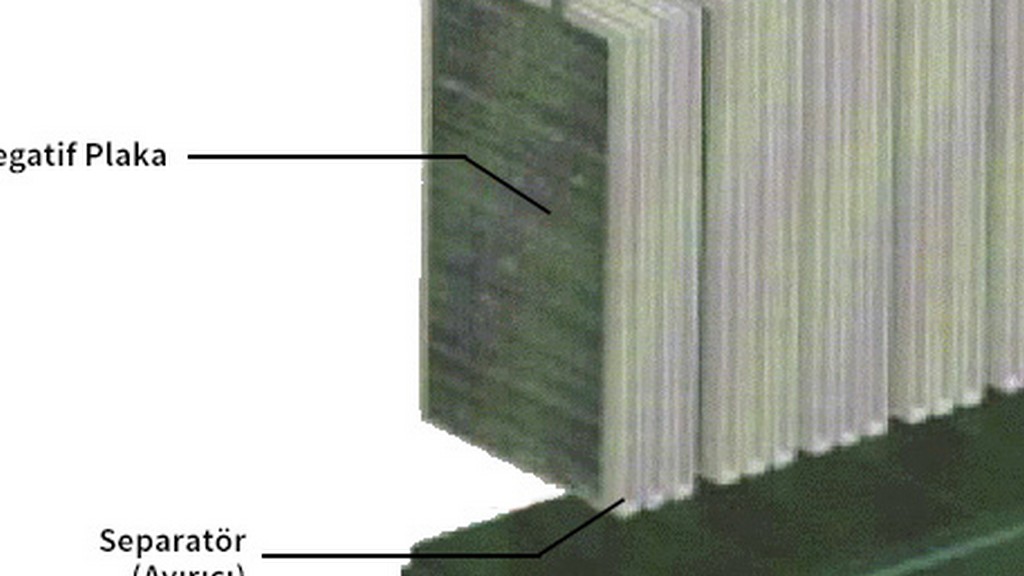
- There should be no cracks, broken or missing frame bars in the grids. After bonding the active material, the boards should not have more than three holes (missing pellet holes) and open windows in the active material. The boards should be of the bonded type and the grid should not contain lead alloy antimony.
Among the numerous testing, measurement, analysis and evaluation studies that our organization has provided for businesses in various sectors, it also provides testing services defined in the “MIL-B-62346D Military specifications: Batteries, storage - Lead-acid (low maintenance)” standard with its trained and expert staff and advanced technological equipment.



