

Developed by the American National Standards Institute (ANSI), the standard "ANSI C57.12.55 American national standard for transformers - Used in unit installations, including unit substations - Compliance standard" describes specific electrical, mechanical and safety requirements and compliance tests for dry-type distribution and power transformers and autotransformers.
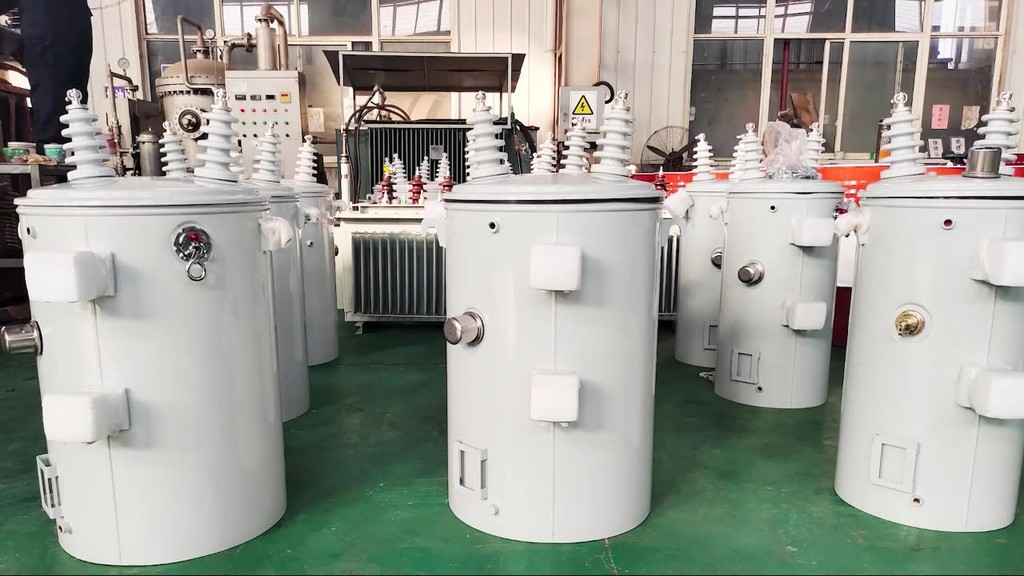
These transformers may be single-phase or polyphase, with ventilated, non-ventilated, or metered enclosures. Such transformers may be remotely or integrally associated with primary or secondary switchgear or substations, or both. The transformers range from 601 Volts to 34500 Volts (primary or secondary) in sizes from 1 kVA to 2,500 kVA. Such transformers are intended to be installed in accordance with the ANSI/NFPA 70 National Electrical Code (standard).
All manufacturers seeking certification under this standard must demonstrate that the performance requirements have been met by performing the tests specified herein, submitting data from previous tests, providing evidence of satisfactory field service, or using a suitable combination of these methods. Families of insulation systems may be certified based on tests performed on a single representative model.
This standard is valid for all dry-type transformers except:
This standard excludes transformers that are under the exclusive control of electricity distribution companies and used for communication, measurement, generation, control, transformation, transmission and distribution of electric energy, regardless of whether such transformers are located indoors in buildings and rooms used exclusively by public utilities for these purposes, or on privately owned or leased property, on privately established rights of ownership, or on public roads (highways, streets, roads, etc.).
Requirements for dry-type transformers used in unit substations or pad-mounted transformers must comply with ANSI C57.12.01 and ANSI C57.12.91. The recommended procedure for thermal evaluation of the insulation system is contained in ANSI C57.12.56.
An enclosure is a containment case or enclosure used to provide some protection to conductors or equipment and to provide some protection to persons from contact with live parts.
The categories of indoor and outdoor enclosures should be as follows:
These enclosures must meet the requirements given for Category A enclosures in the table titled “Requirements for Category A, B and C enclosures” given in the standard.
These enclosures must meet the requirements given for Category B enclosures in the table titled “Requirements for Category A, B and C enclosures” given in the standard.
These enclosures must meet the requirements given for Category C enclosures in the table titled “Requirements for Category A, B and C enclosures” given in the standard.
In the world of electrical distribution, safety, reliability, and performance are paramount. The ANSI C57.12.55 standard plays a key role in ensuring these factors for pad-mounted distribution transformers, a critical equipment category. This standard outlines specific requirements for these transformers, focusing specifically on enclosure integrity and ability to withstand environmental conditions.
This standard specifies test procedures and performance criteria for enclosures of single-phase and three-phase pad-mount transformers and other related pad-mount electrical equipment used in medium-voltage distribution systems (typically 5–38 kV). This standard is applicable to transformers installed outdoors at ground level, typically in residential, commercial, or light industrial areas where underground power distribution is common.
The primary objective of this standard is to ensure that pad-mounted transformer enclosures:
To achieve these goals, this standard defines rigorous testing procedures for environmental durability and mechanical durability. The main test methods are:
Utilities and electric cooperatives rely on this standard to:
Consequently, the ANSI C57.12.55 standard plays a vital role in ensuring the safety and reliability of pad-mounted distribution transformers through rigorous testing of enclosures. Compliance with this standard is essential for manufacturers and utilities seeking to deliver high-performance, long-life equipment that meets the needs of their power distribution networks.
Our organization, which has been supporting businesses across all sectors for years through a wide range of testing, measurement, analysis, and evaluation activities, boasts a strong team of employees who closely follow global developments in science and technology and are constantly improving themselves. In this context, we also provide testing services in accordance with the "ANSI C57.12.55 American National Standard for Transformers - Standard for Use in Unit Installations, Including Unit Substations - Conformity."
To get an appointment, to get more detailed information or to request an evaluation, you can ask us to fill in our form and reach you.

