EN 13101 Steps for Underground Personnel Entrance Rooms - Requirements, Marking, Testing and Conformity Assessment
A European standard, "EN 13101 Steps for underground personnel entry rooms - Requirements, marking, testing and conformity assessment", describes the general requirements and test methods for steps manufactured from cast iron, steel or aluminium for use as a means of access in manholes and other underground human entry rooms.
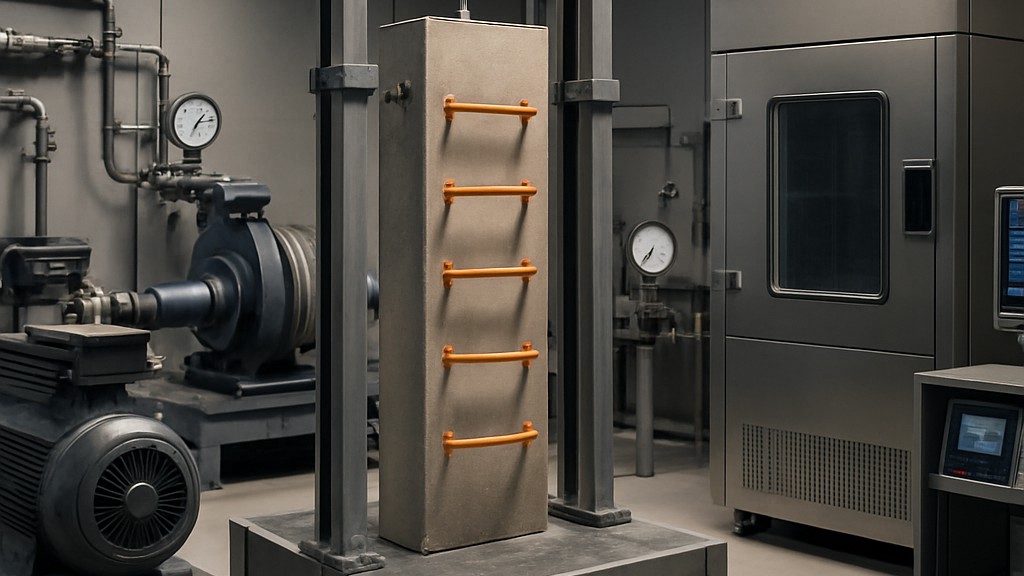
This standard specifies performance criteria for mechanical stability and resistance to fall protection. These include relevant test methods and conformity assessment. The steps specified in this standard are suitable for use in sewage, surface water, and drinking water environments, subject to the requirements of national regulations. Additional protection may be required if the steps are used in particularly corrosive environments, such as industrial wastewater. This standard does not apply to moulded steps in prefabricated manholes made of the same material.
For the purposes of this standard, the following terms and definitions apply:
- Step: It is a component that can be fixed or connected to the wall of an underground human entrance room or manhole, facilitating safe entry and exit.
- Single step: A step designed to support a single foot or hand and intended to be assembled in stages with other steps.
- Double step: A step designed to support two feet or two hands side by side and intended to be mounted in a single vertical alignment with other steps.
- Replaceable step: It is a step designed to be removed and replaced.
- Step: The upper surface of the step for the foot or hand.
- Plastic coating: Polymeric material that provides protection to a metal core.
- Foot distance: The horizontal distance from the vertical face of the manhole or other room to the front of the step after fixing.
- Post: The raised part of the step designed to prevent the foot from sliding laterally off the edge of the step.
The requirements have been determined as follows:
- Treads must comply with the requirements of this clause. Where a fixing system is provided as part of the tread, the system must comply with the requirements of this standard. Treads must be installed in accordance with the manufacturer's instructions. National regulations for the installation of treads must be followed.
- The steps must be manufactured from the following metals:
- Aluminium alloys according to EN 573-3 standard
- Malleable cast iron conforming to EN 1562 standard
- Ductile cast iron with spheroidal graphite conforming to EN 1563 standard
- Flake graphite (grey) cast iron conforming to EN 1561 standard.
- Steel conforming to EN 10025 or ENV 10080 standards
- Austenitic stainless steel conforming to EN 10088-1 or EN 10088-3 standards
Good quality should be used, especially for corrosive environments. Recommendations should be sought from the step manufacturer.
- The material for encapsulating steps in plastics should be polyethylene or an equivalent quality polypropylene copolymer with a minimum density of 0,935 g/cm3 (compliant with ISO 1183). If encapsulated steps are to be installed or stored in a location where they will be exposed to direct sunlight for extended periods, they should be protected from the degrading effects of ultraviolet light. This can be achieved by using suitable pigments or stabilizers. The step manufacturer should be consulted.
- The steps must be one of the following types:
- Type A: Circular step without patterned surface and tread
- Type B: Circular step with tread, without patterned surface
- Type C: Any shaped step with a patterned surface and no tread
- Type D: Any shaped step with a tread and a patterned surface.
A device for attaching handrails or safety devices is permitted on steps. The purpose of the patterned surface is to provide some additional resistance to foot slippage. Any patterned surface design, such as ribbed or squared patterns, is at the discretion of the step manufacturer.
- The steps must comply with the relevant dimensions given in this standard and the dimensions and tolerances declared by the manufacturer and must be measured to the nearest 0,1 mm.
- Cast iron steps must have a minimum section thickness of 5 mm at any point. Plastic encapsulation must have a minimum plastic thickness of 2,5 mm at any point.
- Step width should be 20 mm. Step length should be 145 mm for single steps and 250 mm for double steps.
- The minimum stopping distance must be 120 mm.
- For type B and type D single and double digits, the following applies:
- Single steps must have a protrusion at each end of the step, between 5 mm and 20 mm high and at least 25 mm long, which should act as a boot stopper.
- Double steps must have a protrusion of at least 20 mm in height when measured within 70 mm of the front of the step and between 25 mm and 100 mm at each end of the step, which must act as a boot stopper.
- The limit of a step's placement on a partition wall must be clearly indicated on the step by a single section change or additional information, except when factory-fixed to a precast concrete unit. If the limit of placement on the step is not specified, the manufacturer must specify the placement length used in this standard in their technical literature.
- Steps must not have any visible defects, protrusions or sharp edges.
- The steps must be resistant to corrosion, which will be ensured by the properties of the metal used in production, surface treatment or plastic encapsulation.
- Steel steps:
- Mild steel and non-austenitic stainless steel steps must be protected from corrosion by hot dip galvanising or plastic encapsulation in accordance with EN ISO 1461.
- Surface protection is not required for austenitic stainless steels.
- Aluminium steps:
- Aluminium steps must be provided without additional protection (i.e. bare metal) or with plastic encapsulation or anodising in accordance with standards EN 2101 (chromic acid anodising) or EN 2284 (sulphuric acid anodising).
- Aluminium steps must be fitted with plastic fixing tails that completely cover both ends of the step and project into the bowl by at least 20 mm from the vertical mounting surface.
- Cast iron steps:
- Malleable cast iron and ductile (spheroidal graphite) cast iron steps must be protected from corrosion by hot-dip galvanizing or plastic encapsulation in accordance with EN ISO 1461.
- No surface protection is required for grey cast iron (flake graphite) steps.
Our organization, which has been supporting businesses across all sectors for years through a wide range of testing, measurement, analysis, and evaluation activities, has a strong team of employees who closely follow global developments in science and technology and are constantly improving themselves. In this context, we also provide testing services in accordance with the EN 13101 "Stairs for underground personnel entrance rooms - Requirements, marking, testing, and conformity assessment" standard.



