

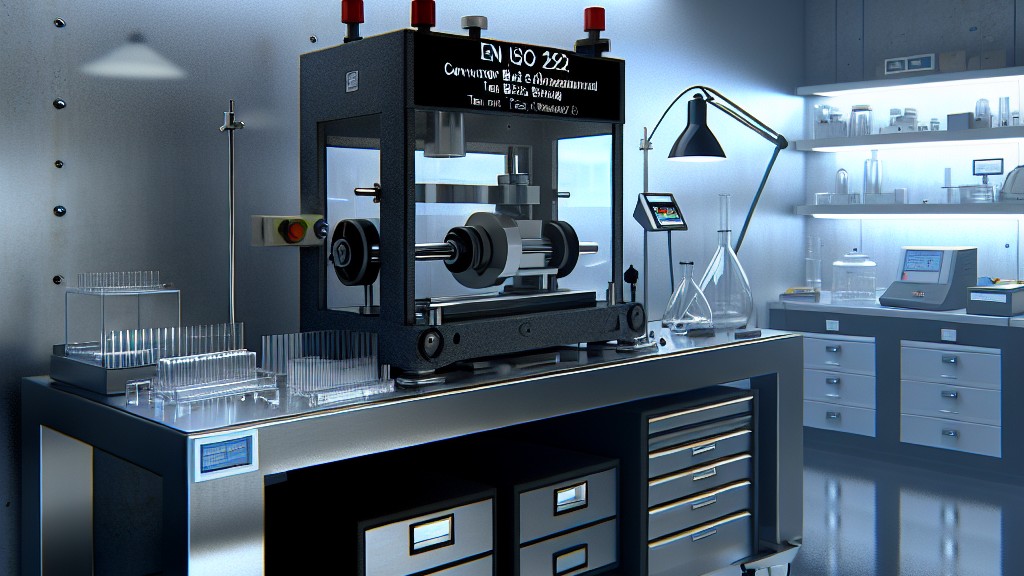
The standard “EN ISO 252 Conveyor belts - Adhesion between structural elements - Test methods”, which is based on a European standard and later published by the International Organization for Standardization (ISO), describes two test methods used to determine the adhesion strength between the structural elements of a conveyor belt, i.e. between layers and between covers and carcass: Method A and Method B. The basic test conditions are in line with the standard “ISO 36:2020 Rubber, vulcanized or thermoplastic - Determination of adhesion to textile fabrics”.
It is applicable to all types of conveyor belt construction except for belts containing steel cord reinforcement and textile reinforced belts with a full thickness tensile strength of less than 160 N/mm. However, these methods are not suitable or applicable for lightweight conveyor belts as described in ISO 21183-1.
Method A and Method B are alternative options, however the average adhesion strength values calculated for the two methods may differ. It is also recommended to seek the advice of the tape manufacturer as both methods may not be equally suitable for all tape structures.
In these tests, the average force required to separate the covers from the carcass and each layer from the next is determined using a constant speed traverse machine.
At the same time, in these tests, a tensile testing machine operating with an appropriate power, in accordance with the ISO 36 standard, should be used.
The time between production and testing shall be at least 16 hours. This time shall also include the conditioning periods described in this standard.
In terms of sample shape and dimensions, each test piece shall consist of a rectangular strip of tape with cleanly cut edges, 25 mm plus/minus 0,5 mm wide and at least 200 mm long. This shall allow a minimum of 100 mm to be peeled off.
For both Method A and Method B, two test pieces in the longitudinal direction shall be used. If agreed between the manufacturer and the purchaser, the test may also be carried out with two transverse test pieces.
Test pieces should be taken from locations at least 100 mm away from the edges of the existing tape sample and as widely spaced as possible.
The test pieces are conditioned in accordance with the ISO 18573 standard in D atmosphere or E atmosphere, and the tests are carried out immediately after completion of the conditioning period.
In applying Method A, at one end of the longitudinal test piece, the top cover is separated from the first layer at a distance suitable for the test grips to be used. The separated ends are secured to the grips of the tensile testing machine and a hand-drawn record is made of the force required to peel off sufficient length to obtain eight or more peak force points at a speed of 100 plus/minus 10 mm/min of the driven grip. The test piece shall be unsupported. This procedure is repeated using the same test piece for each successive layer up to the middle of the test piece. A similar series of tests is carried out on a second longitudinal test piece, but starting with the bottom cover. If testing is to be carried out on transverse test pieces, the test shall be carried out in the same manner. Any separation occurring outside the plane of contact between the two components, for example, inside one of the components under test (for example, a cover), is considered to be a failure of the material forming the component.
In applying Method B, the top cover is separated from the first layer at one end of the longitudinal test piece at a distance suitable to the test grips to be used. The separated ends are secured to the grips of the tensile testing machine and a hand-drawn record is made of the force required to peel off sufficient length to obtain eight or more peak force points at a speed of movement of the driven grip of 100 plus/minus 10 mm/min. The test piece shall be unsupported.
This procedure is repeated using the same test piece, sequentially stripping two unseparated layers from the remainder of the test piece. A similar series of tests is performed on a second longitudinal test piece, but starting by separating the unseparated top cover and the first layer from the second layer. If testing is to be performed on transverse test pieces, the test is performed in the same manner.
Any separation occurring outside the plane of contact between two components, for example inside one of the components under test (e.g. a cover), is considered a rupture of the material constituting the component.
Our organization has a strong staff that closely follows the developments in the world in the field of science and technology and constantly improves itself. Among the numerous test, measurement, analysis and evaluation studies provided for businesses in various sectors, there are also test services in accordance with the "EN ISO 252 Conveyor belts - Adhesion between structural elements - Test methods" standard.
To get an appointment, to get more detailed information or to request an evaluation, you can ask us to fill in our form and reach you.

