

In the standard “ISO 3800 Threaded fasteners - Axial load fatigue testing - Test methods and evaluation of results” published by the International Organization for Standardization (ISO), the conditions for performing axial load fatigue tests on threaded fasteners are explained and recommendations for evaluating the results are given.
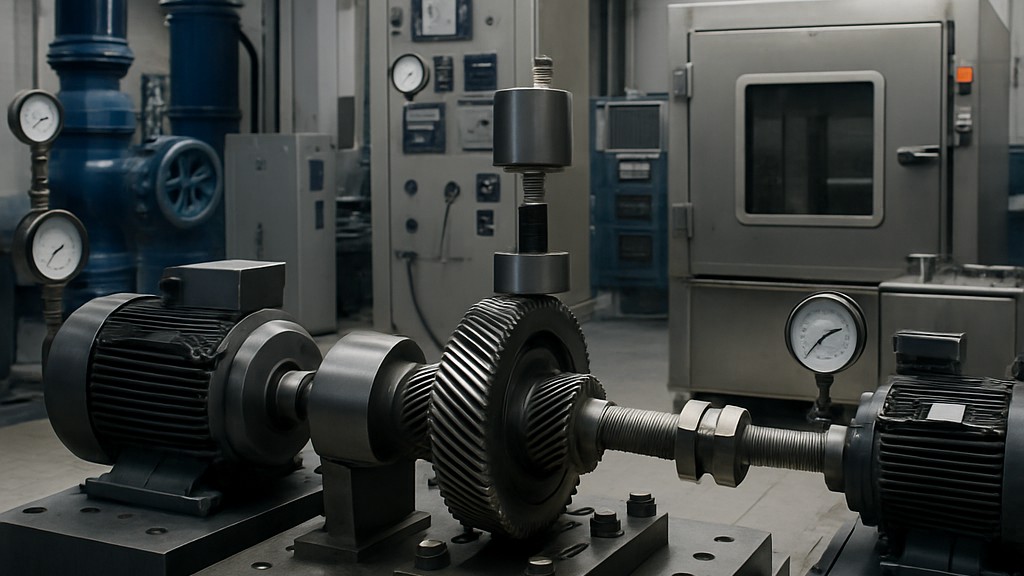
Unless otherwise agreed, tests are of the alternating stress type and are performed at room temperature with the applied load centered along the longitudinal axis of the fastener. The effect of the fit of the clamped parts on the fastener stress is not considered.
This method allows determination of the fatigue strength of threaded fasteners.
Test results can be affected by test conditions. Therefore, this standard specifies minimum requirements to mitigate this effect. Calibration and centering control methods for the test apparatus are also included.
In principle, tests are performed on threaded fasteners to determine fatigue properties, such as the Wohler curve. The threaded fasteners to be tested are mounted in an axial load fatigue testing machine and subjected to fluctuating tensile loading.
Constant average stress is often used to determine indefinite life. Constant stress ratio is often used for quality acceptance testing.
The test continues until the test piece fails or a predetermined number of stress cycles are exceeded. The number of test cycles is generally determined by the material or the endurance fatigue strength of the test specimen. Unless otherwise specified, failure is defined as the complete separation of the fastener into two pieces.
The testing machine used in these tests is equipped with a device that automatically maintains loads within 2 percent of the required values throughout the test and counts and records the total number of cycles per test. To ensure this accuracy, the testing machine is calibrated periodically. The testing frequency range should be between 4,2 Hz and 250 Hz. The testing machine generates a sinusoidal load fluctuation on the test piece. The testing machine should have a device that prevents it from automatically restarting after being stopped due to a power outage.
Test fixtures must be capable of transmitting axial loads to the test piece. Basic requirements are illustrated in the figures provided in the standard. Self-alignment is recommended.
Periodically, the alignment of the test fixture should be verified. This should be determined by using a verification stud with four strain gauges positioned at a 90-inch angle on a common centerline about the axis. The length of the parallel portion of the load verification stud should be four times its diameter. The difference between the maximum stress and the nominal tensile stress, measured at 50 percent of the load range used on the machine, should not exceed 6 percent of the nominal tensile stress. Self-aligning devices are not recommended. If used, alignment should be carefully checked, as any eccentric loading can significantly alter the fatigue test results.
In short, the ISO 3800 standard specifies:
The purpose of this standard is to evaluate the fatigue strength of fasteners, which is critical for predicting durability under cyclic loads.
The basic test procedures described in this standard are:
Tests produce S–N curves that plot stress amplitude against the number of cycles to failure (N). Statistical tools estimate endurance limit values for specified reliability. Methods include:
The main reasons why the ISO 3800 standard is important are:
As a result, ISO 3800 is the authoritative reference for evaluating the axial fatigue performance of threaded fasteners under controlled laboratory conditions. Whether you are a fastener manufacturer, quality engineer, or structural designer, this standard provides the framework for consistency, reliability, and traceability in fatigue testing.
Our organization, which has been serving for many years and meticulously following global developments in science and technology, employs a skilled team and extensive infrastructure to conduct testing, measurement, and analysis in a wide range of areas for businesses across all sectors. In this context, we also provide testing services in accordance with the ISO 3800 standard "Threaded fasteners - Axial load fatigue testing - Test methods and evaluation of results."
To get an appointment, to get more detailed information or to request an evaluation, you can ask us to fill in our form and reach you.

