TS 10880 Expansion Joints - Steel Expansion Joints for Gas Pipelines and Installations
The standard "TS 10880 Expansion Joints - Steel expansion joints for gas pipelines and installations" published by the Turkish Standards Institute (TSE) describes the definition, classification and properties, sampling, inspection and testing methods and the way of placing on the market of steel bellows expansion joints up to DN 500 and with a maximum working pressure of 16 bar in gas pipelines and installations where flammable gases (natural gas, town gas LPG and mixed gases such as natural gas/air and liquid gas/air) are used.
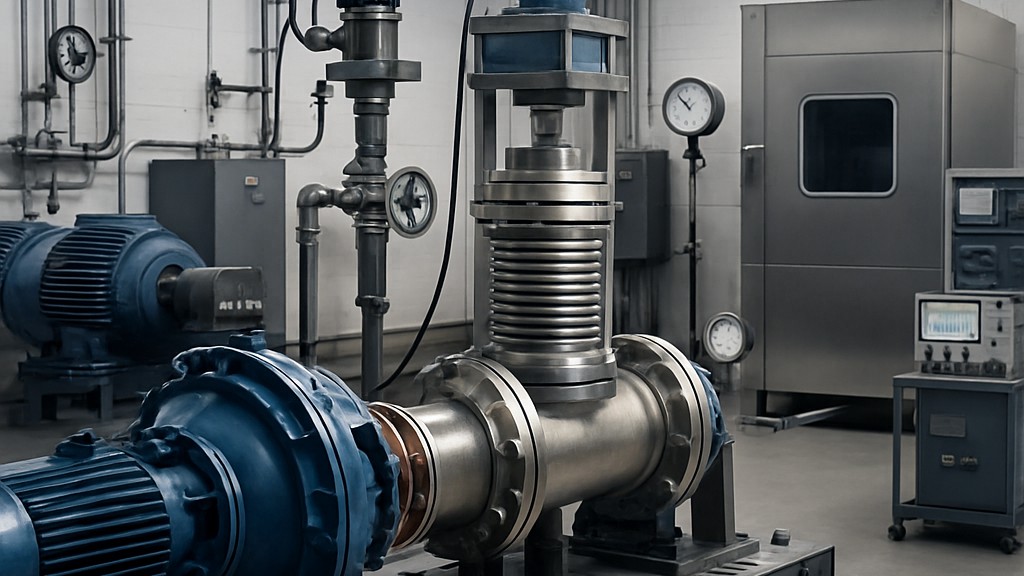
Expansion joints with a maximum working pressure higher than 0,5 bar must comply with the applicable requirements of the pressure equipment directive 97/23/EC.
This standard applies to gas pipelines and installations with expansion joints operating at operating temperatures between -30°C and +300°C. However, if the fittings are made of heat-resistant steel, the maximum operating temperature is +400°C. Stainless steel expansion joints can be used at operating temperatures up to +650°C.
For the purposes of this standard, a compensator (expansion joint) is a component that protects the gas system by compensating for expansion, contraction, vibration, bending, and similar movements occurring in gas pipelines and installations. An axial compensator is a compensator used to compensate for axial movements. A lateral compensator is a compensator used to compensate for lateral axis deflection. An angular compensator is a compensator used to compensate for angular movements. A universal compensator is a compensator capable of compensating for axial, angular, and lateral axis deflection. Axial force refers to the force acting on a compensator mounted on a pipeline in the direction of the pipe axis.
Expansion joints covered by this standard are a class. Expansion joints can be of the following types, depending on their operating method:
- Axial
- Angular
- Yanal
- Universal
Expansion joints can be of the following types according to their connection types:
In this standard, the general characteristics of expansion joints are determined as follows:
- All expansion joint components must maintain their operational properties against mechanical, chemical, and thermal effects occurring during operation, in terms of material quality, design, and manufacturing dimensions, for the period specified by the manufacturer. Expansion joints with a maximum working pressure greater than 0,5 bar or a nominal diameter greater than DN 25 must comply with the essential requirements of Pressure Equipment Directive 97/23/EC. Designing the expansion joint's connecting parts in accordance with TS EN 14917 also meets the essential requirements of that directive.
- The internal volume of the expansion joint must not contain passages that prevent the flow from passing freely (e.g. in the inner casing pipes).
- The total axial movement of the metal bellows must be equally accommodated by the active lengths of all bellows folds.
- The bellows must be connected to the fittings by welding (except for free flanges with bellows edges).
- The existing casing pipes in the axial expansion joints must be fixed in a way that cannot be loosened.
- At least the inner and outer layers of multi-walled bellows must form an interlocking and leak-proof tubular shell.
- The nominal pressure must comply with the TS 3391 standard.
- The joints in the angular expansion joint must be designed in a way that does not require maintenance.
- Expansion joints must consist of bellows arranged in series to compensate for axial and angular movements or lateral axis deviations.
- Angular expansion joints should generally be equipped with joints that can withstand axial force.
- Axial expansion joints can be equipped with inner or outer casing tubes to protect the bellows. However, the casing tubes must not affect the operation of the expansion joint.
- There should be no defects such as scale, ply, or burrs on the surfaces of expansion joints and connecting parts.
In short, the TS 10880 standard includes requirements for steel expansion joints used in gas pipelines and installations. This standard applies to systems transporting flammable gases such as natural gas, LPG, town gas, and mixed gases (natural gas/air and liquid gas/air).
The TS 10880 standard specifies requirements for the design, materials, manufacturing processes, and performance testing of various types of expansion joints (e.g., those made of metallic, rubber, fabric, or composite materials). This standard covers the following key areas:
- Material selection: Requirements regarding the chemical and physical properties of the materials used in expansion joints.
- Design criteria: Integration of expansion joints into the piping system, mobility and durability calculations.
- Testing and inspection: Performance tests such as pressure, sealing and fatigue tests of the produced expansion joints.
- Use and maintenance: Correct installation of expansion joints, operating conditions and periodic maintenance procedures.
This standard applies to expansion joints used in energy, petrochemical, heating, ventilation and air conditioning (HVAC), water treatment, and other industrial piping systems. It also includes suitability criteria for various environmental conditions and operating pressures.
The TS 10880 standard focuses on the following basic features to ensure safe and efficient operation of expansion joints:
- Durability and safety: Expansion joints must be resistant to high pressure, temperature, and chemicals. This is especially critical in systems handling hazardous materials.
- Flexibility and mobility: Expansion joints must be designed to absorb axial, lateral, and angular movements within the system. The standard defines the limits of these movements and design tolerances.
- Material standards: The suitability of the materials used (e.g. stainless steel, rubber or special alloys) is evaluated in terms of corrosion resistance, temperature resistance and mechanical properties.
- Testing procedures: Expansion joints must undergo leakage, compressive strength, and fatigue tests after production. These tests are performed to verify the product's reliability under specified conditions.
- Certification and quality control: The TS 10880 standard requires manufacturers to produce in accordance with quality management systems and to certify the conformity of their products to the standards set by TSE.
Expansion joints are essential for the long-lasting and safe operation of piping systems. The TS 10880 standard ensures consistency and reliability in the design and manufacturing processes of these components. Some of their key benefits in the industry include:
- System reliability: Correct design and manufacture of expansion joints helps prevent failures in piping systems.
- Cost savings: Expansion joints that comply with standards reduce maintenance and repair costs and extend the life of the system.
- Environmental and occupational safety: Leakage and durability tests prevent dangerous leaks and minimize environmental risks and occupational accidents.
- International compatibility: The TS 10880 standard has been prepared in compliance with international standards and therefore provides a competitive advantage in exports.
Expansion joints conforming to the TS 10880 standard are widely used in the following areas:
- Power plants: In steam and hot water pipelines to absorb thermal expansion.
- Petrochemical plants: For vibration and movement control in piping systems transporting chemicals.
- HVAC systems: To provide flexibility in heating and cooling systems.
- Water and wastewater management: To reduce vibration and noise in pump systems.
In conclusion, the TS 10880 standard is an important guide for improving the reliability and efficiency of industrial piping systems. By regulating material selection, design, testing, and maintenance processes, this standard provides quality assurance for both manufacturers and users. This standard is regularly updated to reflect technological advancements and environmental requirements in the industry.
Our organization, which has been serving for many years and meticulously following global developments in science and technology, employs a skilled team and extensive infrastructure to conduct testing, measurement, and analysis in a wide range of areas for businesses across all sectors. In this context, we also provide testing services in accordance with the TS 10880 Expansion Joints - Steel Expansion Joints for Gas Pipelines and Installations standard.



