

Compressive strength testing is one of the most basic types of mechanical testing, along with tensile and flexure tests. These tests are used to determine the behavior of a material under applied crushing loads and are typically performed by applying pressure to a test specimen with cubic or cylindrical geometry using platens or special fixtures on a universal testing machine. During the test, various properties of the material are calculated and a stress-strain diagram is plotted, which is used to determine attributes such as elastic limit, proportional limit, yield point, yield strength, and, for some materials, compressive strength.
Compressive strength testing allows manufacturers to evaluate the integrity and safety of materials, components, and products at various stages of the manufacturing process. For a material to be used in a new application or new production, it must demonstrate its ability to withstand the mechanical forces it will encounter in its end-use application. Potential applications range from testing the strength of a car windshield to testing the durability of concrete beams used in construction. Foam used in seating must be comfortable for the consumer, while medication delivery devices must be easy for medical providers to insert.
Additionally, materials and products can be subjected to mechanical forces over short or long periods of time, through cyclic or repeated use, and across a wide range of different temperatures and environmental conditions. Seat cushions are expected to last a certain period of time, while automotive tires must maintain their elasticity in all weather conditions. Materials that exhibit high tensile strength tend to exhibit low compressive strength, although not always. Similarly, materials that exhibit high compressive strength tend to exhibit low tensile strength. Therefore, compression testing is often used for brittle materials such as concrete, metals, plastics, ceramics, composites, and corrugated materials such as paperboard. These materials are often used in load-bearing capacity where their integrity under compressive forces is critical.
Unlike tensile tests, which are usually conducted to determine the tensile properties of a particular material, compression tests are usually performed on finished products. Common products such as tennis balls, golf balls, water bottles, protective covers, plastic pipes, and furniture are examples of products that need to be evaluated for their compressive strength. For example, an engineer may want to save plastic by creating thinner-walled water bottles, but the bottles must still be strong enough to be palletized and stacked for shipping. Compression testing can help the engineer fine-tune the balance between product strength and material savings.
In addition to its importance for the research and development process, compressive strength is also used by quality assurance departments to ensure that finished product batches meet the required compressive properties. This is important from both a safety and business perspective, as defective products can be hazardous to the end user and can also cause significant damage to manufacturing companies in the form of product delays, lost revenue, and reputational damage.
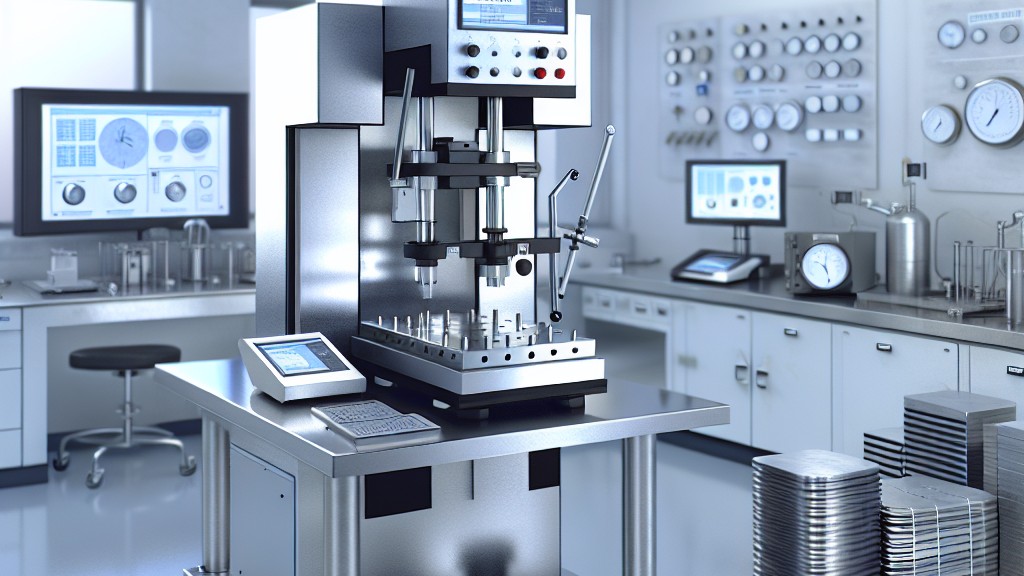
Compression tests are performed on universal testing machines, also known as compression testing machines. These machines consist of a single or double column frame equipped with a load cell, testing software, and application-specific plates and accessories. Universal testing machines come in a wide range of force capacities, ranging from 0,02 N to 2.000 kN. Most low-force tests are performed on a benchtop machine, while higher-force applications require industrial-grade floor model frames. These systems can be configured with different fixtures to test any product, component, or material.
Most compressive strength testing is performed according to established standards published by international standards organizations such as ASTM and ISO. Testing standards specify acceptable test parameters and results for different types of raw materials, such as metals and concrete used in infrastructure projects, and finished products, such as medical devices and consumer electronics.
These standards ensure that materials and products entering the supply chain exhibit predictable mechanical properties and are unlikely to deteriorate in their expected end use.
Some of the most widely used international standards developed by the American Society for Testing and Materials (ASTM) are:
Our organization, which has been trying to support businesses from every sector with its testing, measurement, analysis and evaluation studies carried out in a wide range for years, has a strong staff that closely follows the developments in the world in the field of science and technology and constantly improves itself. In this context, pressure resistance testing services are also provided to businesses.
To get an appointment, to get more detailed information or to request an evaluation, you can ask us to fill in our form and reach you.

