

The standard “ISO 2746 Vitreous and porcelain enamels - High voltage testing” published by the International Organization for Standardization (ISO) describes two test methods for high voltage testing:
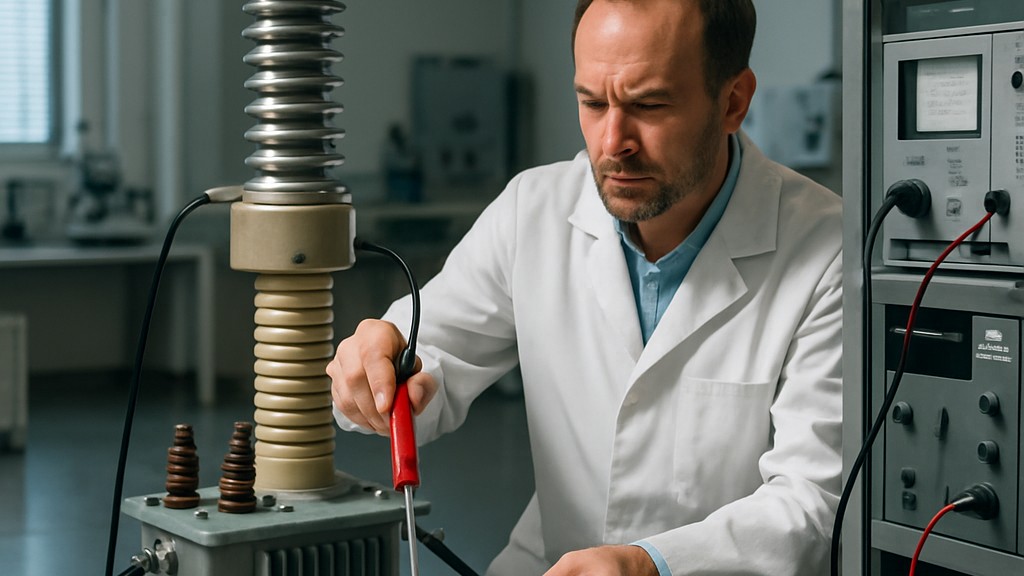
These tests are performed using DC or pulsed DC high voltage. The tests can be applied to dry surfaces of enamel coatings. On moist surfaces, care must be taken to ensure accurate detection of defects. Because test voltages depend on coating thickness, Test A, in particular, may not be suitable for testing specimens where coating thickness varies significantly.
In principle, a high-voltage electrode is passed over the enamel surface. Defects (Test A) or defects and weak spots (Test B) are indicated by a spark and a simultaneous optical or acoustic signal. The applied voltage can be DC or pulsed DC. The test voltage can vary in each case.
At distances less than 2 cm from the edges of enameled parts, an electric arc can occur between the test electrode and the edges with no or limited enamel coating thickness. Therefore, high-voltage techniques may not be applicable to such boundary areas.
In industries like household appliances, chemical processing equipment, and architectural components, where durability and corrosion resistance are paramount, vitreous and porcelain enamels serve as vital protective coatings. Fused to metal surfaces, these glassy layers provide a smooth, impermeable barrier against harsh environments. However, even minor imperfections, such as small holes or cracks, can compromise performance, leading to premature failure. This is where ISO 2746 comes in. This is a globally recognized standard that outlines rigorous high-voltage testing methods to detect and mitigate vulnerabilities.
The ISO 2746 standard ensures that enamel products can withstand harsh conditions, from acidic spills in kitchen sinks to corrosive fumes in industrial tanks. At its core, this standard addresses a critical challenge: invisible defects in enamel coatings that can allow moisture, chemicals, or electricity to penetrate the underlying metal and cause rust, deterioration, or electrical hazards. This standard specifies two different test methods that examine the integrity of enamel using high-voltage electricity without requiring destructive removal.
The ISO 2746 standard covers vitreous (base and top coat) and porcelain enamels applied to steel, cast iron, or aluminum surfaces. Purely decorative enamels or enamels not subject to corrosive or electrical risks are not covered.
This standard utilizes high-voltage testing, exploiting the insulating properties of enamel, which typically withstands 1-5 kV per millimeter of thickness. This process involves applying a test electrode, usually a conductive liquid or a brush, to the enamel surface while the metal substrate is grounded. The voltage is gradually increased, and any disturbance (e.g., sparking) indicates a defect.
Procedures prioritize safety. Operators must use insulated equipment, and tests are conducted in controlled environments to prevent false-positive results from moisture or contaminants. Calibration of the high-voltage source is mandatory, and voltage accuracy is plus or minus 5 percent. After testing, defective areas are marked for repair (e.g., localized enameling).
Testing according to the ISO 2746 standard is indispensable in sectors that rely on enamel barrier properties:
By detecting defects early, this standard reduces warranty claims, extends product life, and aligns with broader regulations such as EU Directive 2009/48/EC on toy safety. In the era of sustainable production, this standard also promotes environmentally friendly practices by minimizing waste from defective coatings.
Our organization, with its competent and experienced team, understands our customers' needs, provides them with the advanced testing services they need, and assists them in establishing, implementing, and improving management systems. In this context, we also provide testing services in accordance with the ISO 2746 Vitreous and Porcelain Enamels - High Voltage Testing standard.
To get an appointment, to get more detailed information or to request an evaluation, you can ask us to fill in our form and reach you.

