

The American Society for Testing and Materials (ASTM) standard, "ASTM D3262 Standard Specification for Fiberglass (Glass-Fiber-Reinforced Thermosetting Resin) Sewer Pipe," covers machine-made fiberglass pipe from 0,2 m to 4 m in diameter, designed for use in gravity-flow systems for conveying sanitary sewers, stormwater, and certain industrial wastes. Both fiberglass-reinforced thermosetting resin pipe and fiberglass-reinforced polymer mortar pipe are fiberglass pipes. For the purposes of this standard, the polymer does not contain natural polymers.
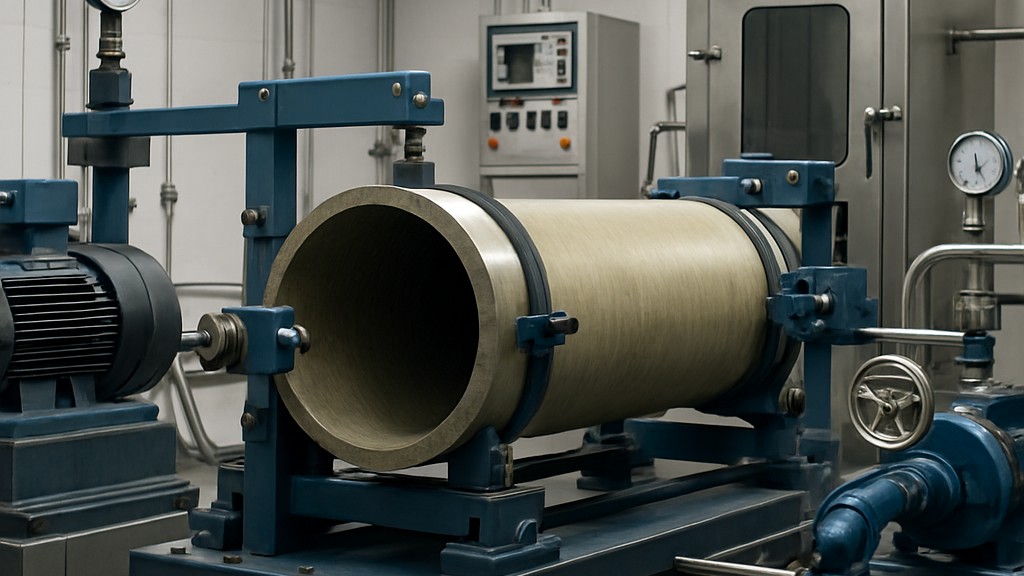
While this standard is primarily suitable for pipes to be installed in buried applications, it is also acceptable to apply to other installations, including, but not limited to, jacking, tunnel lining and slip repair of existing pipelines.
There is no known ISO standard equivalent to this standard.
This standard covers machine-made glass fiber-reinforced thermosetting resin (fiberglass) pipe, such as reinforced thermosetting resin pipe and reinforced polymer mortar pipe (natural polymers not included), for use in gravity flow systems for conveying sanitary sewers, stormwater, and certain industrial wastes.
The material covered,
The pipe, as a composite structure consisting of resin, reinforcements, colorants, fillers and other materials, must be manufactured free from all defects such as dents, delaminations, blisters, pinholes, cracks, pits, bubbles, foreign matter and resin starved areas that are detrimental to the pipe's strength and serviceability.
The pipe must also be uniform in color, opacity, density, and other physical properties, and the interior surface of the pipe must be free of protrusions, dents, ridges, and other defects.
Pipes must be joined using a joining system that provides fluid tightness consistent with the service requirements and that ensures the pipe joint surfaces are free of dents, gouges, and other surface irregularities. Pressure, tension, and long-term chemical tests, as well as dimensional, hardness, and joint tightness tests, must be performed and conform to the specified requirements.
For the purposes of this standard, unless otherwise stated, the following definitions apply, in addition to the terms and definitions given in ASTM D883, ASTM F412, and ASTM D1600:
This standard covers fiberglass sewer pipe, defined by the structural wall (type) and lining materials, the surface layer material (grade), and the pipe hardness. The table within the standard lists the types, linings, grades, and hardnesses covered.
Not all possible combinations of types, linings, grades, and hardnesses may be commercially available. Additional types, linings, grades, and hardnesses may be added as they become commercially available. A thorough study with the manufacturer to determine the appropriate type, lining, grade, and hardness of pipe to be used under the installation and operating conditions that will prevail for the project in which the pipe will be used is essential.
In general, when resins, reinforcements, colorants, fillers and other materials are combined into a composite structure, a pipe that meets the performance requirements of this standard is produced.
The ASTM D3262 standard cites several test methods for evaluating different properties of pipe. These include:
The test methods used may depend on the manufacturer and the pipe class, but all pipes must meet the minimum performance criteria defined in the ASTM D3262 standard.
Our organization, which has been supporting businesses across all sectors for years through a wide range of testing, measurement, analysis, and evaluation activities, has a strong team of employees who closely follow global developments in science and technology and are constantly improving themselves. In this context, we also provide testing services in accordance with the ASTM D3262 Standard Specification for Fiberglass (glass fiber-reinforced thermoset resin) sewer pipe.
To get an appointment, to get more detailed information or to request an evaluation, you can ask us to fill in our form and reach you.

