

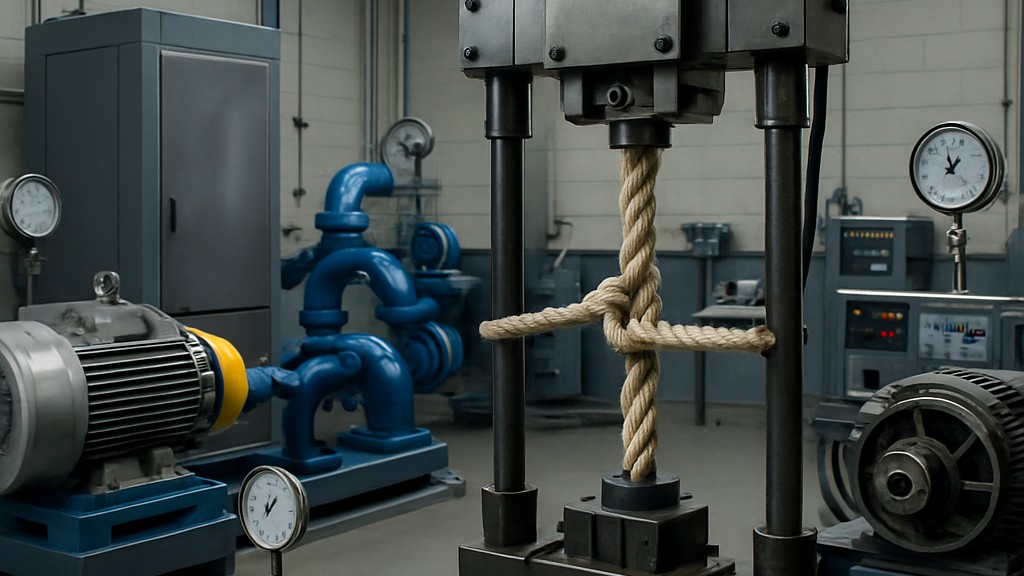
The standard "EN ISO 1346 Fibre ropes - Polypropylene split film, monofilament and multifilament (PP2) and polypropylene high tenacity multifilament (PP3) - 3, 4, 8 and 12-wire ropes", which has its basis in a European standard and was subsequently published by the International Organization for Standardization (ISO), specifies the requirements for 3-wire laid rope and 4-wire shroud laid ropes, 8-wire braided ropes and 12-wire braided ropes for general service made of polypropylene and gives the rules for their identification.
This standard does not cover all variations in strength or product performance. The rope manufacturer should be consulted to ensure that the intended design meets the requirements of the application.
For the purposes of this standard, the terms and definitions given in ISO 1968 apply. Minimum breaking strength is also the minimum strength that a fiber rope will exhibit when tested using a recognized procedure or test method. This strength is determined by each manufacturer using its own internal statistical methods based on breaking tests. The appendix to ISO 9554 provides two statistical methods for determining minimum breaking strength (Annex D).
Polypropylene ropes must be produced in one of the following constructions:
Construction, manufacturing, installation, labeling, packaging, invoicing and delivery times must comply with the ISO 9554 standard.
In the EN ISO 1346 standard, the physical properties are specified as follows: The linear density and minimum breaking strength must comply with the tables titled "Linear density and minimum breaking strength of 3-wire rope-laid polypropylene ropes, type A" and "Linear density and minimum breaking strength of 4-wire shroud-laid polypropylene ropes, type B." The following applies to these tables.
In short, the EN ISO 1346 standard is essential because it provides a standardized framework for plywood specifications, ensuring consistency, quality, and interoperability in plywood production, testing, and use across different regions and industries. The key reasons for considering this standard are:
Without this standard, variations in plywood quality, terminology, and performance can lead to confusion, inefficiency, and potential safety hazards in plywood-based industries. EN ISO 1346 provides a common language and reliable benchmarks for manufacturers, suppliers, and end users globally.
Fiber ropes are used in a wide variety of industries and applications because of their flexibility, strength-to-weight ratio, corrosion resistance and ease of use.
Our organization, which has been supporting businesses across all sectors for years through a wide range of testing, measurement, analysis, and evaluation activities, has a strong team of employees who closely follow global developments in science and technology and are constantly improving themselves. In this context, we also provide testing services in accordance with the EN ISO 1346 Fiber ropes - Polypropylene split film, monofilament, and multifilament (PP2) and polypropylene high-tenacity multifilament (PP3) - 3, 4, 8, and 12-strand ropes.
To get an appointment, to get more detailed information or to request an evaluation, you can ask us to fill in our form and reach you.

