

The standard “ASTM F1292 Standard Specification for Impact Attenuation of Surface Materials in the Use Area of Playground Equipment” published by the American Society for Testing and Materials (ASTM) describes the minimum performance requirements for impact attenuation of playground surface materials installed in the use area of playground equipment.
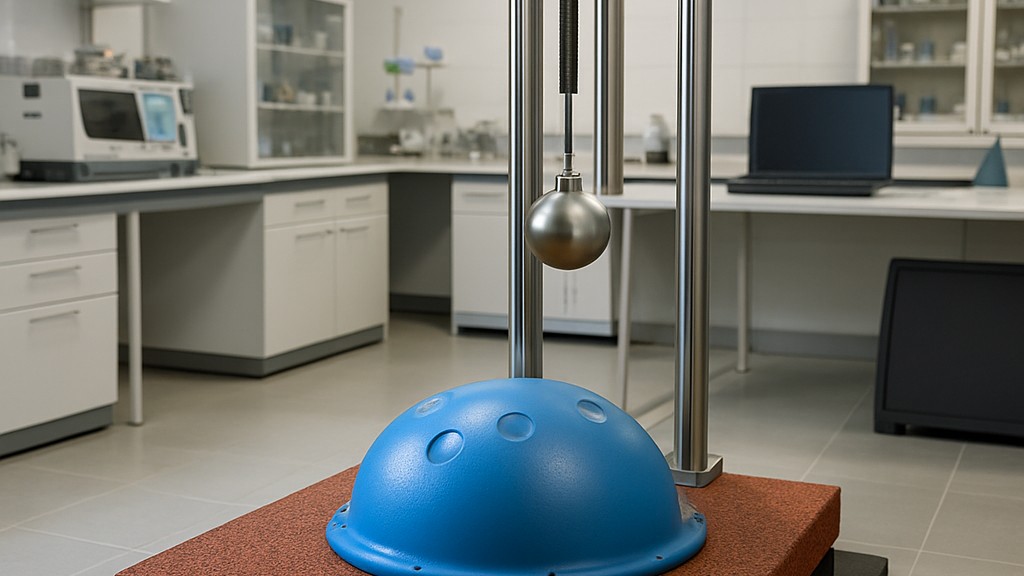
This standard is specific to surfaces used with playground equipment, such as those described in ASTM F1148, ASTM F1487, and ASTM F1918. This standard establishes an impact absorption performance criterion, referred to as the critical fall height, for playground surface materials. This standard specifies procedures for determining the critical fall height of playground surface materials under laboratory conditions. Laboratory testing is mandatory for surfaces to conform to the requirements of this specification. This test addresses the performance of dry surface materials.
This standard also provides optional procedures for determining the critical fall height under wet or frozen test conditions, or both. The critical fall height of a playground surface material determined under laboratory conditions does not account for important factors that have the potential to affect the actual performance of the installed surface materials. Factors known to affect surface material performance include, but are not limited to, aging, moisture, maintenance, exposure to temperature extremes (e.g., freezing), exposure to ultraviolet light, contamination with other materials, compression, loss of thickness, shrinkage, and water immersion.
The impact attenuation specifications and test methods specified in this standard are specific to the risk of head injury. There is limited evidence that compliance with the requirements of this standard reduces the risk of other serious injuries (e.g., long bone fractures).
Fatal risk and the risk of different degrees of head injury can be estimated using the information in Appendix X1, which shows the relationships between the head injury criterion (HIC) scores of an impact and the probability of head injury.
This standard addresses only the impact-reducing properties of playground surfacing materials and does not address other factors that contribute to fall-related injuries. While it is believed that compliance with the requirements of this standard will reduce the risk of serious injury and death from falls, compliance with this standard does not prevent all injuries and deaths.
The purpose of this standard is to establish minimum impact attenuation requirements for playground surface materials to reduce the risk of serious head injury from falls. This standard provides a uniform method for measuring the impact attenuation performance of playground surface materials and is appropriately used to compare the relative performance of different playground surface materials. This standard serves as a reference for determining the impact attenuation performance of playground surface materials.
The information obtained by applying this standard, combined with data correlating impact test scores with head injury, is suitable for estimating the relative risk of serious head injury from falls.
This standard specifies impact absorption performance requirements for playground surfaces and surface materials and provides a way to determine impact absorption performance using a test method that simulates a child's head hitting the surface.
Two test methods are used to determine the impact absorption of a playground surface or surface materials: the critical drop height test and the established surface performance test. These two test methods require the following equipment: a temperature measuring device, an impact testing system, an acceleration measuring system, a drop height measuring system, and battery-powered equipment.
Playgrounds are essential spaces for children's physical development, creativity, and social interaction. However, they also carry inherent risks, particularly falls, which account for the majority of playground-related injuries. To mitigate these hazards, industry standards such as ASTM F1292 have been established to ensure playground surface materials effectively absorb impacts and reduce the severity of injuries. ASTM F1292 serves as a cornerstone of playground safety, guiding manufacturers, designers, and regulators to create safer environments for children ages 3-14.
This standard specifies minimum performance criteria for playground surfaces to cushion falls. The area of use refers to the area immediately beneath and adjacent to playground equipment where falls most frequently occur. The primary objective of this standard is to minimize the risk of serious head injuries by specifying how surface materials, such as loose-fill options such as woodchip or engineered wood fiber, and unitary surfaces such as rubber tiles or poured-in-place rubber, must perform under impact. It provides a uniform framework for testing and evaluation, ensuring consistency across different materials and installations.
At the core of the ASTM F1292 standard are two primary metrics for evaluating impact absorption: the head injury criterion (HIC) and G-max. These metrics are derived from biomechanical research on the impact resistance of the human head:
These thresholds are based on studies showing that exceeding these thresholds significantly increases the likelihood of serious or fatal head injury. This standard also helps designers select appropriate surfacing for equipment such as slides or climbers by defining the critical fall height as the maximum fall height at which a surface can meet both criteria.
This standard emphasizes that to ensure real-world performance, surfaces must be tested in their installed condition, taking into account factors such as depth, compression, and environmental wear.
Compliance with ASTM F1292 is verified through rigorous drop tests. This procedure involves dropping a 10-kilogram instrumented hemispherical head cast, simulating a child's head, from various heights onto the surface material. Sensors in the head cast record acceleration data, which is then processed to calculate HIC and G-max values.
Tests are performed at multiple points within the occupancy area, including directly underneath the equipment and on edges prone to falls.
Falls onto surfaces account for more than 60 percent of playground injuries, and head trauma is a leading cause of emergency room visits. The ASTM F1292 standard has significantly reduced injury rates by mandating impact-absorbing surfaces.
Ultimately, ASTM F1292 exemplifies how technical standards can transform everyday environments into safer places for play. By establishing clear mitigation criteria, it empowers stakeholders to prioritize child well-being without stifling innovation. As playgrounds evolve to meet diverse needs, compliance with this standard remains a key consideration. Parents, educators, and designers are encouraged to verify compliance through certified products and routine inspections, ensuring every bounce, swing, and slide is safe.
Our organization, which has been operating for many years and meticulously follows global developments in science and technology, employs a team of experienced professionals and a broad infrastructure to conduct testing, measurement, and analysis in a wide range of areas for businesses across all sectors. In this context, we also provide testing services in accordance with ASTM F1292, Standard Specification for Impact Reduction of Surface Materials in the Area of Use of Playground Equipment.
To get an appointment, to get more detailed information or to request an evaluation, you can ask us to fill in our form and reach you.

