

The European standard “EN 16122 Indoor and outdoor storage furniture - Test methods for determining strength, durability and stability” describes test methods for determining the strength, durability and stability of all indoor and outdoor storage furniture (including household kitchen furniture). This standard does not apply to office, industrial, catering equipment and retail storage areas, or industrial storage cabinets.
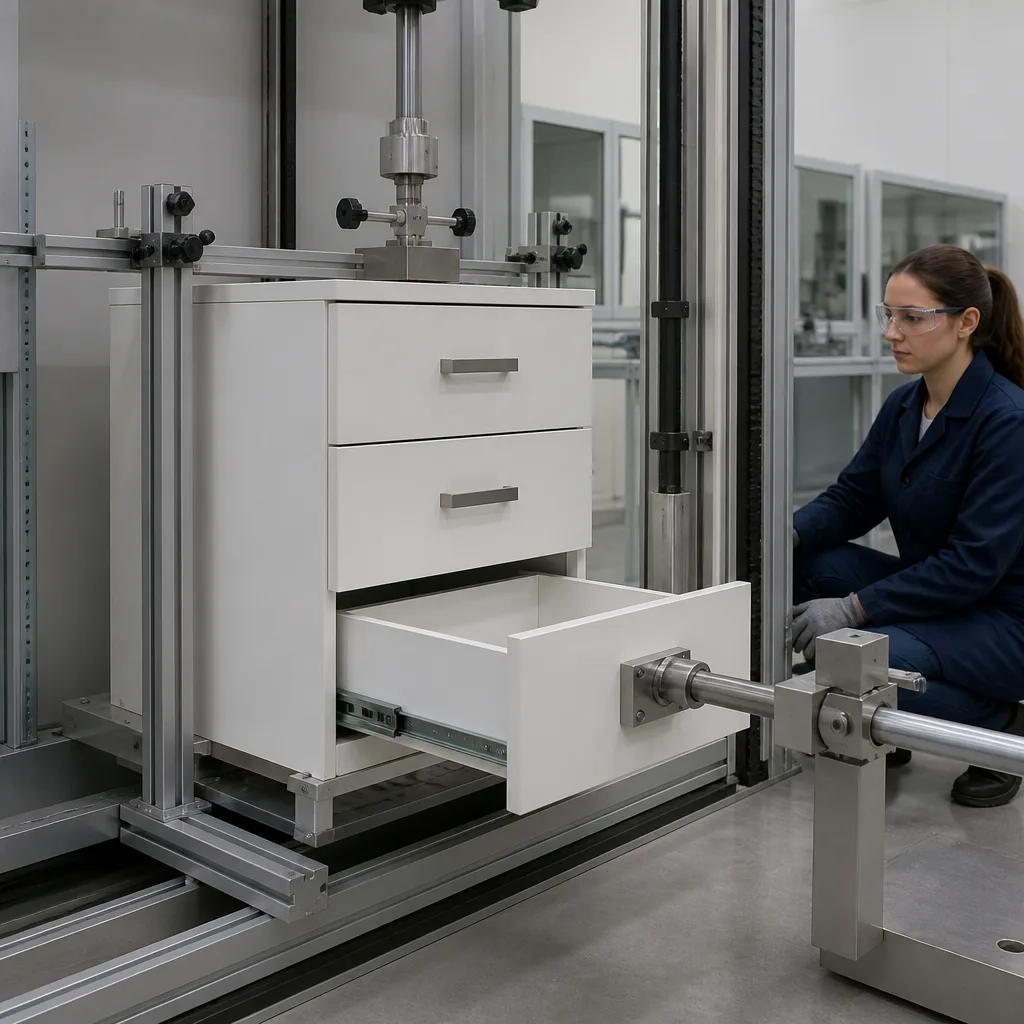
Strength and durability tests do not evaluate the building structure (e.g., the strength of wall-mounted cabinets), but instead only include the cabinets and the parts used for connection. Walls and wall connections are not included. Safety, strength, and durability requirements are addressed in other European standards. Furthermore, the evaluation of aging, deterioration, and flammability effects is outside the scope of this standard. Details of the test equipment for instantaneous opening/closing tests of extension elements are included in the standard annex (Annex A).
EN 16122 is a European standard that specifies standardized test methods for evaluating the strength, durability, and stability of storage furniture used in both residential and commercial settings. This standard provides manufacturers, testing laboratories, and certification bodies with consistent procedures for assessing the mechanical performance of storage furniture throughout its lifespan. It applies to products such as wardrobes, cabinets, shelving units, bookcases, sideboards, chests of drawers, and kitchen storage furniture.
The EN 16122 standard covers all types of indoor and outdoor storage furniture, including:
However, this standard does not apply to:
Furthermore, this standard only evaluates the furniture itself and its connecting components. For wall-mounted furniture, the structural integrity of the building or wall is outside the scope of this standard.
The main objectives of the EN 16122 standard are as follows:
The EN 16122 standard focuses on how tests should be conducted, rather than defining performance requirements. Performance limits are specified in separate European standards for specific furniture categories.
The main test categories defined in this standard are as follows:
After the test, the auditors check the following:
Depending on the type of furniture, the components can go through thousands of work cycles. The goal is to ensure the following:
Stability is especially important for:
This standard includes installation conditions that represent realistic consumer use.
Test laboratories typically use the following equipment:
This standard annex contains specifications for equipment used in instantaneous opening/closing tests of extension elements (Annex A).
After the test, typical evaluation criteria are as follows:
Minor cosmetic damage that does not affect safety or function may be acceptable depending on the relevant product requirements.
The EN 16122 standard is widely used in the following sectors:
The EN 16122 standard is commonly used in conjunction with the following furniture standards:
While the EN 16122 standard defines test methods, complementary standards specify the required pass/fail performance levels for different product categories.
Implementing the EN 16122 standard offers several advantages:
As a result, storage furniture is subjected to constant mechanical stress such as opening doors, pulling drawers, loading shelves, and accidental misuse. Failures such as collapsing shelves, separating drawers, or tipping cabinets can lead to property damage and serious injury. The EN 16122 standard provides a consistent testing methodology that allows manufacturers to identify structural weaknesses before products are released to the market. By simulating real-life use under controlled laboratory conditions, it helps ensure that furniture remains safe, durable, and functional throughout its expected lifespan.
For many years, our organization, with its competent and experienced staff, has been understanding the needs of its clients, providing the advanced testing services they require, and assisting them in the establishment, implementation, and improvement of management systems. Within this framework, we also provide testing services in accordance with the EN 16122 standard.
To get an appointment, to get more detailed information or to request an evaluation, you can ask us to fill in our form and reach you.

