EN 13310 Kitchen Sinks - Functional Requirements and Test Methods
The European standard “EN 13310 Kitchen sinks - Functional requirements and test methods” describes the functional requirements and test methods for household kitchen sinks. These methods ensure that the product performs satisfactorily when installed according to the manufacturer's instructions.
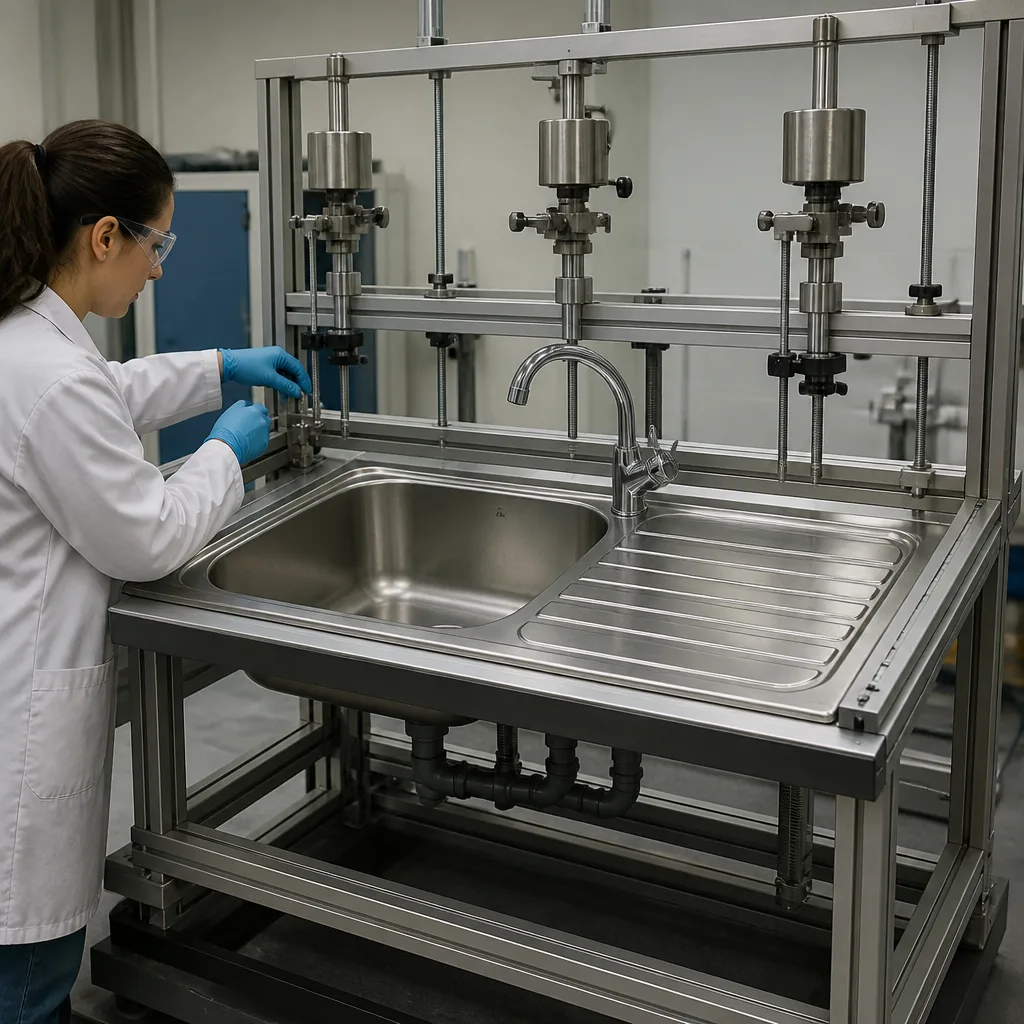
Within the scope of this standard, the term "residential" includes use in hotels, student dormitories, hospitals, and similar buildings. This standard does not specify the aesthetic requirements or general dimensions of kitchen sinks. It also does not apply to industrial kitchen sinks.
The EN 13310 standard guarantees that kitchen sinks installed according to the manufacturer's instructions provide safe, durable, and satisfactory performance in daily use. It applies to home kitchens as well as similar environments such as hotels, hospitals, and student dormitories.
This standard covers:
- Household kitchen sinks
- Functional performance requirements
- Laboratory test methods
- Durability and safety criteria
- Assembly and maintenance instructions
However, this standard does not include the following:
- aesthetic design
- Precise dimensions or shapes
- Industrial kitchen sinks
This means that manufacturers have flexibility in sink appearance and style while adhering to minimum performance and durability standards.
The main functional requirements have been identified as follows:
- Water drainage performance: Kitchen sinks should effectively drain water toward the outlet without excessive water accumulation. The sink surface should be designed with adequate slopes to ensure hygienic use and prevent stagnant water buildup.
- Dry heat resistance: The sink surface must withstand damage from hot cookware and utensils. Tests typically involve exposure to temperatures of approximately 180 degrees to assess for deformation, discoloration, or cracking.
- Temperature resistance: The sinks are subjected to rapid hot and cold temperature cycles to verify that the material does not crack, bend, or separate into layers under thermal stress.
- Chemical and stain resistance: This standard requires resistance to common household chemicals, detergents, food acids, and stain-causing agents. Surfaces must remain functionally and visually stable after testing.
- Surface durability: For coated or multi-layered sinks, the EN 13310 standard evaluates the following:
- Scratch resistance
- Wear resistance
- Surface layer integrity
These tests ensure long-term usability and preservation of appearance.
- Load stability: Wall-mounted or suspended sinks must withstand the specified loads without permanent deformation, cracking, or detachment from the supports.
- Overflow performance: Overflow systems must safely discharge water at the minimum required flow rate to reduce the risk of flooding.
The EN 13310 standard defines standardized laboratory procedures for evaluating sink performance. Tests are typically conducted under controlled ambient conditions at around 23 degrees Celsius. The procedures include:
- Drainage test: Evaluates water flow efficiency.
- Thermal shock test: Checks resistance to sudden temperature changes.
- Dry heat test: Measures resistance to hot cooking vessels.
- Chemical resistance test: Evaluates the reaction to detergents and food substances.
- Wear test: Determines wear resistance.
- Scratch test: Evaluates surface hardness.
- Load test: Verifies structural stability.
- Overflow test: Measures the overflow discharge capacity.
The EN 13310 standard applies to a variety of sink materials, including the following:
- Stainless steel
- Ceramic
- Granite composite
- Synthetic resin materials
- Enamelled steel
This standard focuses on performance rather than material type, allowing manufacturers to innovate while maintaining compliance.
The EN 13310 standard offers many benefits for manufacturers, architects, designers, and customers:
- Manufacturers use this standard for the following purposes:
- Demonstrating product quality.
- To meet European market requirements
- To support CE marking and conformity assessment.
- Standardizing product testing.
- Architects and specifiers rely on products that comply with this standard, ensuring the following:
- Durability
- Security
- Long-term performance
- Compliance with legal regulations
- Consumers benefit from the following:
- Improved reliability
- Better hygiene
- Safer work
- Longer product lifespan.
The EN 13310 standard is related to the European Construction Products Framework and is used as part of the conformity assessment procedures for placing kitchen sinks on the European market. Manufacturers typically combine the following:
- Type test
- Factory production control
- Product documentation
- Demonstrating compliance
EN 13310 is necessary because kitchen sinks are subjected to continuous mechanical, thermal, chemical, and hygienic stress throughout their lifespan. Without a common technical standard, product quality and safety can vary significantly between manufacturers, increasing the risk of premature failure, unsafe installations, hygiene issues, and consumer dissatisfaction. The key reasons why this standard is important are:
- Ensuring safety: Kitchen sinks handle hot cookware, boiling water, sharp utensils, heavy loads, and cleaning chemicals. A poorly designed or low-quality sink can cause:
- It can crack under thermal shock.
- It can collapse under load.
- It can leak and damage cabinets.
- It can overflow and cause flooding.
- Sharp or damaged surfaces may form.
This standard specifies minimum safety and robustness requirements to mitigate these risks.
- Product durability guaranteed: Kitchen sinks are expected to withstand many years of daily use. This standard verifies resistance to heat, temperature fluctuations, scratches, abrasion, household chemicals, and impact and load.
- Consumer protection: This standard helps consumers by guaranteeing that compliant sinks provide proper drainage, stain resistance, structural integrity, remain hygienic, and perform consistently over time.
- Facilitating access to the European market: This standard supports compliance with European regulatory frameworks and harmonized product requirements. Manufacturers use this standard to demonstrate compliance, support CE marking procedures, and access multiple European markets using a single testing framework.
In conclusion, the EN 13310 standard plays a significant role in ensuring the quality, durability, and safety of household kitchen sinks sold across Europe. Rather than regulating appearance or design, this standard focuses on real-world performance characteristics such as heat resistance, drainage efficiency, chemical resistance, and structural stability.
Because kitchen sinks are exposed to heat, humidity, detergents, and mechanical wear on a daily basis, this standard provides a reliable benchmark for manufacturers, testing laboratories, architects, and consumers seeking trustworthy and long-lasting products.
For many years, our organization, with its competent and experienced staff, has been understanding the needs of its clients, providing the advanced testing services they require, and assisting them in the establishment, implementation, and improvement of management systems. Within this framework, we also provide testing services in accordance with the EN 13310 standard.



