ISO 5644 Porcelain Tableware - Specification and Test Method
The “ISO 5644 Porcelain tableware - Specification and test method” standard published by the International Organization for Standardization (ISO) describes the technical specifications, test methods and sampling, marking and labeling procedures for porcelain tableware used in the preparation and serving of food.
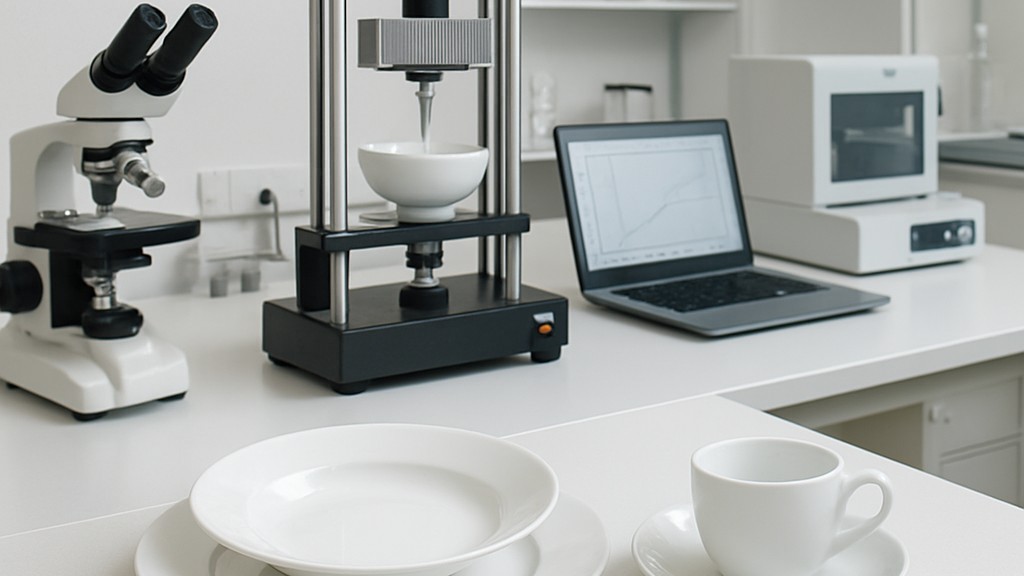
For the purposes of this standard, the following terms and definitions apply:
- Ceramics are inorganic, non-metallic materials made by firing a mixture of raw materials at high temperatures. The firing temperature is high enough to impart the necessary strength to the already formed material, but lower than the temperature required to achieve complete fusion of the mixture.
- A glaze is a substance formed by melting or sintering inorganic components and designed to form a surface layer that is fused into one or more layers during the firing process. Glazes can be opaque or transparent.
- Porcelain is a vitrified, impermeable, white or artificially colored, translucent, and resonant ceramic material. It is typically made from kaolin or other china clays, silica, feldspar or feldspathic fluxes, and sometimes calcium carbonate or alumina. The water absorption of the body, as determined according to test method A of EN 1217, is less than 0,5 percent. Porcelain is generally fired in a kiln at temperatures between 1200°C and 1400°C. The fired body presents the simultaneous presence of a glassy phase and a mullite crystalline phase in proportions of 60 to 80 percent and 40 to 20 percent, respectively.
- Soft (soft-paste) porcelain is porcelain that generally contains less alumina but more silica and fluxes than hard-paste porcelain. After initial firing at a high temperature to produce a vitreous biscuit piece, it is typically coated with a colorless, transparent glaze and then fired at a lower temperature to allow the glaze to cure. The initial firing temperature is typically above 1220°C (1220°F). The body's water absorption, determined according to test method A of EN 1217, is less than 0,5 percent.
- China is a glazed ceramic material, a vitrified, impermeable, white or artificially colored, translucent, and resonant material. It is a type of soft-paste porcelain typically made from kaolin (or other china clays), silica, feldspar, or feldspathic fluxes, and sometimes calcium carbonate or alumina. The water absorption of the body, as determined according to test method A of EN 1217, is less than 0,5 percent.
This standard applies to porcelain tableware designed for the preparation and serving of food. It details the physical and chemical requirements that porcelain tableware must meet to ensure safety and suitability for food contact.
The test methods described include procedures for evaluating the quality and safety of porcelain tableware, including tests for thermal shock resistance, mechanical strength, and chemical stability.
This standard is important for manufacturers, quality assurance professionals, and regulatory bodies to ensure that porcelain tableware products are safe and meet international quality standards.
Test methods for porcelain tableware are designed to evaluate the durability, safety, and performance of porcelain ware used for food service. Typical test methods used for porcelain tableware generally include:
- Thermal shock resistance test: This test checks whether porcelain can withstand rapid temperature changes without cracking. During the test, the product is heated to, for example, 180 degrees Celsius and then immersed in cold water. Afterward, it's inspected for cracks or damage.
- Chemical resistance testing: This test ensures that the glaze and body are resistant to attack by acids and alkalis found in foods or detergents. During the test, the surface is exposed to acidic (citric acid) or alkaline (sodium carbonate) solutions. This is then evaluated for changes in surface appearance, texture, or mass loss.
- Mechanical strength test: This test measures the resistance to breakage under mechanical stress (for example, from dropping or impact). During the test, pressure is applied to the center of a flatware (such as a plate). The force required to break the product is then measured.
- Dishwasher durability test: This test checks durability through repeated dishwashing cycles. During the test, products are put through multiple dishwasher cycles. Afterward, they are examined for glaze deterioration, pattern fading, or structural weakening.
- Water absorption test: This test determines the porosity of porcelain (which should be very low). The product is immersed in water. It is then weighed before and after to measure the water absorption.
- Lead and cadmium release testing: This test ensures that food-contact surfaces do not leach harmful heavy metals. An acidic solution is used to simulate food contact. The solution is then analyzed for lead and cadmium using atomic absorption spectroscopy.
- Visual inspection: This test checks for surface defects (cracks, glaze defects, pinholes). Manual or automated inspection is performed under controlled lighting conditions during testing.
The ISO 5644 standard is important because it ensures safety for food contact. Porcelain is in direct contact with food, so ensuring that no harmful substances (such as lead or cadmium) are leached is crucial. This standard is also important for verifying compliance with global health and food safety regulations. It also defines performance criteria such as resistance to thermal shock, mechanical strength, and dishwasher safety. Manufacturers rely on this standard to produce higher-quality porcelain that resists chipping, cracking, or staining.
Our organization, which has been supporting businesses across all sectors for years through a wide range of testing, measurement, analysis, and evaluation activities, has a strong team of employees who closely follow global developments in science and technology and are constantly improving themselves. In this context, we also provide testing services in accordance with the "ISO 5644 Porcelain Tableware - Specification and Test Method" standard.



