EN 14749 Household and Kitchen Storage Units and Kitchen Countertops - Safety Requirements and Test Methods
The European standard “EN 14749 Furniture - Household and kitchen storage units and countertops - Safety requirements and test methods” describes the safety requirements and test methods for all types of kitchen and bathroom storage units, as well as household storage furniture and components. This standard does not apply to non-residential storage, office storage, industrial storage, catering equipment, retail storage, and industrial storage cabinets.
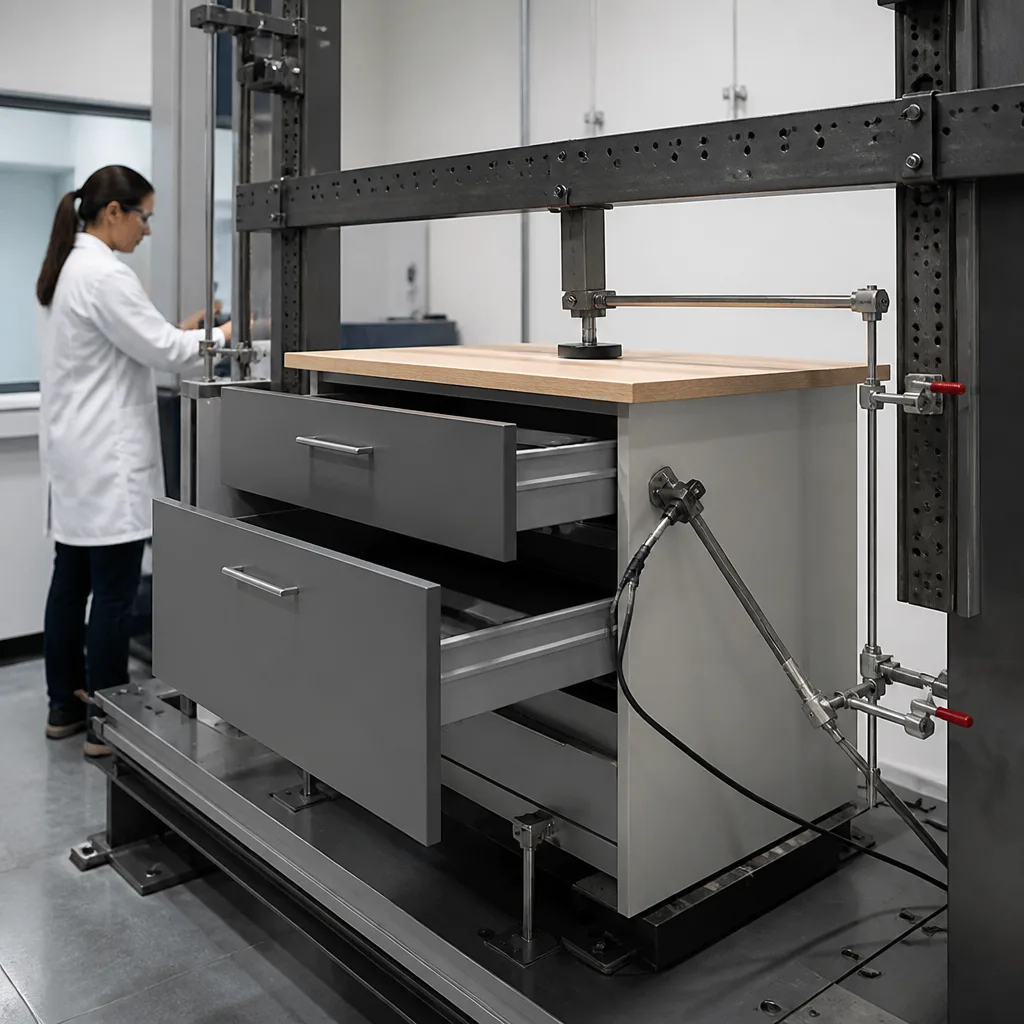
It also does not include requirements for resistance to aging, deterioration, flammability, and electrical safety. Similarly, safety related to the building structure is not included; for example, the durability of wall-mounted units only includes their components, including the cabinet and wall mounting devices. The wall and wall mountings are not included.
For all tests specified in this standard, the “General test conditions” and “Test equipment and device” defined in the EN 16122 standard apply.
The EN 14749 standard helps ensure that furniture products are structurally safe, robust, durable, and able to withstand normal household use without posing a danger to users. The main objectives of this standard are:
- Improving the safety of household storage furniture.
- Minimizing the risks associated with structural failure.
- To prevent accidents caused by unbalanced cabinets or overloaded shelves.
- To establish standardized laboratory testing methods across Europe.
- To ensure consistent product quality among manufacturers.
This standard is widely used by furniture manufacturers, retailers, testing laboratories, and certification bodies.
The EN 14749 standard applies to:
- Kitchen cabinets
- Bathroom storage cabinets
- Wall-mounted cabinets
- Base cabinets
- High storage units
- Bathroom cabinets
- Bookcases
- Wardrobes
- TV furniture (listed in the latest appendix with special provisions)
- Kitchen countertops
- Components such as:
- shelving
- Kapilar
- Drawers
- Hinges
- Rails
- Assembly systems
- Wall mounting devices
This standard covers both fully assembled furniture and flat-pack (unassembled) products.
Conversely, the EN 14749 standard does not apply to the following products:
- office furnitures
- Industrial storage systems
- Warehouse shelving
- Retail display systems
- Food and beverage equipment
- Industrial cabinets
- Children's toys covered by EN 71-1 standard.
- Electrical safety of integrated devices
- Fire resistance
- Material aging and weather resistance
- Chemical resistance
This standard focuses specifically on mechanical safety.
The EN 14749 standard includes performance requirements for various critical safety aspects:
- Structural strength: Furniture must withstand the expected household loads without the following conditions being met:
- Break
- Permanent deformation
- Joint disorder
- Panel cracking
- Component separation
The tests involve static loading of shelves, countertops, drawers, and cabinet structures.
- Stability: Stability is one of the most important requirements. Tests confirm resistance to tipping over under the following conditions:
- When the drawers are opened
- When the doors opened
- When the shelves are loaded
- When external forces are applied
- When unbalanced loading occurs
Wall-mounted units are evaluated in terms of the durability of the cabinet and mounting devices, while the wall itself is outside the scope of the standard.
- Shelf performance: Shelves are evaluated based on the following criteria:
- Load capacity
- Flexibility
- Permanent deformation
- Support durability
- Keep it inside the cupboard.
-
Tests ensure the shelves remain functional throughout their normal lifespan.
- Drawer durability: Drawers are repeatedly opened and closed to assess the following:
- Durability of the rails
- Smooth operation
- Yapısal bütünlük
- Grip feature
- Load carrying capacity
- Door durability: Doors are repeatedly opened and closed to evaluate the following aspects:
- Hinge performance
- Alignment
- Operation of the locking mechanism
- Yapısal bütünlük
- Wear resistance
- Countertop strength: Kitchen countertops undergo load tests to ensure they can withstand the following loads:
- Cooking utensils
- Food preparation
- Household loads
The various test methods defined in the EN 14749 standard are as follows:
- Static load test: By applying a specific load for a defined period, it is determined whether permanent deformation or failure occurs.
- Horizontal load test: Horizontal forces simulate pushing, pulling, or leaning on the furniture.
- Vertical load test: Vertical forces represent the weight of stored household items.
- Stability test: The furniture is loaded with drawers or doors open to assess its resistance to tipping.
- Rack bending test: Rack bending is measured under specified loads to verify acceptable performance.
- Door cycle test: Doors undergo thousands of opening and closing cycles to assess long-term durability.
- Drawer cycle test: Drawers are repeatedly run under load to evaluate rail wear and reliability.
- Wall cabinet load test: Wall-mounted cabinets are loaded to verify that the cabinet structures and fasteners remain secure.
Manufacturers must provide clear information including the following:
- Installation instructions
- Assembly instructions
- Maximum load limits
- Wall mounting recommendations
- Maintenance manual
- Safety warnings where appropriate.
Clear labeling reduces the risk of incorrect installation or unsafe use.
Tests conducted according to the EN 14749 standard help identify problems such as:
- Shelf collapse
- Drawer rail malfunction
- Hinge breakage
- Cabinet deformation
- Joint separation
- Fastener loosening
- Excessive shelf sagging
- Wall bracket malfunction
- Furniture tipping over
Identifying these weaknesses during the development phase allows manufacturers to improve product safety before launching it on the market.
The EN 14749 standard is widely applied in the following areas:
- Manufacturing of residential furniture
- Kitchen cabinet manufacturing
- Bathroom furniture manufacturing
- Furniture assembly production
- Manufacturing of furniture components.
- Product certification laboratories
- Quality assurance departments
- Furniture import and export businesses
The EN 14749 standard is generally used in conjunction with the following complementary European furniture standards:
- EN 16122: Strength, durability and stability test methods for storage furniture.
- EN 12520: Requirements for household seating groups
- EN 1728: Test methods for seating groups
- EN 1730: Tables - Stability, strength and durability testing methods
- EN 581 series: Outdoor furniture requirements.
Together, these standards provide a comprehensive framework for evaluating the safety and performance of furniture products.
Manufacturers complying with the EN 14749 standard can gain several advantages:
- Improved product safety
- Reducing the risk of furniture-related accidents.
- Increased consumer confidence
- Improved product durability.
- Easier access to European markets
- Consistent quality assurance.
- Reduced warranty claims
- Simplified product certification and regulatory compliance.
In conclusion, the EN 14749 standard helps ensure that furniture remains safe and reliable throughout its lifespan by defining standardized safety requirements and mechanical performance tests, including the evaluation of strength, stability, durability, shelves, drawers, doors, and wall-mounted units.
For many years, our organization, with its competent and experienced staff, has been understanding the needs of its clients, providing the advanced testing services they require, and assisting them in the establishment, implementation, and improvement of management systems. Within this framework, we also provide testing services in accordance with the EN 14749 standard.



