

The standard "ASTM F1614 Standard Test Method for Shock Attenuation Properties of Material Systems for Athletic Footwear" developed by the American Society for Testing and Materials (ASTM) describes a test method for measuring the specific shock attenuation properties and rapid-rate force-displacement relationships of material systems used in the midsole of athletic shoes designed for use in normal running motions.
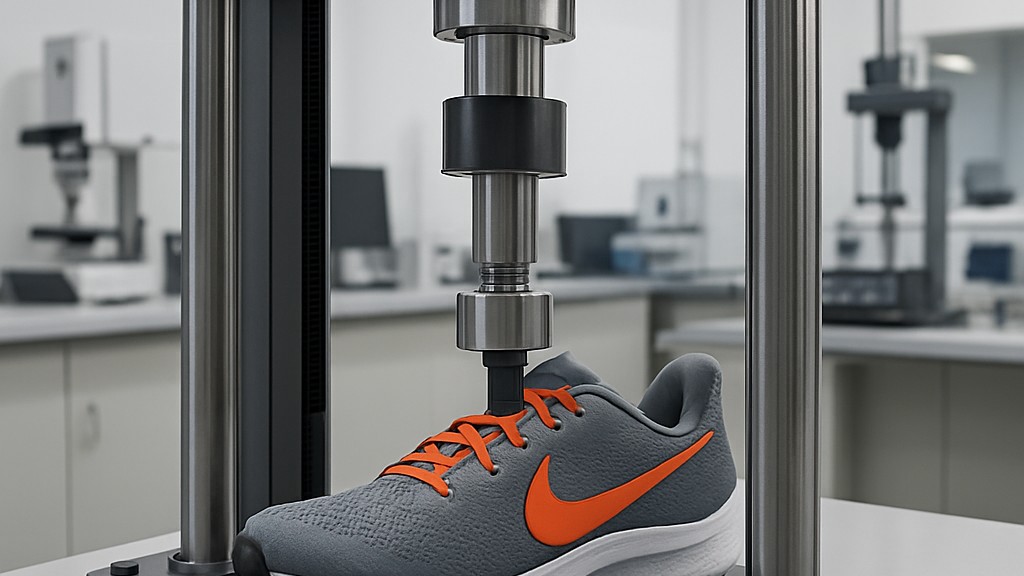
This test method covers three different procedures for the performance of rapid-rate force application:
The material system response for rapid-rate force application may differ for each of the three procedures of this test method.
This test method is based on the use of an 8,5 kg mass dropped from a height of 50 mm to generate peak compression forces similar to those experienced by the midsole in heel strike tests for normal running motion. This requires the specimen to be rigidly supported and the energy to be transmitted through a 45 mm diameter straight tube (striker).
This test method applies an impulse to create a fast-ratio compression force-displacement hysteresis loop and evaluates the shock attenuation properties of the specimen. The maximum energy applied to the specimen occurs at peak displacement and should be within +10% of a reference value used to normalize the data for comparative purposes.
Shock attenuation properties for this test method are in terms of energy lost during the hysteresis cycle, peak pressure, maximum stress, and average stiffness. Each of these properties has varying importance depending on the design objectives of the material system in the athletic footwear product.
Test results obtained with this test method are characterized by the specimen thickness and the reference maximum energy applied. Nominal specimen thickness values for this test method range from 5 to 35 mm. The standard value for the reference maximum energy applied by this test method is 5,0 J. Other values may be used if clearly stated in the report.
For Procedure A, using a mass of 8,5 kg and an initial distance of 50 mm between the tube and the sample produces the required impulse and results in maximum energy applied values in the range of 5 + 0,5 J, depending on sample thickness and material response.
For Procedures B and C, the required impulse is generated so that the maximum applied energy is within 10 percent (5 J) of the reference value and the time to reach the peak control variable (force or displacement) is 15 ms + 5 ms.
The shock-attenuating properties of material systems for athletic footwear focus on understanding and evaluating how different materials and material combinations used in athletic footwear absorb and dissipate impact forces. This is crucial for reducing the risk of injury and improving performance in athletes. Shock attenuation refers to the reduction of impact forces transmitted to the body. This process involves the following mechanisms: energy absorption, energy dissipation, and load distribution. These measurement techniques are used to determine these properties: G-force reduction, impact testing with drop towers or force plates, and time to peak force.
For footwear performance and safety, the ASTM F1614 standard provides:
The ASTM F1614 standard typically uses a gravity-driven impact test, where a mass is dropped onto a test specimen. Key measurements include peak G-force (shock), energy return (rebound), and deformation characteristics.
In short, this standard is essential for ensuring that footwear materials are safe, comfortable, and effective at absorbing impact. It is an essential tool for developers, manufacturers, and regulatory bodies in the footwear and protective equipment industries.
Our organization, which has been supporting businesses across all sectors for years through a wide range of testing, measurement, analysis, and evaluation activities, has a strong team of employees who closely follow global developments in science and technology and are constantly improving themselves. In this context, we also provide testing services in accordance with the "ASTM F1614 Standard Test Method for Shock Reduction Properties of Material Systems for Athletic Footwear."
To get an appointment, to get more detailed information or to request an evaluation, you can ask us to fill in our form and reach you.

