

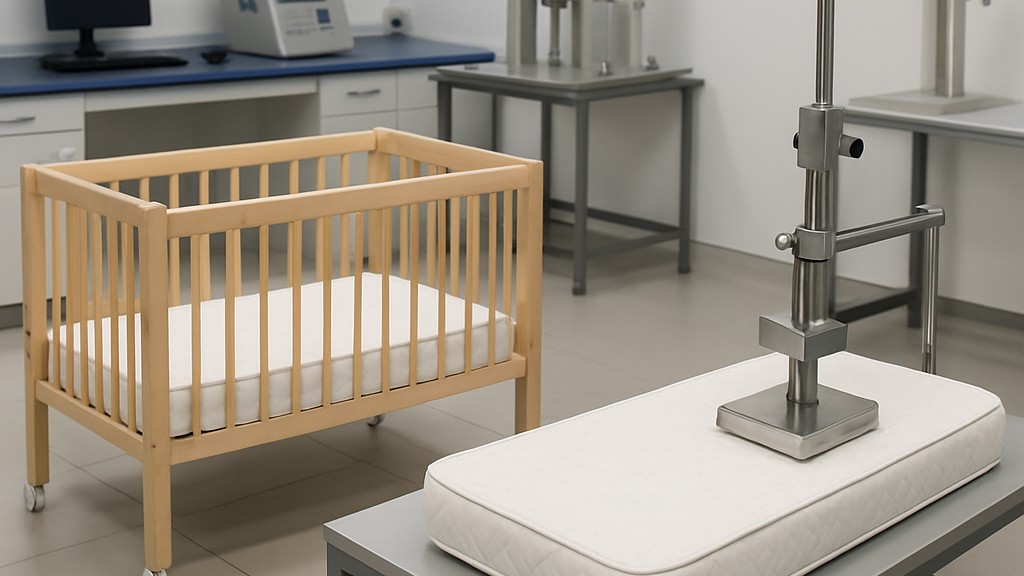
The European standard "EN 16890 Children's furniture - Cots and bassinets - Safety requirements and test methods" describes the safety requirements and test methods for mattresses, including mattress bases and mattress tops, used in cots, travel cots, bassinets, and sling beds for both domestic and non-domestic use. This standard does not apply to carrycot and pram body mattresses, air mattresses, waterbeds, or mattresses used for medical purposes.
For the purposes of this standard, the following terms and definitions apply:
Furniture is tested as delivered. Unless otherwise specified, tests are performed on the same sample. Unless otherwise specified by the manufacturer, the sample is stored indoors for at least 24 hours immediately prior to testing. Tests are conducted indoors. However, if the temperature during testing is outside the range of 15°C to 25°C, the maximum or minimum temperature must be recorded in the test report.
Test forces in endurance and static load tests should be applied slowly enough to ensure negligible dynamic load. Forces in endurance tests should be applied slowly enough to prevent kinetic heating. Unless otherwise specified, static forces should be maintained for 10 seconds plus/minus 2 seconds. Unless otherwise specified, endurance forces should be maintained for 2 seconds plus/minus 1 second. Forces may be replaced by masses. The relationship 10 N = 1 kg is used.
Unless otherwise stated, the following tolerances apply:
For the purpose of uncertainty measurement, test results are assumed not to be adversely affected when the above tolerances are met.
The aim of the EN 16890 standard is to ensure safer sleep for babies and toddlers. Safety is undeniable in the world of children's products. Parents and caregivers entrust their cribs and cribs to babies and toddlers, the most vulnerable members of their families. Therefore, every component, especially the mattress, must meet rigorous standards. This is where EN 16890 comes in, which has become a key element in ensuring sleep safety for manufacturers, retailers, and regulators. This standard provides comprehensive guidelines to prevent accidents such as suffocation, entrapment, and material degradation. This standard addresses a critical gap in child safety regulations and complements EN 716-1 and similar standards for cribs.
The EN 16890 standard applies to mattresses designed for cots, travel cots, bassinets, and sling beds. Targeting products for children up to 18 months, it emphasizes the importance of a firm, breathable sleep surface that minimizes risks. This standard excludes certain products, such as mattresses for carrycots or strollers, inflatable or water-filled options, and those intended for medical use, to avoid conflicting with specific regulations. The primary goal is to create a safe sleep environment that reduces hazards while supporting healthy development.
At its core, the EN 16890 standard requires a set of mechanical, chemical, and performance-based requirements to ensure that bearings can withstand daily use without compromising safety. The key elements of this standard are:
These requirements prevent the possible release of gas that could lead to situations such as exposure to a chemical.
The EN 16890 standard details precise test methods for assessing durability and performance:
Ultimately, the EN 16890 standard demonstrates a commitment to child well-being by translating abstract safety ideals into concrete safeguards. By prioritizing firmness, breathability, and durability, it ensures that the first bed a baby calls home is a haven, not a risk. For anyone working in the children's furniture industry or simply looking for a crib mattress, this standard is not just a guideline; it's a lifeline.
Our organization, which has been operating for many years and meticulously follows global developments in science and technology, employs a team of experienced professionals and a broad infrastructure to conduct testing, measurement, and analysis in a wide range of areas for businesses across all sectors. In this context, we also provide testing services in accordance with the EN 16890 Children's furniture - Baby beds and cribs - Safety requirements and test methods standard.
To get an appointment, to get more detailed information or to request an evaluation, you can ask us to fill in our form and reach you.

