

The European standard "EN 12727 Furniture - Arranged seating - Requirements for safety, strength and durability" describes the requirements for the safety, structural strength, and durability of all types of seating permanently fixed to the floor or wall, whether in the form of benches or armchairs. This standard does not apply to freestanding seating or street furniture that is not fixed to the floor or wall. It also does not include requirements for resistance to ageing, deterioration, flammability, the effects of ambient temperature, or durability of upholstery materials.
For the purposes of this standard, the following terms and definitions apply:
General test conditions will be in accordance with the “EN 1728 Furniture - Seating - Test methods for determining strength and durability” standard.
The seat must be designed to minimize the risk of injury to the user. All accessible parts must be designed to avoid physical injury or damage. This requirement is met if:
Movable and adjustable parts must be designed to prevent injury and accidental activation. It must not be possible for any load-bearing part of the seat to become unintentionally loose. All parts lubricated to facilitate sliding must be designed to protect users from oil stains during normal use.
Only shear and compression points created during installation and folding, including tilt chair actions, are acceptable unless the following conditions apply, as it can be assumed that the user is able to control their movements and immediately stop applying force if they feel pain:
The edges of the parts that move relative to each other and create shear and compression points will be as specified above.
Except for tilting chairs, there should be no shear or pinch points created by motorized seating components (e.g., springs and gas lifts). There should be no shear or pinch points created by forces applied during normal use. If the user's weight creates a hazard during normal movements and actions, such as adjusting the backrest, there should be no shear or pinch points. This hazard is best prevented by the use of automatic locking mechanisms.
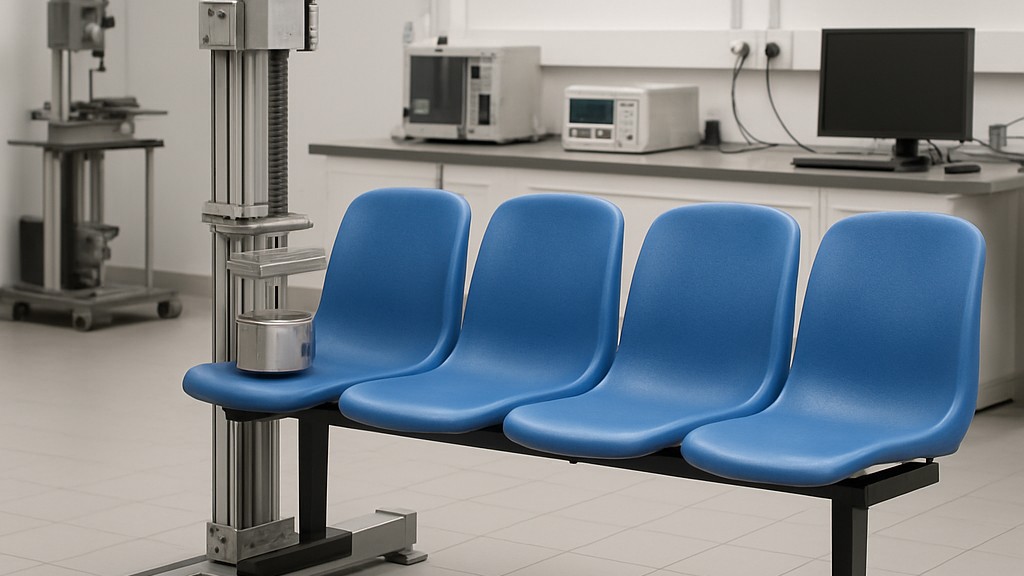
Seats should be tested for strength and durability in the order listed in the table titled "Strength and durability tests." Guidance on selecting the test intensity, taking into account the product's end-use, is included in the standard appendix (Annex B). For multiple seating units, all seats not subject to testing shall be loaded to 950 N if required by EN 1728.
The tests foreseen in the table titled “Strength and endurance tests” are as follows:
According to this table, after the test, the following conditions are considered to be met:
The EN 12727 standard is important because it specifies the safety and performance requirements for tiered seating (e.g., stadium seating, auditoriums, or similar fixed seating arrangements) used in public and private venues across Europe. The main reasons for this are:
Our organization, which has been supporting businesses across all sectors for years through a wide range of testing, measurement, analysis, and evaluation activities, has a strong team of employees who closely follow global developments in science and technology and are constantly improving themselves. In this context, we also provide testing services in accordance with the EN 12727 Furniture - Row seating - Safety, strength, and durability requirements standard.
To get an appointment, to get more detailed information or to request an evaluation, you can ask us to fill in our form and reach you.

