

The European standard "EN 1957 Furniture - Beds and mattresses - Test methods for determining functional characteristics and evaluation criteria" describes test methods for determining the durability and firmness of mattresses and all types of fully assembled beds with mattresses (and mattress pads when they form a single unit with the mattress). These methods do not apply to waterbeds, air mattresses, or cots.
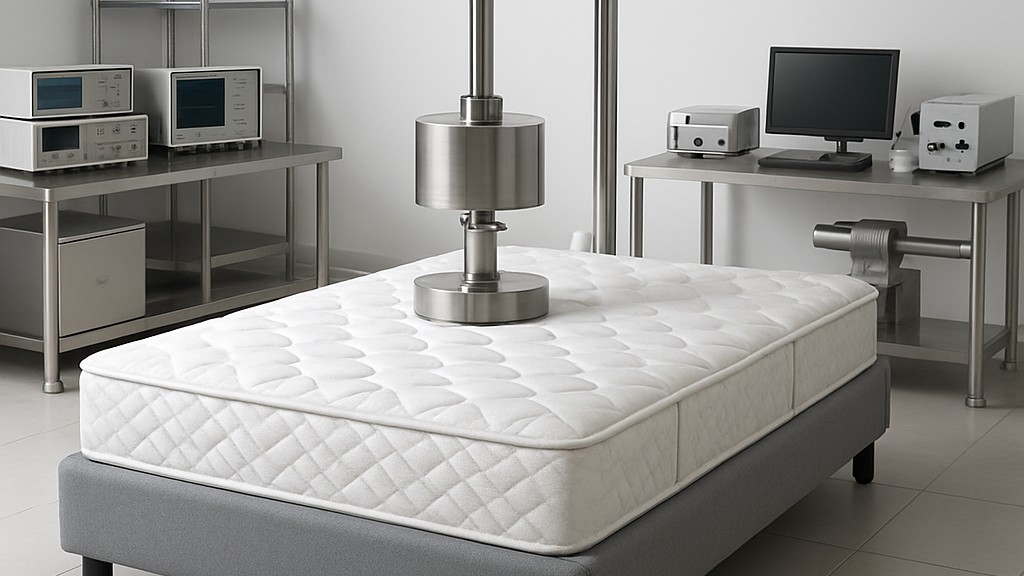
This standard includes a method for determining the firmness of a mattress or bed based on subjective assessment by individuals (Appendix A). However, the firmness rating cannot be used to indicate the comfort or quality of a mattress or bed.
Ageing and deterioration caused by air, light, humidity, and temperature are outside the scope of this standard. Test results are only valid for the product tested. If test results are intended to be applied to other similar products, the test sample must be representative of them.
For the purposes of this standard, the following terms and definitions apply:
During the pre-conditioning process, the test unit should be conditioned under standard climatic conditions of 23°C plus/minus 2°C and 50% plus/minus 5% relative humidity for at least one week immediately prior to testing, unless otherwise specified by the manufacturer. Subsequent conditioning should also be carried out under these climatic conditions.
Tests should be carried out under indoor conditions, but if the temperature during the test is outside the range of 15 degrees to 25 degrees, the maximum or minimum temperature should be recorded in the test report.
During conditioning and transport, beds should be kept level and unloaded.
If a test cannot be performed as specified in this standard, for example if a loading pad cannot be used to apply force due to the design of a product, the test should be performed as specified whenever possible.
Complete bearings should be tested as delivered. Unassembled bearings should be assembled according to the instructions provided with the test unit. If the test unit can be assembled or assembled in different ways, the most unfavorable combination should be used for testing. Detachable fasteners should be tightened before testing.
If necessary, the bearing pads should be prevented from moving during the test by a suitable method (e.g. adhesive tape or pins).
Where the firmness of bed bases is adjustable, the adjustment during testing should be recorded in the test report.
If the manufacturing information states that the mattress has a soft and a hard side, each side should be tested using separate mattresses.
Unless otherwise stated, the tolerances specified in the standard are applied to the test equipment.
All tests must be performed on the same test unit and in the following order:
In furniture production and consumer safety, standards play a crucial role in ensuring that everyday items like beds and mattresses meet rigorous performance criteria. The EN 1957 standard provides comprehensive test methods for assessing the functional properties of beds and mattresses. This standard is vital for manufacturers, retailers, and regulators across Europe, helping to ensure durability, safety, and user comfort in home environments.
The EN 1957 standard specifies standardized laboratory test methods for evaluating the durability, firmness, and overall performance of fully assembled domestic beds (including bases and mattresses) and freestanding mattresses. This standard focuses on functional aspects such as mechanical strength, durability under repeated use, and resistance to deformation, but does not cover specialized products such as waterbeds, air mattresses, or cots. This standard emphasizes objective measurements to classify products according to their ability to withstand typical domestic stresses, aiding quality control and consumer assurance.
Unlike broader furniture standards (e.g., EN 1021 for flammability), the EN 1957 standard focuses on sleep-related furniture, providing criteria for pass/fail assessments that inform labeling and marketing claims. This standard aligns with the European Union's general product safety directive and encourages harmonized testing across member states.
The EN 1957 standard outlines a series of mechanical tests performed in controlled environments, typically at 23°C and 50% relative humidity after one week of conditioning. The basic procedures are:
The results are factored into the evaluation criteria that grade products (e.g., Grade 1 for basic use, higher for premium use). This standard references tools like digital load cells for accuracy. These tests ensure that products can be used without compromising safety for an average of 5-10 years.
The EN 1957 standard applies primarily to domestic beds and mattresses sold in European Union countries, influencing designs in the residential, hospitality, and healthcare sectors. Manufacturers use it for CE marking compliance, while retailers leverage the results for eco-labels such as the EU Eco-Label.
Compliant products reduce the risk of injuries from collapse or excessive sagging, which account for thousands of claims each year. In a market shifting toward sustainable materials, the standard supports innovation in environmentally friendly foams and frames. Comparisons with global standards such as ASTM F1566 support exports by highlighting differences in platen design and procedures. In short, the EN 1957 standard increases consumer confidence, minimizes returns, and raises industry standards.
Ultimately, the EN 1957 standard remains a vital tool for ensuring that beds and mattresses deliver on their promises of comfort and longevity. By standardizing functional performance tests, it protects users while guiding manufacturers toward excellence. As sleep health grows in importance, the standard's role in promoting reliable, safe furniture becomes even stronger.
Our organization, which has been operating for many years and meticulously follows global developments in science and technology, employs a team of experienced professionals and a broad infrastructure to conduct testing, measurement, and analysis in a wide range of areas for businesses across all sectors. In this context, we also provide testing services in accordance with the EN 1957 Furniture - Beds and Mattresses - Test Methods for Determining Functional Properties and Evaluation Criteria standard.
To get an appointment, to get more detailed information or to request an evaluation, you can ask us to fill in our form and reach you.

