

The "ASTM F355-23 Standard Test Method for American National Standard for Impact Absorption of Playing Surface Systems, Other Protective Sports Systems and Materials Used in Athletics, Recreation and Play" standard, developed by the American Society for Testing and Materials (ASTM) , measures the impact absorption of surface systems and materials, particularly peak impact acceleration (impact shock), and calculates criteria for head injury produced under predicted impact conditions.
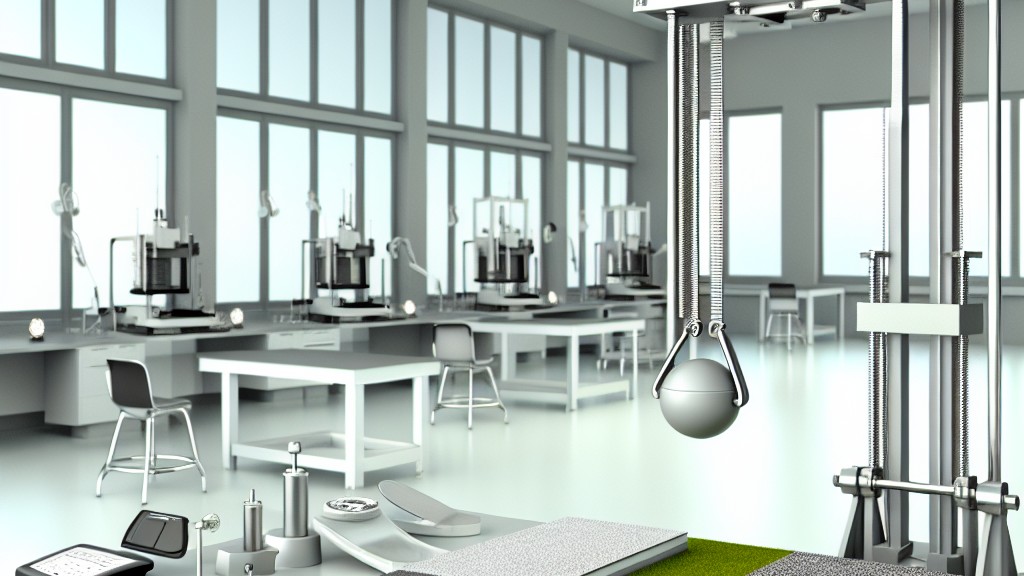
This test method is applicable to surface systems designed to provide impact absorption, whether made from naturally occurring or synthetic materials. This test method is applicable to impact absorption mats and padding used in sports facilities, including, but not limited to, stadium wall infill, gymnastics mats, wrestling mats, turf playing systems, pole vault landing systems, and playground protective surfaces.
This test method is used to measure the impact absorption of materials and components used as protective padding on trampoline frames, goal posts and the like, but the material or component must be capable of being tested separately from the equipment to which it is attached.
Without modification, this test method should not be used to test materials and components that are attached to structures or equipment or finished products unless the impact absorption of the entire system is of interest.
Although it is widely believed that lower values for impact damping may reduce the severity of impact injuries, the relationship between the results of this test method and specific injury risk is within automotive test data.
A test specimen or mounted surface system is impacted by a specified missile of specified mass and geometry, at a specified speed or height, as specified in the specification or test method. An accelerometer mounted on the missile is used to record the acceleration-time history of the impact. Peak acceleration and duration are used as measures of impact severity.
This test method defines two missiles for use in playing surface impact tests:
Both missiles are equipped with three-axis accelerometers. The specific masses and geometries of the missiles are detailed in the standard annex (Annex A1).
The results of this method quantify the impact attenuation of playing surface and system samples under specified test conditions in a laboratory or on-site installation where the surface system is installed for use. The test method measures the result of impacts performed under specified conditions. It does not quantify the intrinsic material properties of the tested samples. Test results from different samples obtained under the same conditions (i.e., same missile mass and geometry, drop height, etc.) are used to compare the impact attenuation under those conditions. Test results obtained under different conditions are not comparable. Those obtained specifically with different missiles are not equivalent and cannot be directly compared. Similarly, test results obtained using the same missile but using different drop heights are not directly comparable.
Test samples shall be representative of the surface system or protective infill intended for use. The minimum distance between the outer dimension of the missile and the edge of the sample shall be at least 25,4 mm and shall not be less than the thickness of the sample. Where the sample is to be tested in a controlled laboratory, a method of containment for the sample shall be required if specified in the appropriate standard.
A test protocol that specifies the test procedure in the system specification when testing is to be performed on an installed surface or in a location where it will be used. The procedure typically includes impact velocity or drop height, test locations, surface preparation, temperature, and requirements for collecting, recording, storing, and reporting data. Where missiles and annexes to this standard are used in the testing of surface systems, the appropriate specification provides all necessary reference or approval procedures.
The number of samples tested as a sample often varies greatly depending on the intended use of the data. It is recommended that at least two samples be tested for each set of conditions. To achieve a certain level of quality assurance, the sampling procedures of ASTM E105 and ASTM E122 standards should be followed. The appropriate standard will have requirements for the number and size of samples required for laboratory testing. If testing is to be done at the installation or in-use location, the appropriate standard will provide direction on the number of test locations and how to determine them.
In a laboratory, samples should not be stacked during any conditioning. They should be in the intended use condition or preconditioned at 50 percent plus/minus 2 percent relative humidity and 23 degrees plus/minus 2 degrees for at least 4 hours or until the desired temperature is reached. The characteristics of the surface system to be field tested outline any conditions required for conditioning or preparing the surface or selection of the test location. Because many materials are subject to extreme surface temperature changes, varying thermal conductivities, and extreme time dependence of temperature profiles, such testing can introduce variability.
Our organization, which has been trying to support businesses from every sector with its testing, measurement, analysis and evaluation studies carried out in a wide range for years, has a strong staff that closely follows the developments in the world in the field of science and technology and constantly improves itself. In this context, testing services are also provided to businesses in accordance with the standard "ASTM F355-23 Standard test method for the American national standard for impact reduction of playing surface systems, other protective sports systems and materials used for athletics, recreation and games".
To get an appointment, to get more detailed information or to request an evaluation, you can ask us to fill in our form and reach you.

