

All products designed for a child up to 36 months of age to eat independently or with the assistance of another person are covered by this standard. This includes products that have a distinct primary function but a secondary function that allows the child to eat independently or with the assistance of another person.
Pre-prepared food containers or cutlery and feeding utensils designed for special medical applications or for use under medical supervision are outside the scope of this standard.
This standard includes test methods for specified mechanical and chemical requirements and requirements for instructions for use. Some products are designed as toys or with toy-like features. These products must also meet the relevant requirements of the standard "EN 71 Safety of Toys."
This standard does not apply to drinking equipment (feeding bottles, teats, cups and glasses) within the scope of standards EN 14350-1 and EN 14350-2.
For the purposes of this standard, the following terms and definitions apply:
All materials must comply with the requirements of this standard. Visually and tactilely, all components of cutlery and feeding utensils must be free of points and edges that could cause injury when assembled for use. The product must be free of splinters, burrs, and burrs. Accessible points must not be the sharp points defined herein. Accessible edges must not be the sharp edges defined herein. When placed in a small parts cylinder, no component part of the tested sample shall fit completely into the cylinder in any orientation and without compression.
To prevent trapping of fingers, the device must not have an accessible hole that allows insertion of a 5,5 mm diameter rod, except for an accessible hole that allows insertion of a 12 mm diameter rod or has a penetration of less than 10 mm. This requirement applies only to components constructed from materials with a Shore A hardness greater than 60 IRHD. Circular holes that do not meet this requirement risk restricting blood circulation. Furthermore, non-circular holes with narrow V-shaped angles or inward-facing holes that are not well rounded should be avoided.
For printed decorations, when tested in accordance with EN ISO 2409, no decorative print should be removed from any product. Adhesive labels should not be used.
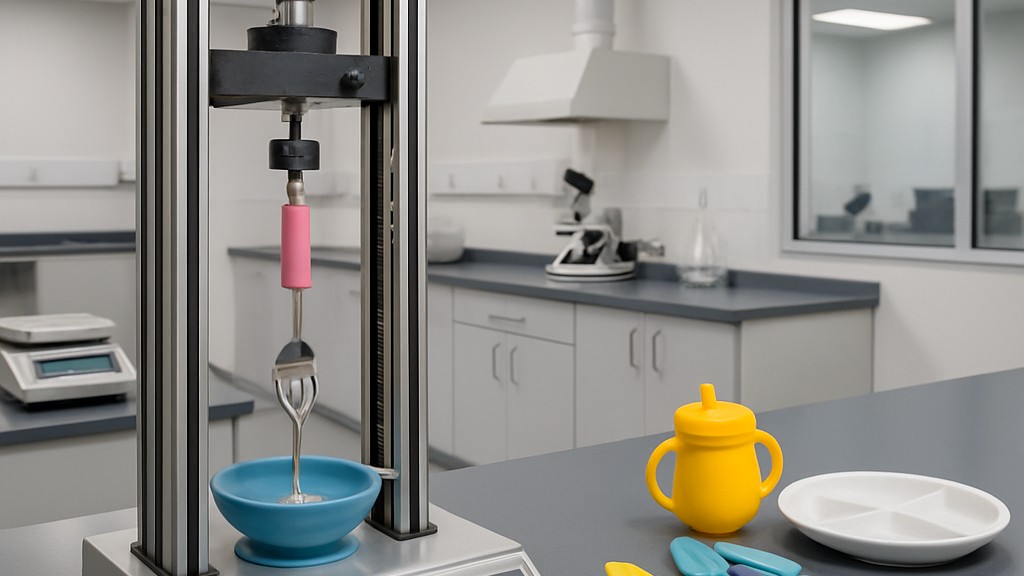
Besides the general requirements, this standard includes requirements for mechanical requirements (tensile strength, torque test, tear resistance, strength and hardness, and drop test) and chemical requirements (requirements by material, migration of certain elements, phthalate content, volatile compound content, formaldehyde release, nickel release, and bisphenol A (BPA) release).
In short, EN 14372 specifies the safety requirements and test methods for cutlery and feeding utensils intended for use by infants and young children. This standard ensures that such products are safe, non-toxic, and fit for purpose, minimizing the risk of injury or chemical exposure during feeding.
Infants and young children are particularly vulnerable to physical injury and exposure to hazardous substances. This standard was developed to regulate the quality and safety of nutritional products such as:
The purpose of this standard is to reduce the risks associated with:
This standard applies to reusable and disposable cutlery and feeding utensils made of all materials (plastic, metal, wood, silicone, and similar). Products excluded from the scope of this standard include:
The EN 14372 standard includes specific test procedures for assessing compliance. These include:
In order for products to be offered for sale in the European market, they must pass all tests to be considered compliant and receive the CE mark.
Compliance with the EN 14372 standard is vital for manufacturers in terms of:
The EN 14372 standard is considered important for the following reasons:
This significantly reduces the likelihood of accidents during feeding.
These chemicals have been linked to developmental, hormonal, and neurological problems in children. This standard ensures that the materials are non-toxic and safe for repeated food contact.
This reduces the risk of bacterial contamination and foodborne illness, to which babies are particularly susceptible.
This helps parents and caregivers make safe and informed decisions when choosing products for their children.
This ensures that kitchenware lasts longer, performs reliably and does not break under normal use, which could otherwise pose a risk.
Consequently, the EN 14372 standard plays a vital role in protecting babies during feeding, one of the most critical early stages of life. As legal regulations evolve, adhering to these standards ensures that baby products are not only functional and durable, but also free from harmful substances and design flaws. When purchasing baby feeding accessories in the European Union, attention is always paid to compliance markings and certifications.
Our organization, which has been operating for many years and meticulously follows global developments in science and technology, conducts testing, measurement, and analysis in a wide range of areas for businesses across all sectors with a team of experienced professionals and a broad infrastructure. In this context, we also provide testing services in accordance with the EN 14372 Childcare Products - Cutlery and Feeding Utensils - Safety Requirements and Testing standard.
To get an appointment, to get more detailed information or to request an evaluation, you can ask us to fill in our form and reach you.

