

The European standard “EN 16510 Residential solid fuel heating appliances” consists of the following sub-sections published under the same title:
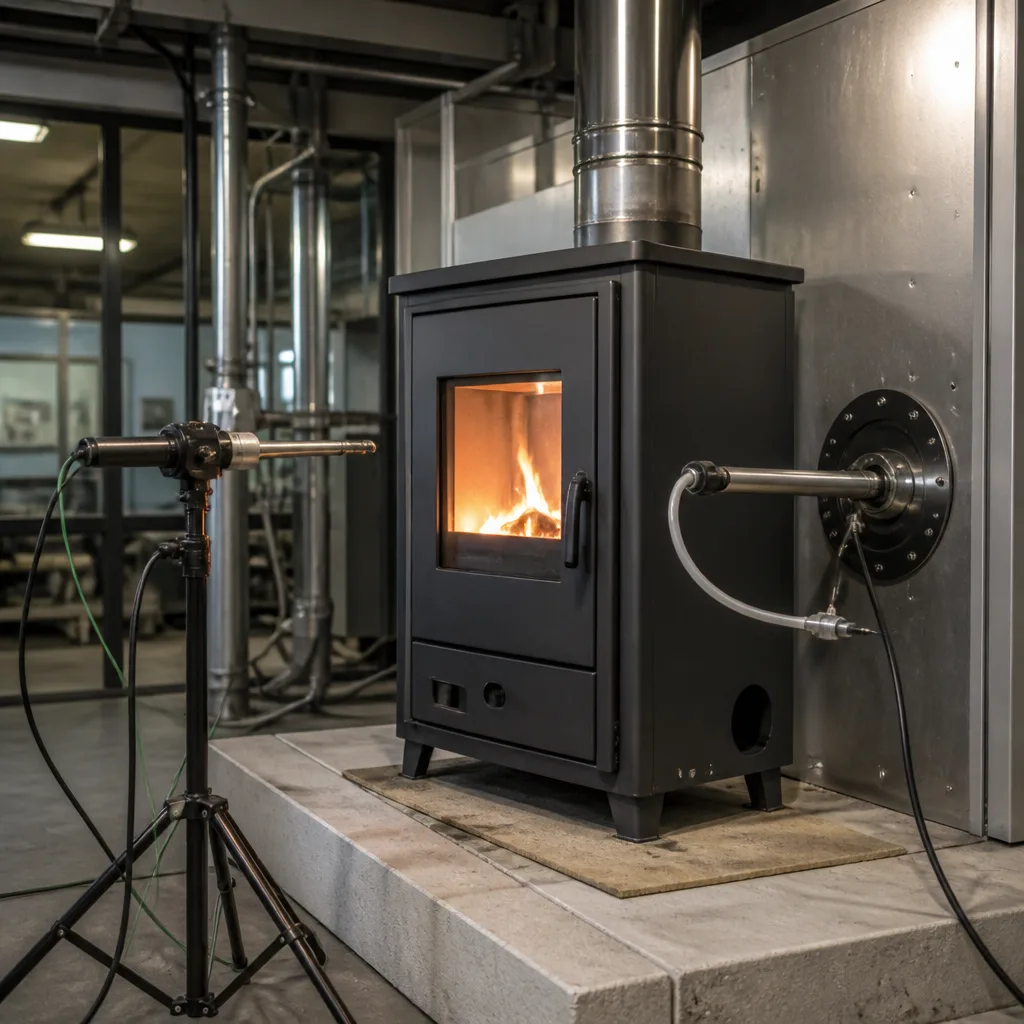
This standard describes the requirements and provides instructions for the design, manufacture, construction, safety, and performance (efficiency and emissions) of solid fuel-fired appliances. It also includes provisions for assessing the conformity of these appliances, namely initial type testing and factory production control and marking.
This standard specifies emission test methods for carbon monoxide, nitrogen oxides, organic gaseous carbon, and particulate matter. This standard also applies to appliances intended to carry flue gas loads.
Appliances that draw combustion air from the outside of the building through a non-airtight duct system are not considered to have achieved room airtightness.
This standard does not apply to appliances with boiler parts that come into contact with fire or flue gases, unless the boiler parts are made of steel or cast iron. It also does not apply to appliances with boilers designed for water systems with the following characteristics:
This standard does not apply to devices that are intended to operate with ventilation systems where the device is intended to operate at a pressure below -15 Pa relative to the outside atmosphere in the installation room.
It is part of the modular EN 16510 series of standards, which replaces many older standards, particularly the EN 13240 standard for room heaters, with the aim of harmonizing safety, performance, emission and efficiency requirements for solid fuel appliances across the EU.
This standard does not cover open fires without doors, stoves, boilers, pellet-fired appliances (which fall under other sections such as EN 16510-2-6), or appliances with significant functional modifications.
The intended use is space heating in residential buildings. Some models may include an integrated boiler for hot water.
This standard works in conjunction with EN 16510-1, which provides common test procedures for emissions, efficiency, and safety. Part 2-1 contains specific requirements and verification procedures for room heaters.
The intended use of these devices is for space heating in residential buildings. For central heating systems, they may be equipped with a boiler (an integral part of the device containing the water to be heated) for hot water supply. The surroundings of these devices are integrated with the building, with the exception of freestanding devices and built-in devices mounted in fireplace recesses or housings.
These devices can burn one or more of the following solid fuel types:
This standard also applies to built-in appliances with a nominal heat output of up to 15 kW.
This standard does not apply to appliances with fan-assisted combustion air or mechanically fed appliances. Furthermore, open fireplace components such as bottom grates and associated fireboxes intended to be mounted in an existing heat-resistant, insulated firebox are not covered by this document.
This standard specifies procedures for evaluating and verifying the performance continuity of solid fuel built-in appliances, including open fireplaces.
These devices can burn one or more of the following solid fuel types:
This standard does not apply to devices with fan-assisted combustion air or mechanically fed devices.
This standard specifies the procedures for evaluating and verifying the consistent performance of solid fuel cookers.
The devices are intended for space heating in residential buildings. This is achieved through hot water supply for direct or central heating. They are designed for use only with open ventilated systems at operating pressures not exceeding 2 bar.
These devices can burn one or more of the following solid fuel types:
The devices are operated with or without a ventilation system. Depending on their intended use and the possible mode of operation in conjunction with a room ventilation system, the devices are classified according to their airtightness.
This standard does not apply to:
This standard specifies the procedures for evaluating and verifying the performance continuity of freestanding boiler devices that operate on solid fuel.
The devices are intended for space heating in residential buildings. For central heating systems, they can be equipped with a boiler or heat exchanger (an integral part of the device containing the water to be heated) for hot water supply.
These slow heat release devices can be supplied as a fully assembled unit or as a pre-designed unit consisting of pre-fabricated components designed for on-site construction according to specified assembly instructions.
These devices can burn one or more of the following solid fuel types:
This standard does not apply in the following cases:
This standard specifies procedures for evaluating and verifying the performance continuity of slow-release solid fuel appliances.
These devices typically use auxiliary energy, which is also measured in this standard. They can be operated with natural draft or fan-assisted combustion air. A fan-assisted device continues to operate under negative pressure in the flue gas system.
These appliances only burn wood pellets as directed. They only operate when the fire lids are closed.
This standard does not apply to the following devices:
This standard specifies procedures for evaluating and verifying the sustained performance of the mechanical properties of room heaters, built-in appliances, and stoves powered by wood pellets.
The devices are intended for space heating in residential buildings and can also be used for cooking. For central heating systems, they can be equipped with a boiler (an integral part of the device containing the water to be heated) for hot water supply.
These devices typically use auxiliary energy, which is also measured in this standard. They are operated by natural draft and may be fan-assisted. A fan-assisted device still operates under negative pressure in the flue gas system.
These appliances burn only wood pellets and logs in accordance with the appliance instructions. They only operate when the fireboxes are closed. These appliances may have an integrated fuel tank or be combined with an external fuel tank. These appliances may be equipped with a single or double combustion chamber with a single flue gas outlet.
This standard specifies the procedures for evaluating and verifying the consistent performance of wood and pellet-fired combination appliances.
This standard does not apply to the following devices:
This standard applies to appliances equipped with fully integrated wood pellet baskets that are an integral component of the device. If the appliance is to be used to burn wood logs or compressed untreated wood (wood briquettes), the configuration of the combustion chamber may be modified according to the instructions. Different fuels cannot be operated simultaneously.
The intended use of these appliances is space heating in residential buildings and (when properly tested) they can also be used for cooking. These appliances may be supplied as a fully assembled unit or as a pre-designed unit consisting of pre-manufactured components designed for on-site installation according to specified installation instructions. They only operate when the fire doors are closed.
This standard does not apply to the following devices:
This standard specifies and provides instructions for the design, manufacture, construction, safety, and performance (efficiency and emissions) of multi-burner sauna stoves that use wood logs. It also includes provisions for conformity assessment (i.e., initial type testing and factory production control) and marking of these products.
This standard applies to manually ignited, intermittent-burning multi-fire sauna stoves that provide heat to the area where they are installed. These multi-fire sauna stoves may be supplied as a fully assembled appliance or as a unit consisting of pre-manufactured components designed for on-site installation according to the manufacturer's specified assembly instructions. One-off installations are not included.
These multi-burner sauna stoves can only burn natural wood logs, provided the appliance is used according to the instructions.
Single-fire heat storage sauna stoves, where the stones are heated directly by fire and flue gases passing through them, are not covered by this standard. This standard also does not apply to mechanically fed sauna stoves, sauna stoves with fan-assisted combustion air, sauna stoves with boilers, sauna stoves with integrated flues, or sauna stoves with any electrical connection.
For many years, our organization, with its competent and experienced staff, has been understanding the needs of its clients, providing the advanced testing services they require, and assisting them in the establishment, implementation, and improvement of management systems. Within this framework, we also provide testing services in accordance with the EN 16510 standard.
To get an appointment, to get more detailed information or to request an evaluation, you can ask us to fill in our form and reach you.

