EN 13061 Knee Pads for Football Players - Requirements and Test Methods
The European standard “EN 13061 Protective clothing - Knee pads for football players - Requirements and test methods” describes the general requirements for the ergonomics, safety, sizing, coverage, performance, and cleanliness of knee pads for football players. This standard also defines test methods and performance levels. Furthermore, it specifies requirements for marking the knee pads and the information that must be provided with them.
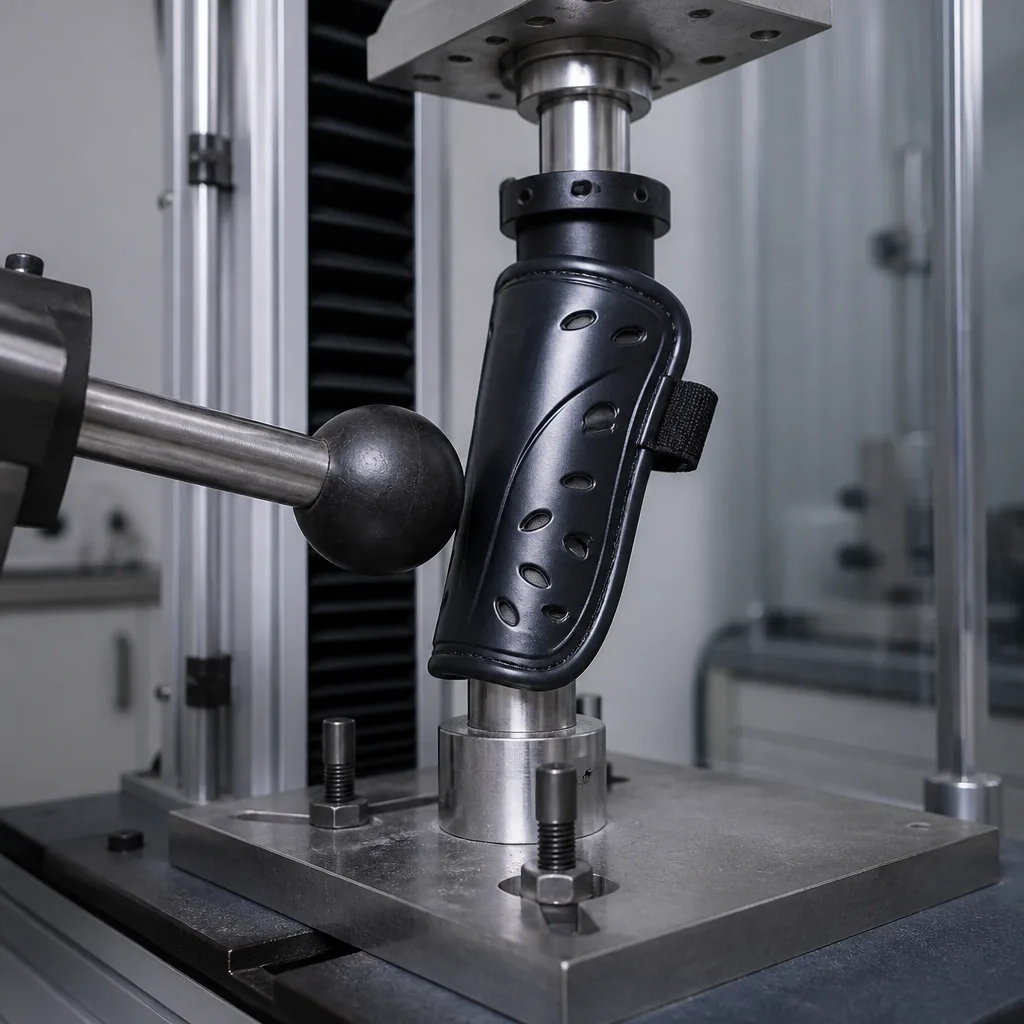
Knee pads for football players must meet the general requirements of safe use and fitness for purpose, as well as the following specific requirements:
- Construction materials or derivatives thereof must not cause harm to those who come into contact with them. Information on the identification and classification of such substances is contained in Directive 67/548/EEC on the classification, packaging and labelling of hazardous substances and Regulation 1907/2006 on the registration, evaluation, authorization and restriction of chemicals.
- The manufacturer must list the substances used for the main components of the product in the information provided by the manufacturer.
- When tested according to this standard, the product's surfaces must not contain any hard or sharp edges, seams, buckles, or other elements that could cause harm to the user or other players during normal use.
- If there are any protrusions on the inside of the knee brace that can be felt with the fingers, these should also be tested.
- If the outer surface of the knee brace has protrusions greater than 1 mm, these must be tested according to this standard. The knee brace meets this requirement only if the endpoints of the spring of the appropriate measuring instrument contact the surface of the knee brace in all test positions and in all directions of the measuring instrument as described herein.
- From an ergonomic standpoint, knee pads designed for soccer players must allow the user to perform typical game movements (e.g., running, jumping, foot bending) without restriction under predictable conditions of use. If restriction or significant discomfort is reported, the product is considered a failure. A knee pad must be designed to be worn comfortably during soccer activities. Its shape and construction should conform to the player's lower leg without creating unnecessary discomfort or restricting normal movement. Proper ergonomic design is important because a protector that is excessively mobile, creates pressure points, or restricts movement may provide less effective protection.
- In terms of sizing, knee pads designed for soccer players must be size-marked. The size marking should indicate the body height range of the players for whom the knee pad is designed to fit. This standard defines the requirements regarding the dimensions and measurements of knee pads. The product must provide a proper fit for the intended user. Correct sizing helps ensure the protective area remains on the knee during normal soccer activity.
- Knee pads designed for soccer players must be designed to remain in place during normal play and during impacts. The fastening system recommended by the manufacturer or authorized representative must be tested to comply with this standard. When the force is released, the displacement of the knee pad from its initial position must be less than 15 mm or less than 15 percent of the linear dimension of the test area measured in the direction of the applied force (if greater than 15 mm). The materials and construction of the knee pad must not present unacceptable hazards to the wearer. Considerations include potentially hazardous materials, skin contact, and other safety-related features. This requirement is particularly important because knee pads are worn directly on or near the player's body.
- Knee pads for soccer players, when tested according to this standard, must withstand the impact of a 10 mm diameter metal spike. The inner surface of the tested knee pads should not tear or puncture easily. The rigid material should not disintegrate or give rise to potentially injury-causing fragments. The spike should stop less than 25 mm below the zero line. In short, the knee pad must provide an adequate protection area on the lower leg. Coverage area is important because impacts can occur at different points along the knee. Therefore, the standard takes into account the relationship between the dimensions of the protector and the leg area it is intended to protect.
- When tested according to this standard, the transmitted force of three single impacts applied to the same point on three knee braces should not exceed 2,0 kN in either the central or lateral test areas. Impact resistance is one of the most important functional characteristics of a knee brace. This standard includes test procedures to evaluate the product's ability to withstand impacts and provide protection. The aim is not only to prevent the knee brace from breaking, but its structure must also provide an adequate level of impact protection for the user.
The aim of the EN 13061 standard is to establish a consistent level of protection for the lower legs of soccer players. This standard is designed to reduce the severity of injuries resulting from knee pads, impacts, collisions, kicks, and contact with other players or equipment.
The EN 13061 standard applies to knee pads designed for football players. This standard sets general requirements regarding the following:
- Ergonomics and fit
- Harmlessness and material safety.
- Dimensions and measurements
- Protective coverage
- mechanical performance
- Impact protection
- Cleaning and care
- Labeling and product information
This standard also defines appropriate test methods and performance levels for evaluating knee braces.
The EN 13061 standard includes test methods aimed at verifying the performance and safety characteristics of knee pads. Depending on the requirement being evaluated, the tests cover the following areas:
- Size and dimensions specifications
- Protective coating
- Mechanical properties
- Impact resistance
- Fastening/holding features
- Material and structural safety
- Cleaning-related features
- Signage and information requirements
This standard defines performance levels as well as methods for evaluating whether a knee brace meets specified requirements.
The EN 13061 standard also specifies requirements for the marking of knee pads and the information provided with the product. This allows users to identify important product information and understand how to use and maintain the protective equipment. Clear information is particularly important for protective equipment because incorrect sizing, installation, use, or maintenance can reduce its protective properties.
The EN 13061 standard is important because football frequently involves lower leg impacts. A standardized approach allows manufacturers and testing laboratories to evaluate knee pads using consistent requirements and test methods. This standard helps:
- Improving player protection against impacts and collisions.
- To standardize product performance among manufacturers.
- To provide objective testing criteria for knee braces.
- To support proper ergonomic design and fit.
- To check the protective coverage and impact performance.
- To provide users with consistent product information.
- To support product quality and safety assessment.
Therefore, the EN 13061 standard provides a technical framework for evaluating whether a football knee pad is properly designed and performs its intended protective function.
In conclusion, the EN 13061 standard provides a comprehensive framework for the safety and performance evaluation of football knee pads. It covers ergonomics, harmlessness, dimensions, coverage, impact performance, cleanliness, labeling, and user information. By defining requirements and test methods, this standard helps manufacturers develop reliable protective equipment and provides laboratories with a consistent basis for evaluating knee pads.
For many years, our organization, with its competent and experienced staff, has been understanding the needs of its clients, providing the advanced testing services they require, and assisting them in the establishment, implementation, and improvement of management systems. Within this framework, we also provide testing services in accordance with the EN 13061 standard.



