

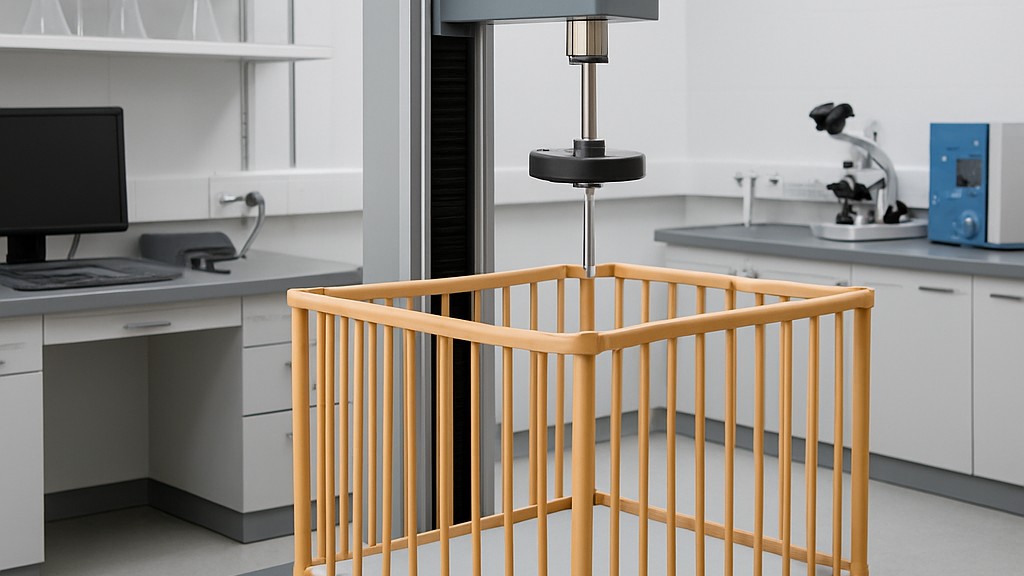
The European standard "EN 12227 Playpens for home use - Safety requirements and test methods" describes the safety requirements and test methods for playpens and folding playpens for home use for children weighing up to 15 kg. If a playpen has more than one function or can be converted to another function, it must comply with the relevant standards. If additional products are planned to be added to the playpen, a hazard and risk analysis must be conducted to identify potential hazards.
For the purposes of this standard, the following terms and definitions apply:
In the busy world of modern parents, playpens offer a valuable haven where babies can explore, sleep, or simply hang out, while parents can breathe. However, this versatility comes with a huge responsibility: ensuring these spaces don't accidentally become hazardous. That's where the EN 12227 standard comes into play.
Harmonized under the European Union's General Product Safety Directive, this standard has been a vital safeguard since its inception, setting standards for structural integrity, hazard prevention, and user guidance. Today, in an era of evolving baby equipment, it continues to provide this assurance.
The EN 12227 standard emerged amid growing awareness across Europe of child injuries associated with nursery products. This standard covers playpens with floors designed to limit and delimit a child's play area in homes, excluding public or institutional use. Multifunctional products, such as those that can be converted into cribs or changing units, must also meet additional standards, such as EN 716 for cots. By harmonizing national differences, EN 12227 facilitates free trade within the European Union while maintaining the precautionary principle for children under 15 kg.
The EN 12227 standard is not a checklist, but a comprehensive defense system against chemical, thermal, and mechanical threats, backed by rigorous testing protocols. It ensures that playgrounds can withstand simulated child chaos, from violent shaking to prolonged loading, and that nothing breaks at a critical moment.
The EN 12227 standard provides the following mechanical and structural safety measures:
This standard imposes the following material and hazard controls:
This standard is based on the following user-oriented elements:
As a harmonized standard, EN 12227 provides presumption of conformity under the European Union's general product safety directive 2001/95/EC. This means compliant products carry the CE mark and face fewer barriers to entry into the single market. Furthermore, national standards based on this standard are enforced through consumer protection laws.
For parents, seeing the CE mark and compliance with the EN 12227 standard on labels is a quick signal of confidence. Meanwhile, as playgrounds become smarter with sensors and apps, the need for updates to electromagnetic compatibility also increases.
Our organization, which has been operating for many years and meticulously follows global developments in science and technology, employs a skilled team and extensive infrastructure to conduct testing, measurement, and analysis in a wide range of areas for businesses across all sectors. In this context, we also provide testing services in accordance with the EN 12227 Playgrounds for Home Use - Safety Requirements and Test Methods standard.
To get an appointment, to get more detailed information or to request an evaluation, you can ask us to fill in our form and reach you.

