EN 12503 Sports Mats
The "EN 12503 Sports Mats" standard, a European standard, consists of the following sub-sections published under the same title:
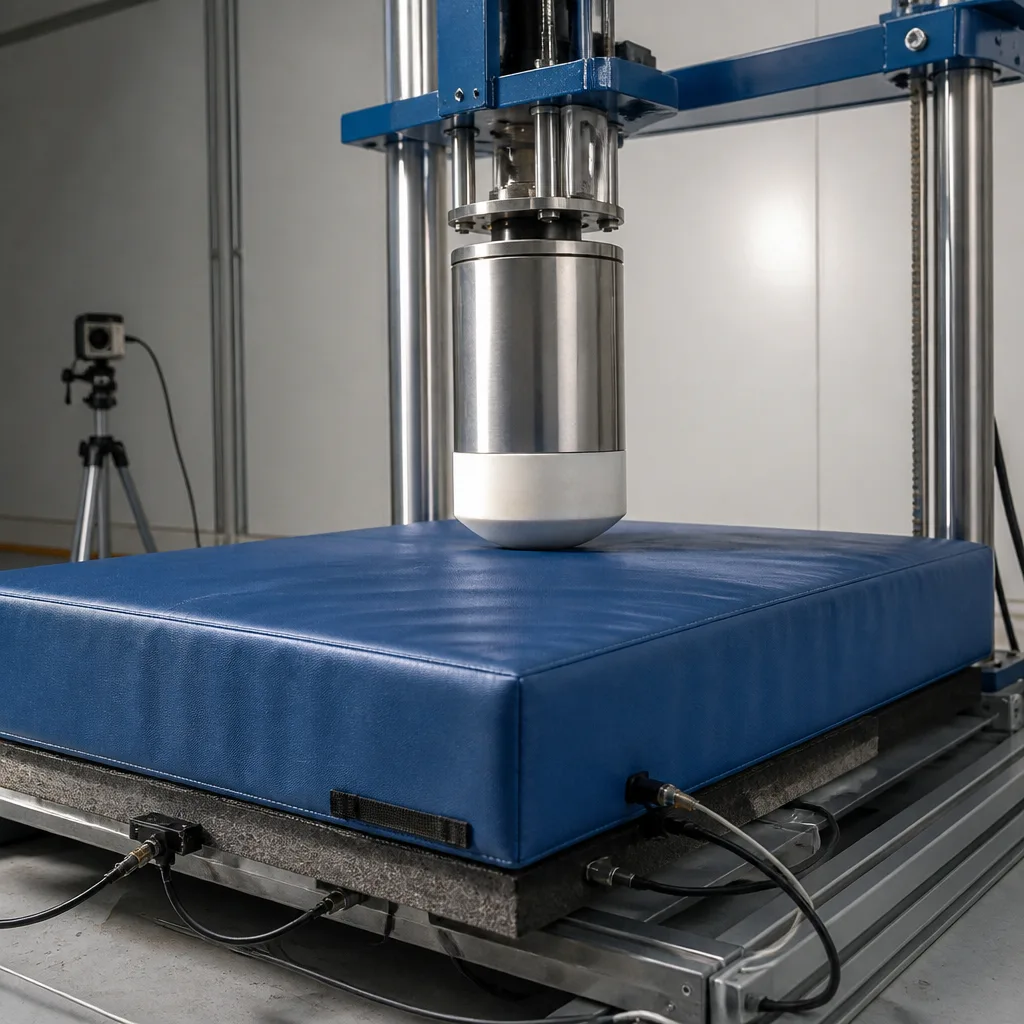
- The standard “EN 12503-1 Part 1: Gymnastic mats, safety requirements” describes the safety requirements (including performance requirements) for 8 types of gymnastics mats used in schools, training, and competitions. Performance and safety values cover shock absorption, anti-slip properties of the base, and surface friction properties. However, for the specific requirements of official international competitions, the relevant international regulations apply.
Gymnastic mats are classified according to their typical intended use, as shown in the table provided within the standard:
- Type 1: Floor exercise mat that doesn't require jumping (basic skills)
- Type 2: Bouncing floor exercise mat
- Type 3: Jumping and landing floor exercise mat
- Type 4: Controlled landing, simple landing mat from the device.
- Type 5: Landing mat
- Type 6: Hard landing mat
- Type 7: Fall mat for simple exercises.
- Type 8: Fall protection cushion
The EN 12503-2 standard applies to types 9, 10, and 11, while the EN 12503-3 standard applies to type 12.
Gymnastic mats are critical safety equipment that absorbs impact during falls, jumps, tumbles, and other physical activities. The EN 12503-1 standard provides manufacturers and users with standardized performance criteria that ensure these mats provide consistent protection while maintaining adequate friction and stability.
The purpose of this standard is:
- To reduce injuries resulting from falls during gymnastics.
- To define consistent safety and performance requirements across Europe.
- To help manufacturers design reliable gymnastics mats.
- To help schools, sports centers, and clubs purchase compatible equipment.
- Improving the overall quality and durability of sports mats.
The EN 12503-1 standard applies to gymnastics mats designed for the following purposes:
- Schools
- sports clubs
- Gymnastics training facilities
- Recreational sports centers
- National and regional competitions
This standard covers:
- Security requirements
- Performance requirements
- Product classification
- Marking requirements
- User manual
International elite competitions may have additional requirements set by international sports federations.
This standard classifies eight types of gymnastics mats:
- Landing mats
- General gymnastics exercise mats
- Foldable cushions
- Training mats
- Multipurpose gymnastics mats
- Cushions for educational environments
- Lightweight training mats
- Special gymnastics mats
Each category has its own size and performance requirements depending on its intended use.
- The standard “EN 12503-2 Part 2: Pole vault and high vault mats, safety requirements” describes the safety requirements (including performance requirements) for Type 3 high vault and pole vault mats used in schools, training, and competitions. This standard specifies performance and safety values for the mat's shock absorption and the anti-slip properties of the base. For specific requirements of official international competitions, relevant international regulations apply.
Pole vaulting and high jump involve athletes clearing a bar and landing from significant heights. Landing mats must safely absorb the energy generated during impact and maintain their structural integrity throughout repeated use.
The objectives of the EN 12503-2 standard are as follows:
- To protect athletes from injuries during landing.
- To establish uniform safety requirements for landing gear across Europe.
- To ensure consistent performance through standardized test methods.
- To support manufacturers in designing safe and robust landing systems.
- To help schools, sports clubs, and competition organizers select appropriate equipment.
The EN 12503-2 standard specifies safety requirements, including performance requirements, for three types of pole vault and high jump mats designed for the following purposes:
- Schools
- Athletics clubs
- Training centers
- Indoor and outdoor athletics facilities
- National and regional competitions
This standard addresses:
- Product classification
- Security requirements
- Performance requirements
- Marking and product identification
International competitions may require adherence to rules set by organizations such as the World Athletics Federation.
This standard covers three categories of landing mats designed for the following purposes:
- High jump
- Pole vault
- Different training and competition practices
Each category has specific design and performance requirements suited to its intended use.
- The standard “EN 12503-3 Part 3: Judo mats, safety requirements” describes the performance and safety requirements for judo mats used in schools, training, and competitions. Performance and safety values relate to shock absorption, stiffness, anti-slip properties of the base, and surface friction properties. These refer to test methods defined in specific standards specified in EN 12503-2. Dimensions and tolerances are given in an informative appendix. For the specific requirements of official international competitions, the relevant international regulations apply.
The EN 12503-3 standard applies to judo mats used for the following purposes:
- Educational institutions
- martial arts training centers
- sports clubs
- National and regional competitions
This standard sets performance criteria for mats used during normal judo activities. For international competitions, organizations such as the International Judo Federation may specify additional competition requirements beyond those set out in the EN 12503-3 standard.
The main objectives of the EN 12503-3 standard are as follows:
- To protect athletes from injuries during falls and throws.
- To ensure consistent mattress quality across Europe.
- To increase the athlete's comfort and confidence.
- To minimize slipping and uncontrolled movement.
- To provide manufacturers with uniform design and testing requirements.
The standard “EN 12503-4 Part 4: Determination of shock absorption” is applicable for determining the shock absorption of the following types of sports mats:
- Types 1-8 of sports mats (gymnastics mats) as specified in EN 12503-1 standard.
- Types 9-11 sports mats (pole vault and high jump mats) as specified in EN 12503-2 standard.
- 12 types of sports mats (judo mats) specified in EN 12503-3 standard.
This standard does not specify minimum performance values; instead, it provides the test method used to determine whether the mattresses meet the safety requirements specified in the relevant product standards.
The main objectives of this standard are:
- To provide a uniform method for measuring shock absorption.
- To provide reproducible and comparable test results across laboratories.
- To support product certification and quality assurance.
- Verifying compliance with the safety requirements of the EN 12503 series.
- Improving athlete protection by evaluating the cushioning performance of sports mats.
The described test evaluates how effectively a sports mat absorbs energy when subjected to impacts. During the test, a controlled impact is applied to the mat using specialized laboratory equipment, and the forces transmitted through the mat are measured. The lower the transmitted impact force, the better the shock absorption performance of the mat. This procedure is designed to simulate the types of impacts experienced during sporting activities while maintaining consistent test conditions.
Several factors influence shock absorption:
- Foam density
- Foam thickness
- Material composition
- Surface coating material
- Internal structure
- Age and wear of the cushion
- Environmental conditions such as temperature
Manufacturers must take these factors into account when designing sports mats.
- The standard “EN 12503-5 Part 5: Determination of base friction” describes the method for determining the anti-slip properties of the base of sports mats according to EN 12503-1 Type 1 to Type 8 and EN 12503-3 Type 12. In principle, the mass of the mat is determined along with the slip resistance properties of the mat's base. This is measured using an aluminum foot (slider) attached to a pendulum arm. This foot is slid across the base over a specific distance, and the energy absorbed by friction is measured.
The EN 12503-5 standard applies to determining the base friction of the following types of sports mats:
- Sports mats #1-8 according to EN 12503-1.
- Judo mats #12 according to EN 12503-3.
This standard provides a uniform test procedure for evaluating the anti-slip properties of the mat's underside, but does not specify minimum acceptable friction values. These performance requirements are included in the relevant product standards.
The objectives of the EN 12503-5 standard are as follows:
- To establish a consistent method for measuring ground friction.
- To ensure that sports mats remain stable during use.
- To support athlete safety by reducing unwanted mat movement.
- To enable manufacturers to demonstrate compliance with European safety requirements.
- To produce comparable and repeatable test results in different laboratories.
During sports activities, athletes generate significant horizontal and vertical forces. If a mat slides on the floor, it can create dangerous situations such as:
- Unexpected loss of balance
- Separation between cushions placed side by side
- Cavity formation
- Increased risk of falls and trips.
- Decreased self-confidence during performance
Sufficient friction on the ground helps the mat maintain its position throughout training and competition.
- The standard “EN 12503-6 Part 6: Determination of the coefficient of friction” describes a test method for determining the coefficient of friction of sports mats according to EN 12503-1 Types 1 to 8 and EN 12503-3 Type 12. In principle, a gradually increasing torque is applied to a stationary, weighted foot resting on the mat, and the torque required to cause the initial movement is measured.
This standard applies to determining the top friction of the following types of sports mats:
- Sports mats #1-8 according to EN 12503-1.
- Judo mats #12 according to EN 12503-3.
Instead of specifying acceptable friction values, the EN 12503-6 standard provides a test method used to measure the surface friction properties of sports mats consistently across laboratories. The main objectives of this standard are:
- To establish a standardized method for measuring top friction.
- Improving athlete safety by evaluating the grip of mat surfaces.
- To provide repeatable and comparable test results.
- To support manufacturers during product development and quality control.
- Verifying compliance with the safety requirements of the EN 12503 series.
The standard “EN 12503-7 Part 7: Determination of Static Stiffness” describes a test method for determining static stiffness for EN 12503-3 Type 12. In principle, an indentation end is applied to the mat under a specific mass, and the deflection of the mat, normalized to the deflection at a specified distance from the indentation point, is measured.
EN 12503-7 standard applies to determining the static stiffness of Type 12 judo mats as specified in EN 12503-3 standard. It specifies the following:
- A standardized test procedure
- Test equipment requirements
- sample preparation
- Conditioning requirements
- Calculating and expressing the results.
- Test reporting requirements
This standard does not specify acceptable hardness limits; these are defined in the relevant product standard.
The main objectives of the EN 12503-7 standard are as follows:
- To provide a repeatable method for measuring static stiffness.
- To support compliance with the EN 12503-3 standard.
- To provide comparable results between different laboratories.
- Improving product consistency and quality control.
- To help manufacturers optimize mattress performance in terms of safety and usability.
For many years, our organization, with its competent and experienced staff, has been understanding the needs of its clients, providing the advanced testing services they require, and assisting them in the establishment, implementation, and improvement of management systems. Within this framework, we also provide testing services in accordance with the EN 12503 standard.



