

A European standard, “EN 15570 Furniture hardware - Strength and durability of hinges and their components - Hinges rotating about a vertical axis”, describes the test methods and requirements for the strength and durability of all types of hinges and their components rotating about a vertical axis for all areas of application.
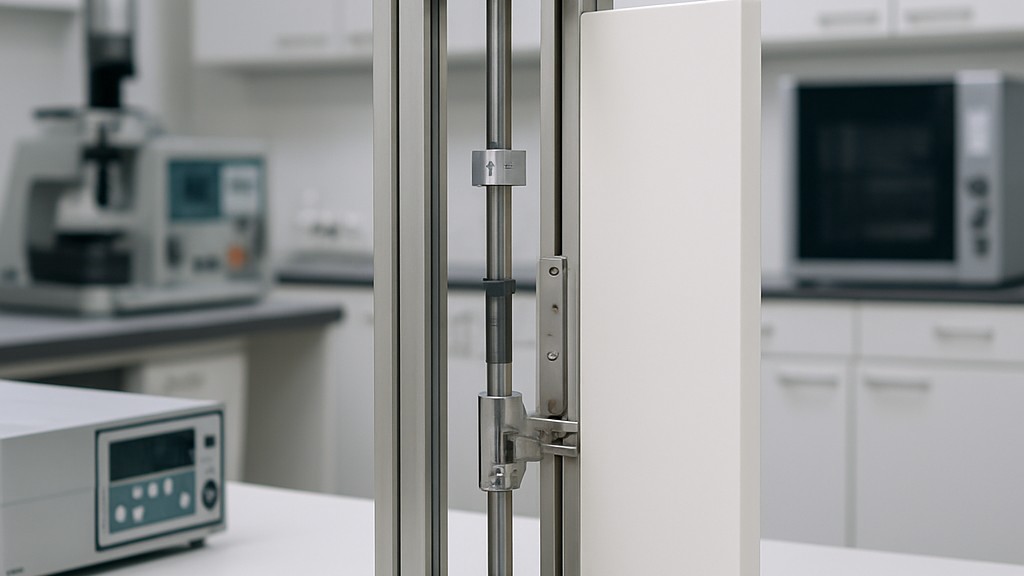
Tests consist of the application of loads, forces, and speeds that simulate normal functional use, as well as misuse that could reasonably be expected to occur. With the exception of corrosion testing, tests are designed to evaluate properties without regard to materials, design/construction, or manufacturing processes.
Strength and durability tests apply only to hinges and connecting parts, such as mounting plates and screws. Strength and durability tests are performed within a test frame with specified specifications. Test results can only be used as a guide to the performance of a piece of furniture.
The test results are valid only for the hinges tested. These results may be used to represent the performance of production models, provided the tested model is representative of the production model.
Excluding corrosion, aging and the influence of heat and humidity.
Annexes to the standard include requirements for product information (Annex A) and loads and cycles (Annex B).
For the purposes of this standard, the following terms and definitions apply:
In preparation for the tests, hinges must be assembled, positioned, or adjusted according to the instructions provided. If no assembly, assembly, or adjustment instructions are provided, the most unfavorable configuration must be used, and the assembly or assembly method must be recorded in the test report. Fasteners must be tightened before testing and not re-tightened unless specifically required by the manufacturer's instructions. If the configuration must be modified to produce the worst-case conditions, this must be recorded in the test report.
Tests should be conducted indoors at a temperature between 15°C and 25°C. If the temperature during a test falls outside the 15°C to 25°C range, the maximum and minimum temperatures should be recorded in the test report. Hinges containing structural hardware components made of hygroscopic plastic materials such as polyamide should be conditioned at 23°C plus/minus 5°C and 50 percent relative humidity for 7 days prior to testing. EN ISO 1110 can be used to expedite the conditioning process. For designs not covered in the test procedures, tests should be conducted as described, as far as possible, and any deviations from the test procedure should be recorded in the test report.
Before testing begins, hinges and components are thoroughly visually inspected. All defects are recorded to eliminate the possibility of them being caused by testing. Measurements are taken if indicated.
Unless otherwise specified, tests can be performed with any suitable instrument, as the results are not instrument-dependent. The equipment must not obstruct the test cap's deflection; that is, it must be able to move during the test to allow the test cap to deflection.
Forces in static load tests should be applied slowly enough to ensure negligible dynamic force is applied. Unless otherwise specified, each force should be maintained for a minimum of 10 seconds and a maximum of 15 seconds. Forces in endurance tests should be applied at a rate that ensures overheating does not occur. Forces can be replaced by masses.
Unless otherwise stated, tolerances must be the values given in the standard.
Tests should be performed in the order specified in this standard. If this order is not followed, the order should be recorded in the test report.
Before and after each test is completed, an inspection should be performed as specified, using any calibration devices. Any changes since the initial inspection should be recorded. The inspection should include, at a minimum, the following:
The main test methods defined in this standard are:
Our organization, which has been supporting businesses across all sectors for years through a wide range of testing, measurement, analysis, and evaluation activities, has a strong team of employees who closely follow global developments in science and technology and are constantly improving themselves. In this context, we also provide testing services in accordance with the EN 15570 Furniture Hardware - Strength and Durability of Hinges and Components - Hinges Rotating on a Vertical Axis standard.
To get an appointment, to get more detailed information or to request an evaluation, you can ask us to fill in our form and reach you.

